




The Middle East Powder Keg: Between Rocket Attacks, Oil Price Shock, and Nuclear Uncertainty
Following massive U.S.-Israeli military strikes against Iran and Iranian counterstrikes in the region in the Emirates, Lebanon, Israel, Saudi Arabia, Qatar, Cyprus, Kuwait, and Oman, the international community is facing a severe test. While Tehran laments damage to its nuclear program, the IAEA urges caution. In Austria, the government is preparing for the economic consequences, while thousands of citizens are stranded in the crisis region.
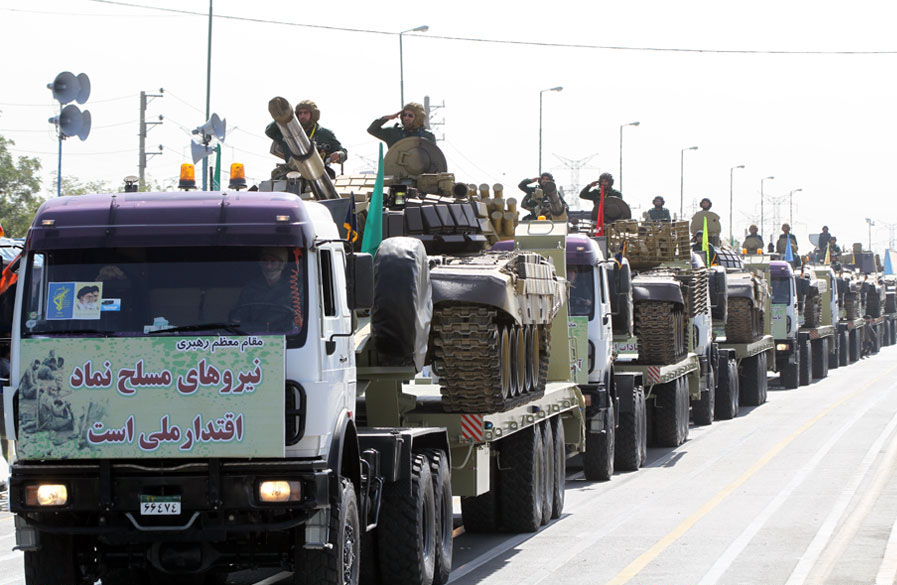 Army of the Guardians of the Islamic Revolution exhibits it's main battle tanks during Sacred Defence Week parade. / Picture: © Wikimedia Commons; Mohammad Sadegh Heydari, CC BY 4.0
Since the coordinated attack by the U.S. and Israel on Iranian territory at the end of February, the security situation in the Middle East has deteriorated dramatically. The operation, which, according to Washington and Jerusalem, was aimed at weakening the regime's nuclear and missile infrastructure, triggered an unprecedented spiral of escalation. Among those killed in the attacks were the head of state and religious leader Ayatollah Ali Khamenei. Tehran responded with massive drone and missile attacks on Israeli cities and U.S. bases in the Gulf.
IAEA: No evidence of hits on nuclear facilities
The atmosphere at the Vienna headquarters of the International Atomic Energy Agency (IAEA) can only be described as “controlled panic.” Director General Rafael Grossi appeared before the world press to attempt the impossible: to deliver facts at a time when the fog of war is engulfing everything.
Grossi emphasized that the agency had so far found “no clear evidence” that Iran's nuclear facilities had been directly hit. This stands in stark contrast to the desperate reports coming out of Tehran. Iran's envoy to the IAEA, Reza Najafi, called the attack on the Natanz complex an act of aggression against “peaceful, secure nuclear facilities.”
Despite the claims by Iranian IAEA ambassador Reza Najafi that the Natanz complex had been specifically targeted, Grossi gave the all-clear for the time being: “So far, we have no indication that nuclear facilities such as the Bushehr power plant or the research reactor in Tehran have been hit or damaged.”
The problem for the IAEA is that inspectors' access has been severely restricted since June last year. Grossi issued an urgent warning: “We cannot rule out a radiological release with serious consequences, including the need to evacuate areas as large as or larger than major cities.” Currently, contact with the Iranian regulatory authorities has been completely severed. The IAEA is currently acting as a blind referee in a highly explosive game.
The Strait of Hormuz as an economic bottleneck
As the missiles fly, economists around the world are bracing for a shock that could make the energy crisis of 2022 seem like a gentle prelude. Iran has effectively brought shipping through the Strait of Hormuz—the most important bottleneck in global energy trade—to a standstill.
The effects of the conflict are already being felt at the pumps and on the energy markets. As Iran restricted shipping traffic through the strategically important Strait of Hormuz, wholesale gas prices jumped by around 25 percent on Monday – the sharpest rise since summer 2023, as reported by ORF. Experts such as economist Sebastian Koch from IHS expect that rising fuel prices alone could fuel inflation in Austria by up to an additional 0.3 percentage points.
Despite the market turmoil, Chancellor Christian Stocker (ÖVP) and the energy company OMV emphasize that Austria's physical security of supply is currently guaranteed thanks to strategic reserves and low dependence on Iran.
Austrian diplomacy and evacuation plans
Political tensions are running high in Vienna. Federal President Alexander Van der Bellen and Foreign Minister Beate Meinl-Reisinger (NEOS) issued a joint call for de-escalation. While Van der Bellen expressed his hope for a future regime change in Iran, Meinl-Reisinger emphasized solidarity with the attacked Gulf states such as the UAE, Kuwait, and Qatar.
Austria's moment of truth: 17,700 citizens in the crisis region
In Vienna, Chancellor Christian Stocker (ÖVP) has convened the crisis management team. The priority is clear: “Leave no one behind.” But the situation is a logistical nightmare. Since the airspace over the Gulf states is largely closed, the only option is often the arduous and dangerous land route.
So far, only 70 people have been evacuated from the UAE via Oman. Ten countries in the region are on the highest security level 4. Interior Minister Karner has been instructed to increase protection for Jewish and US institutions in Austria to prevent the conflict from spreading to domestic soil.
Meanwhile, Vice-Chancellor Andreas Babler (SPÖ) is pushing for the activation of the energy crisis mechanism to cap prices for the population. It is clear that Austria's neutrality protects it from missiles, but not from the economic shock waves of a global conflagration.
Diplomacy at an end? The spirit of Geneva has evaporated
How did it come to this? IAEA chief Grossi wistfully recalled the negotiations in Geneva on February 16 and 17. At that time, the US and Iran were still at the table, albeit indirectly. Grossi contributed technical expertise to make Iran's nuclear program verifiable. But no agreement was reached.
Today, the path back to the negotiating table seems blocked. The Iranian regime is isolated, and the US and Israel are counting on military degradation. The danger: a “radiological incident” could create facts that diplomacy can no longer remedy.
Dancing on a volcano
The next few hours will be decisive. If communication channels between Vienna and Tehran can be reestablished, there is a glimmer of hope. If not, the “billionaire playground” in the Gulf threatens to be reduced to rubble and ashes for good, with fatal consequences for heating bills in Europe.
Despite the military force, the IAEA leadership remains convinced that only diplomacy can bring about a lasting solution. “Diplomacy is difficult, but never impossible,” said Grossi. Given that Iran has stocks of nearly weapons-grade uranium (60%), time is more pressing than ever for the inspectors to return.