




Iran and IAEA Push Ahead with Talks Ahead of U.S. Summit
Diplomatic tensions are running high in Geneva. While Foreign Minister Abbas Araqchi negotiates with IAEA chief Grossi on Iran's nuclear program, Tehran is simultaneously sending a show of military force to the strategically important Strait of Hormuz.
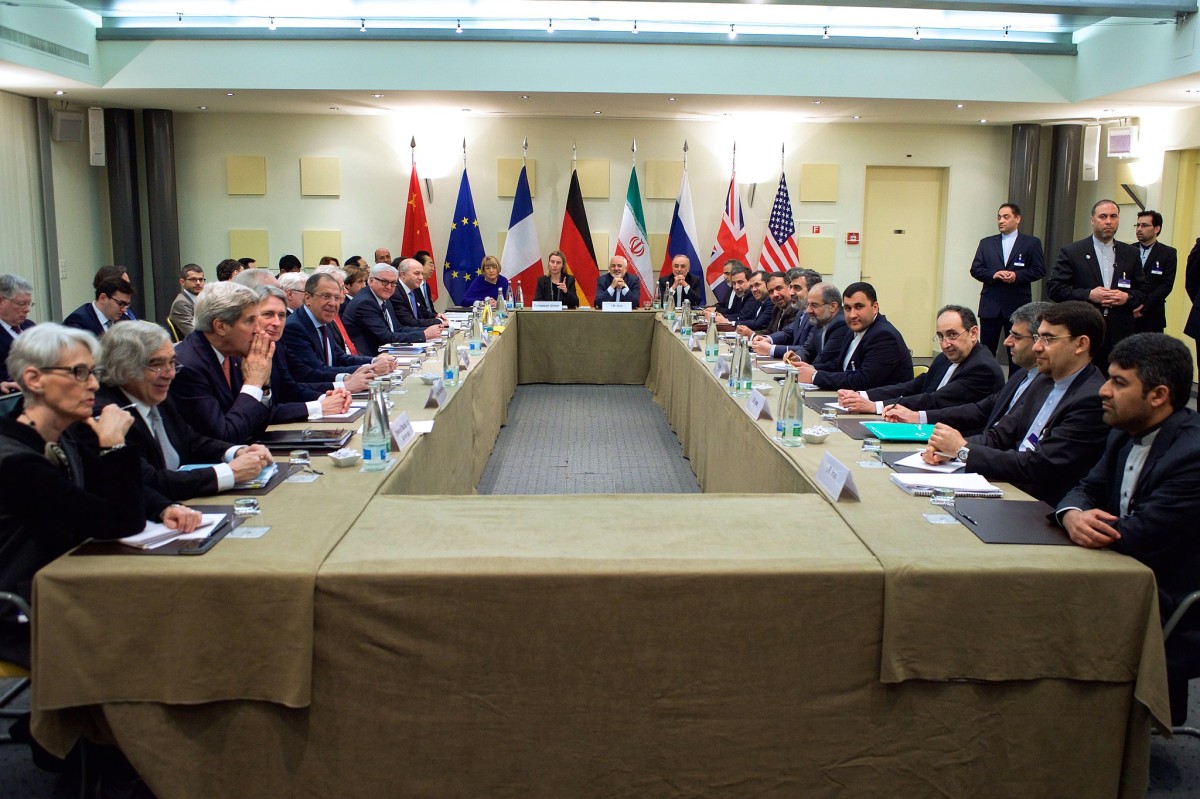 The ministers of foreign affairs and other officials from the P5+1 countries, the European Union and Iran meeting at the discussion for the original JCPOA in 2015. / Picture: © Wikimedia Commons / United States Department of State, Public Domain
It is a diplomatic balancing act between technical cooperation and military deterrence. A few days before the start of the second round of indirect nuclear talks with the United States, Iranian Foreign Minister Abbas Araqchi arrived in Geneva. His goal: to build rapport with the International Atomic Energy Agency (IAEA) in order to prepare the ground for political negotiations.
“Technical depth” versus political mistrust
According to those involved, the meeting between Araqchi and IAEA Director Rafael Grossi was intense, as reported by Reuters. Araqchi emphasized on Platform X that “intensive technical discussions” had taken place. Grossi, for his part, described the exchange as “thorough” and underscored the importance of these preparations for the upcoming negotiations with the U.S. .
Just completed in-depth technical discussions with Iran’s Foreign Minister @araghchi in preparation for important negotiations scheduled for tomorrow in Geneva. pic.twitter.com/dBAinDrljc
— Rafael Mariano Grossi (@rafaelmgrossi) February 16, 2026
Iran is under international pressure because the country has massively expanded its uranium enrichment program in recent years, far beyond the limits of the original 2015 agreement. IAEA experts regularly warn that Tehran has enough material for several nuclear devices should it decide to pursue militarization.
The legacy of “maximum pressure”
The negotiations are taking place in a changed political climate, according to MS Now. Under the aegis of the new (and old) Trump administration, the US delegation is led by two confidants of the president, namely Steve Witkoff, U.S. special envoy, and Jared Kushner, Donald Trump's son-in-law and architect of the Abraham Accords.
The fact that Kushner is once again playing a central role suggests that the U.S. is pursuing a regional approach that goes beyond the nuclear dossier alone. Araktchi nevertheless appeared combative in Geneva: he said he had come with “real ideas for a fair and just agreement,” but made it clear that Tehran would not “submit to threats.”
Saber-rattling in the Gulf
While diplomats are meeting in Switzerland, Tehran is flexing its muscles in the Persian Gulf, as reported by ORF. The Iranian Revolutionary Guard Corps (IRGC) has launched large-scale military maneuvers in the Strait of Hormuz. State media are reporting preparations for “potential security and military threats.”
This dual tactic is typical of Iranian foreign policy: willingness to negotiate in Europe, military presence at home. The Strait of Hormuz is considered the most important bottleneck for global oil trade; about one-fifth of global consumption passes through this strait. Any instability there has a direct impact on the global economy.
As the talks are being conducted indirectly, as was the case in Oman – i.e., without US and Iranian representatives sitting directly opposite each other – the process remains arduous. If the technical hurdles with the IAEA are not cleared, new sanctions by the UN Security Council are looming, which would further exacerbate the already fragile economic situation in Iran.