




IAEA Urges Iran: Immediate Need for Action on Uranium Stocks Following Military Attacks
Iran is under increased pressure from the International Atomic Energy Agency (IAEA) to provide complete transparency regarding its nuclear activities, and in particular its uranium stocks, following the military attacks in June.
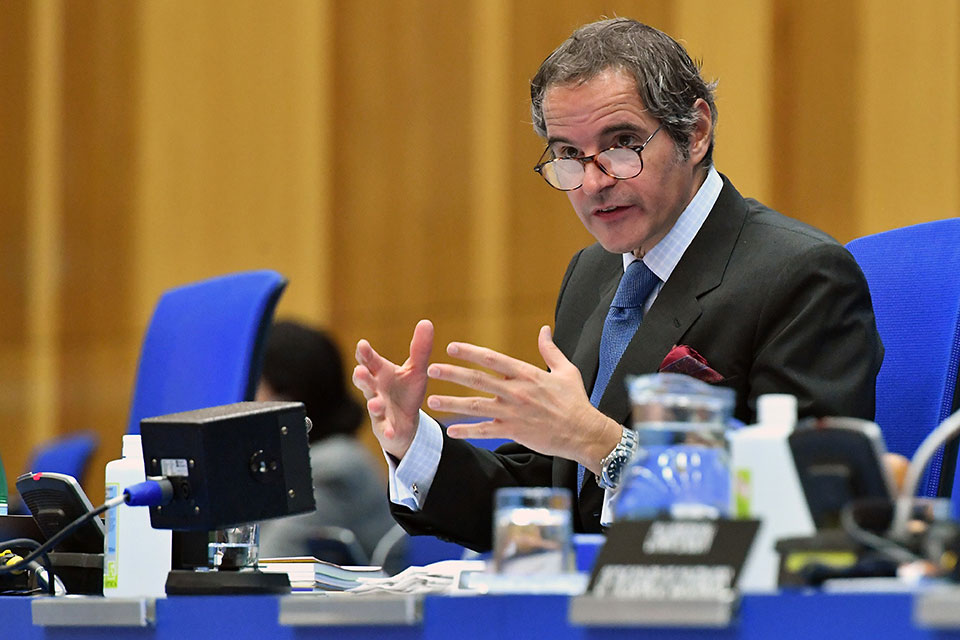 The head of the UN's nuclear watchdog, Rafael Grossi, is putting pressure on Iran due to a lack of information on the whereabouts of uranium that is almost weapons-grade. / Picture: © IAEA International Atomic Energy Agency / Dean Calma / Flickr Attribution (CC BY 2.0, https://creativecommons.org/licenses/by/2.0/)
At the meeting of the Board of Governors in Vienna, IAEA Director General Rafael Grossi called on Tehran to submit a report “without delay” on the status of the affected nuclear facilities and the nuclear material stored there.
Since the attacks in June, which Grossi said affected facilities, the IAEA has had no access to the uranium stored there. Grossi stressed that verification of the material—low-enriched uranium (LEU) and highly enriched uranium (HEU)—is long overdue.“The agency's five-month lack of access to this nuclear material in Iran means that verification of the material – in accordance with standard safeguards practice – is long overdue,” Grossi said.
According to reports, this involves more than 400 kilograms of uranium, which experts say would be enough for several nuclear weapons if it were further enriched. Although Iran denies seeking nuclear weapons, the situation highlights the critical security gap. While inspectors were able to conduct inspections at almost all unaffected facilities in Tehran, they were unable to carry out verification activities at the affected facilities.
Diplomatic efforts and resolution
In response to the lack of cooperation, Germany, France, the United Kingdom, and the United States have prepared a joint Iran resolution for the IAEA Board of Governors. It urges the Islamic Republic to provide the IAEA with “full and immediate” information and access. This resolution, which does not provide for sanctions, is to be voted on later this week, according to ORF.
In September, Rafael Grossi signed an agreement with Iranian Foreign Minister Araghchi in Cairo that provided for inspections and security measures following the military attacks, but its full implementation is still pending.
Additional background information on Iranian uranium enrichment
The amount of highly enriched uranium (HEU) is a key point of contention. Current estimates by independent think tanks and media suggest that Iran's total uranium stockpile at various enrichment levels, including the critical 60 percent enrichment, is well above the limits set in the 2015 JCPOA (Joint Comprehensive Plan of Action).
Iran has enriched uranium to up to 60 percent. Approximately 90 percent is required to produce nuclear weapons, and the jump from 60 to 90 percent is technically considered the easiest and fastest. Enrichment beyond the 3.67 percent limit set by the JCPOA began after the US withdrew from the agreement in 2018 under President Trump and imposed new sanctions. Negotiations on reviving the agreement have been on hold for some time.
The demand for full access and the looming resolution by the Board of Governors reflect growing international concern about the controllability of Iran's nuclear program, especially since experts estimate that the “breakout time” (the time it would theoretically take Iran to produce weapons-grade uranium) is extremely short.