




The Mullahs' Vienna Network: How the Iranian Regime Moves Millions in Austria
A failed million-dollar deal involving a Viennese supermarket chain, secret crypto transfers, and visas for the regime's elite: There are many reveals around the dense network through which the Iranian leadership—including the son of the revolutionary leader—uses Vienna as a financial hub and escape route.
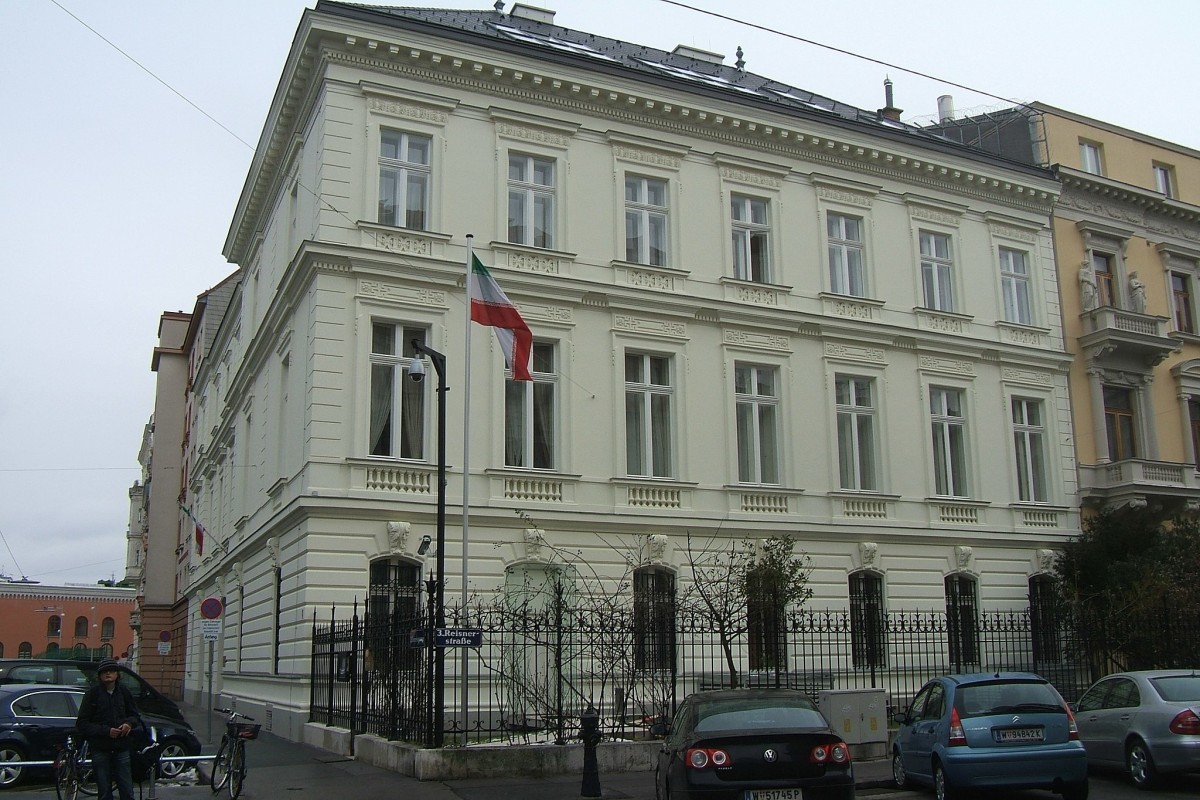 The Iranian Embassy in Vienna is not officially part of Blue River's business structure or crypto networks, but it forms the diplomatic backbone for the individuals involved in these transactions. / Picture: © Wikimedia Commons / Erich Schmid, CC BY-SA 3.0 (https://creativecommons.org/licenses/by-sa/3.0)
While the Revolutionary Guards are violently suppressing a popular uprising in the streets of Tehran, leaving thousands dead, the discreet offices of Vienna's Leopoldstadt district are bustling with activity. Research by STANDARD and international partners reveals the dense network through which the Iranian leadership uses Vienna as a financial hub and safe haven. At stake is the survival of a regime that is economically collapsing and internationally isolated. But in the shadow of sanctions, a network has established itself that uses Vienna as a strategic hub for securing assets and accessing the Schengen area.
The crown prince and his “money man” in Vienna
At the center of the latest revelations is a figure whose position of power is hard to beat: Mojtaba Khamenei (56), son of 86-year-old Supreme Leader Ali Khamenei. He is not only considered his father's potential successor, but also the business mastermind behind an estimated €400 million real estate empire that stretches from Dubai to Frankfurt to London.
According to research by STANDARD, this portfolio was to be expanded in 2024 to include a Viennese company: Blue River Holding GmbH. The planned purchase price for the network of companies, which operated in Iran under the “Spar” brand, was an astronomical €706 million, according to draft contracts.
However, the buyer was not Khamenei himself, but his alleged frontman: the oligarch Ali Ansari. Ansari, who is under British sanctions and accused of financing the Revolutionary Guards, acts as the “main account holder” for Khamenei's private finances, according to experts at the Washington Institute for Near East Policy.
The “Spar” label as a cover
Why is the inner circle of mullahs interested in a Vienna-based company that operates only a handful of supermarkets in Iran? The answer lies in the cover, as reported by STANDARD. The name “Spar” seems unassuming and inspires confidence. Authorities and banks are less likely to be suspicious of a well-known European brand.
In the past, this circumstance was apparently exploited to the full. Documents show that between 2019 and 2022, Vienna-based Blue River helped numerous members of the Iranian elite – including sons of sanctioned judicial officials and daughters of Revolutionary Guard generals – obtain Schengen visas. The letters of invitation simply stated that the individuals were “employed in the Spar supermarket chain.” After arriving in Vienna, some of them even received Austrian bank cards, with a cover address in the 18th district listed as their place of residence.
The collapse of the deal
The €700 million deal fell through at the last minute. In December 2024, Spar International in Amsterdam revoked Blue River's license – a direct response to reports of dubious ties to the regime. Without the “Spar” brand name, the company suddenly lost value for Ansari and his backer Khamenei.
But the network is agile. As traditional company sales become more difficult, the regime is increasingly turning to the digital space.
Crypto offensive: The Revolutionary Guard's nest egg
An explosive document from January 2026, signed by Brigadier General Mohammad Qasem Nazer, instructs the Iranian central bank to convert funds from front companies around the world – including in Austria – into cryptocurrencies such as the stablecoin USDT “as quickly as possible.”
Actors and their roles
The extensive network is controlled by a handful of key figures who operate strategically between Tehran, Vienna, and London, as reported by STANDARD. Ali Mohammad Hajialinaghi is considered one of the most influential figures behind the scenes. The businessman, who holds citizenship of Iran, the Emirates, and St. Kitts and Nevis, owns 49% of Vienna-based CIH Investments Holding GmbH, among other companies. He is identified as the actual mastermind behind the Vienna-based network of companies and has been entrusted in the past with procuring sensitive equipment such as encrypted satellite phones for the Iranian regime.
Closely linked to the financial interests of the revolutionary leadership is the oligarch Ali Aliakbar Ansari, as reported by STANDARD. He is described by international experts as Mojtaba Khamenei's “money man.” It was only in January 2026 that the British authorities froze his assets there because he is suspected of acting as the central financier of the Revolutionary Guards (IRGC). His European real estate portfolio, which includes luxury hotels in Frankfurt and Kitzbühel, is estimated to be worth around 400 million euros.
The network draws on experienced experts such as Tahmasb Mazaheri to handle complex transactions and search for buyers, as reported by STANDARD. The former Iranian Minister of Economy and Central Bank Governor now works as a management consultant and acted as an intermediary in the attempted sale of Blue River Holding. Mazaheri is no stranger to the headlines: in 2013, he made news when German customs officials stopped him at Düsseldorf Airport with a €54 million check from Venezuela.
Babak Morteza Zanjani, meanwhile, facilitates the transition to the shadow economy of cryptocurrencies, as reported by STANDARD. After his death sentence in Iran was commuted to a prison term in 2024, he once again came into focus as the mastermind behind covert financial structures. Current U.S. sanctions from January 2026 are specifically targeting two crypto exchanges associated with him, through which billions from the oil business are said to have been funneled past the international financial system using stablecoins.
Vienna as a safe haven?
The trail leads repeatedly to the same address in Vienna's Leopoldstadt district, as reported by STANDARD. This is where companies such as CIH Investments Holding, in which dubious players from Dubai have a stake, are based. The Directorate for State Protection and Intelligence (DSN) is now investigating the money flows. “It's a race against time,” says one investigator. “The regime is trying to conceal its assets before the West can finalize access to them.”
It remains to be seen whether the Austrian authorities will take more decisive action against the front companies in downtown Vienna this time around. The story of Blue River shows at least one thing: as long as European structures can serve as a cover, Vienna will remain an attractive location for the mullahs' money.