




Vienna Celebrates the First International Taijiquan Day with Chinese Ambassador Qi Mei
Hundreds of enthusiasts gathered in Vienna to mark UNESCO’s first official International Taijiquan Day. Among the guests was China’s Ambassador Qi Mei, who practiced the “24-form” alongside sports stars and members of the public, symbolizing the 55-year friendship between China and Austria.
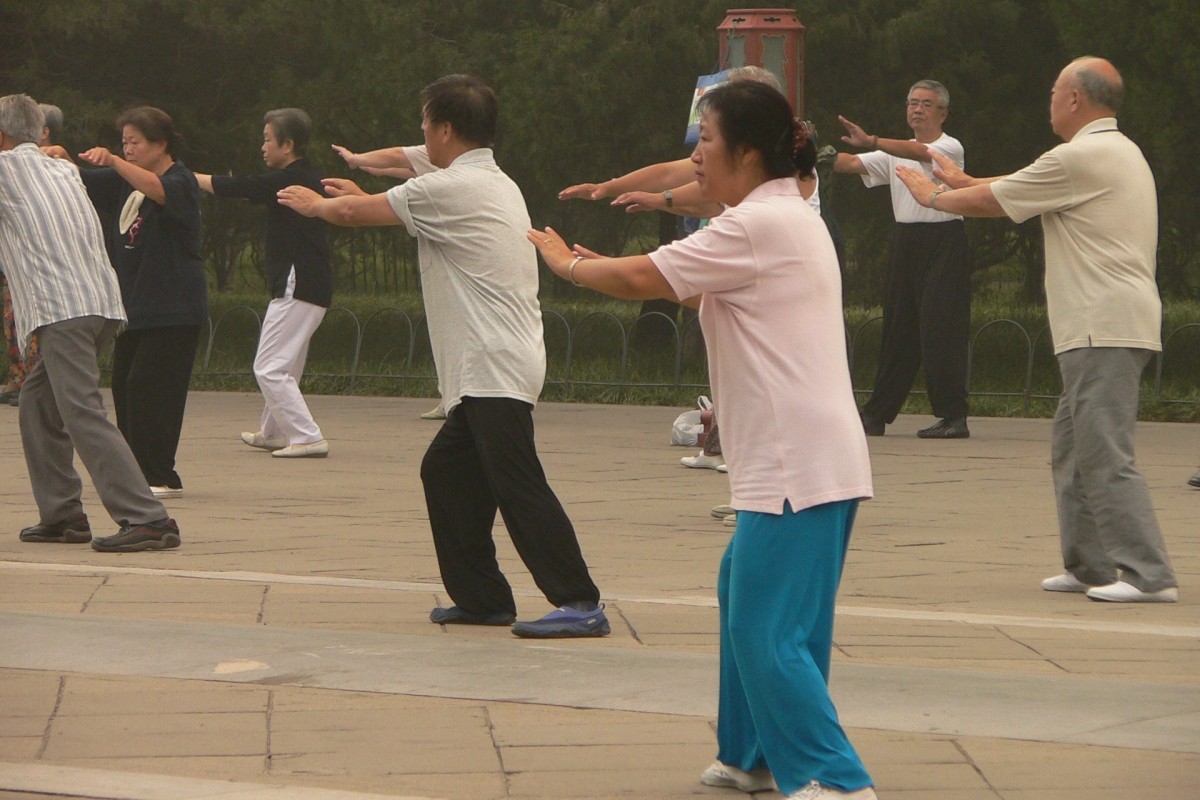 Tai Chi at the Temple of Heaven in Beijing: This low-impact exercise promotes balance, strength, and stress relief, and is particularly popular worldwide among seniors as a health-enhancing practice. / Picture: © Wikimedia Commons/ Tai Chi / CC BY-SA 2.0 (https://creativecommons.org/licenses/by-sa/2.0/deed.en)
It was a scene of tranquility amid the hustle and bustle of the city: around 300 people moving in unison, their arms tracing slow, flowing circles, breathing deeply and evenly. Last weekend, Austria joined the global community in celebrating the first International Taijiquan Day. The event in Vienna marks a milestone for the Chinese martial art, which has achieved a new level of global recognition since its inclusion on UNESCO’s List of Intangible Cultural Heritage of Humanity.
Ambassador Qi Mei is an active participant
A special highlight of the gala was the active participation of the Chinese Ambassador to Austria, Qi Mei. Setting aside diplomatic protocol, she traded the podium for the practice mat and performed the famous 24-form Taijiquan alongside the participants.
Taijiquan ist weit mehr als eine Kampfskunst – es ist eine Lebenskunst.Eine Praxis, die Bewegung, Philosophie und Gesundheit vereint – und heute weltweit begeistert: in über 180 Ländern, mit Hunderten Millionen Praktizierenden. Auch in Österreich wächst die Community… pic.twitter.com/CbeCkwinIS
— Qi Mei 亓玫 (@EmbQiMei) March 20, 2026
In a subsequent interview, including one with the Vienna city station W24, the diplomat emphasized the deeper meaning of this practice: “Taijiquan is far more than a traditional martial art. It is the living expression of a philosophy and an art of living based on balance and inner peace,” said Qi Mei.
Taijiquan – eine jahrhundertealte Kunst aus China mit fast 400 Jahren Geschichte.Mehr als nur Bewegung: Es steht für Yin und Yang, für Balance, für ein harmonisches Miteinander. Es verbindet Körper, Geist und das Verständnis des Universums – und vermittelt Werte wie Toleranz,… pic.twitter.com/UhYIZARcVS
— Qi Mei 亓玫 (@EmbQiMei) March 19, 2026
She highlighted that the values of Taijiquan—harmony, mutual respect, and peaceful coexistence—exactly reflect the core of bilateral relations between China and Austria. This is particularly significant, as both countries are celebrating the 55th anniversary of the establishment of their diplomatic relations this year.
Prominent Support from the World of Sports
The gala, organized by the Austrian Wushu Federation (IWVF) in cooperation with local organizations, also attracted high-profile representatives from the world of sports. Among the guests of honor was Horst Nussbaumer, who was elected president of the Austrian Olympic Committee (ÖOC) just one year ago. Nussbaumer, himself a three-time Olympian in rowing, emphasized in his welcoming remarks the health benefits and unifying power of sports.
Also in attendance were Peter Turkovic, Secretary General of the Wushu Kungfu Federation of Europe (WKFE), and Christian Pfannhauser, President of the Austrian Wushu Association. The experts were impressed by the diversity of styles on display, ranging from the gentle movements of the Yang style to the explosive elements of the Chen style.
A Global Celebration of Health
March 21 was designated by UNESCO as International Taijiquan Day to honor the practice as “China’s gift to the world.” Similar events took place simultaneously around the globe—from mass demonstrations in China’s Hebei Province to celebrations at UNESCO headquarters in Paris.
In Vienna, it became clear that Taijiquan is no longer a niche sport in Austria. The enthusiasm of the 300 participants shows that the pursuit of balance and health speaks a universal language. For the ambassador, it is clear: such cultural bridges are the foundation for stable international understanding.