




Between Artistic Appreciation and Kremlin Calculations: Vienna's New Role in the Shadowy World of Espionage
Vienna has always been considered the world capital of spies. But methods have changed: instead of operating in dark alleys, actors now increasingly operate in the spotlight of galleries, theaters, and journalists' clubs. A search for clues between “soft power,” Russian disinformation campaigns, and the infiltration of civil society institutions.
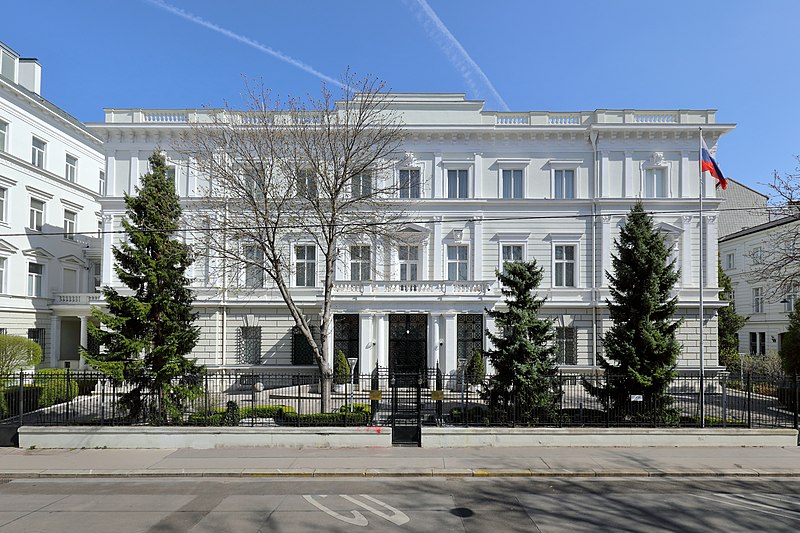 Russia relies on strategies under the guise of art for espionage. / Picture: © Wikimedia Commons / C.Stadler/Bwag / CC BY-SA 4.0 (https://creativecommons.org/licenses/by-sa/4.0)
In Vienna's Donaustadt district, a grandiose building towers into the sky, equipped with a conspicuous number of satellite dishes. It is the so-called “Russencity,” a branch of the Russian embassy. Experts such as historian and intelligence researcher Thomas Riegler are convinced that these dishes are not used for television reception, but to tap into data streams from Western satellites. But while technical surveillance remains hidden, a far more subtle battle for influence is taking place in Vienna's cultural scene, as the Wiener Wochenzeitung "DerFalter" and journalist Lina Paulitsch discovered in her research.
The Kremlin's “soft power”
Russia deliberately uses art and culture as an instrument of “soft power.” The aim is to polish up the country's image and build networks with like-minded people. “It's often about contact and networking with pro-Russian opinion leaders,” explains Riegler. According to critics, Kremlin propaganda is systematically disseminated in so-called “Russian Houses” – cultural institutes that offer language courses and events. In Vienna, the NEOS party called for the closure of this institution as early as 2023, as it is considered a hub for disinformation, as reported by Vienna.at.
The strategy is effective: at vernissages or theater performances, various actors with anti-liberal views come together. This creates “supportive milieus” that can be mobilized when needed. Cultural associations or think tanks often serve as cover for intelligence agents who are not officially registered as diplomats with the Austrian authorities.
When journalists become propagandists
The role of individuals who are supposed to be committed to objective reporting is particularly controversial, as reported by ORF. The Austrian Journalists' Club (ÖJC) recently came under massive pressure. In February 2026, an extraordinary general meeting resulted in a bombshell: Dieter Reinisch was voted off the board. The accusation: “damaging the interests of the association.” Reinisch regularly appeared as an expert on Russian state media such as the TASS news agency and the Rossija 1 television station, and also worked for the Iranian state television channel Press TV.
At the same time, John Herzog was expelled from the association on charges of having increased Chinese influence in the club. These cases show how vulnerable even established institutions are to the influence of authoritarian states.
The embassy's response: “Russophobia” as a protective shield
The Russian embassy's response to an investigation by journalist Lina Paulitsch shows how sensitive the Russian power apparatus is to revelations. In a Facebook post, the embassy accused the reporter of “aversion to everything Russian” and described her work as “a pointless waste of time.” Riegler sees this as a familiar pattern: “Never admit anything, immediately go on the counterattack, and use the accusation of ‘Russophobia’ as a means of dismissing uncomfortable questions.”
The embassy defends the right of Russian journalists to pursue their “artistic calling” abroad – for example, when a TASS correspondent plays the piano in a Vienna theater under a pseudonym. What superficially appears to be cultural exchange is often part of a deliberate staging, according to experts.
Vienna: A safe haven for agents?
It is no coincidence that Vienna has become the epicenter of these activities. Its central location, neutrality, and the presence of numerous international organizations (UN, OSCE, OPEC) make the city attractive to intelligence services. Austria is also considered a legal “paradise” for spies: as long as espionage is not directed against the Austrian state itself, but against other states or organizations, it is hardly punishable under the current penal code.
Although the government recently discussed tightening the espionage law, implementation remains slow. Until then, Vienna will likely continue to be the stage where diplomacy, art, and espionage intertwine—often separated only by a thin velvet curtain.