




“Remembrance is a Duty”: Austria Commemorates the Victims of the Shoah with New Initiatives
On the 81st anniversary of the liberation of the Auschwitz-Birkenau concentration camp, Austria sent a strong signal against forgetting. Between state visits from Yad Vashem, new dialogue projects for descendants of Nazi victims, and plans for a national Holocaust museum, it became clear that the Alpine republic increasingly sees its historical responsibility as an active mission for the present.
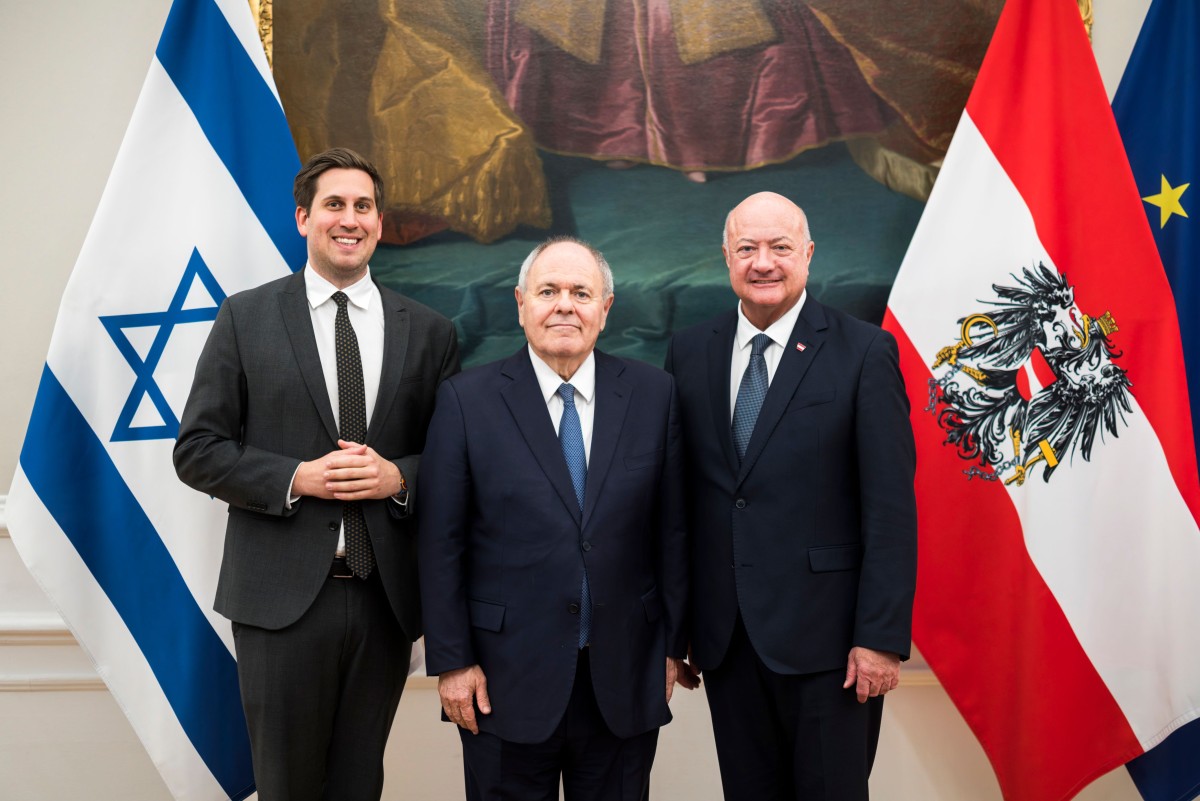 Austrian Chancellor Christian Stocker (r.) welcomed Dani Dayan (c.), Chairman of the Board of Yad Vashem, to a working meeting at the Federal Chancellery with State Secretary Alexander Pröll (l.). / Picture: © Bundeskanzleramt (BKA) / Christopher Dunker
On the occasion of Memorial Day, Federal Chancellor Christian Stocker and State Secretary Alexander Pröll welcomed Dani Dayan, Chairman of the Yad Vashem Holocaust Memorial, to the Federal Chancellery. The discussion focused on the massive increase in anti-Semitic incidents in recent years. Stocker emphasized that remembrance gives rise to a direct responsibility: “We must never accept intolerance, no matter what form it takes.”
Dayan also used his visit to Vienna to meet with Education Minister Christoph Wiederkehr and young people from the “Likrat” dialogue project, who reported on their experiences in combating prejudice in schools. Dayan sent a clear political signal during his meeting with IKG President Oskar Deutsch, reaffirming that Yad Vashem maintains its rejection of parties with Nazi roots.
U.S. Embassy: Wreath laying and call for vigilance
The United States also actively participated in the commemoration in Vienna. The new U.S. Ambassador Arthur “Art” Graham Fisher laid a wreath at the Holocaust Memorial on Judenplatz to commemorate the six million Jewish victims and the millions of others persecuted by the Nazi regime.
Fisher recalled the role of U.S. soldiers in liberating the concentration camps and quoted General Eisenhower, who said that the horrors must be documented in order to prevent history from repeating itself. He emphasized that the promise “Never again” is a daily mission to defend truth and human dignity – especially in times when anti-Semitism is on the rise again worldwide.
New ways of remembering: Focus on “re-Austrians.”
The project “Memory in Dialogue” launches a new chapter in Austrian remembrance culture by supporting connections between descendants of Nazi victims and Austria. Since the law changed in 2019, over 40,000 individuals have regained Austrian citizenship through this initiative.
State Secretary Sepp Schellhorn and National Fund Director Hannah Lessing presented an initiative aimed at bringing these “re-Austrians” and their family histories back into public consciousness through artistic and scientific residencies. “It is crucial to reestablish relationships that were torn apart by violence,” said Lessing.
Education and infrastructure against forgetting
To further anchor remembrance for future generations, the federal government is pushing ahead with two major projects: the Austrian Holocaust Museum (ÖHM) and the National Strategy against Anti-Semitism (NAS 2.0). State Secretary Pröll emphasized the importance of extracurricular learning venues during a tour with schoolchildren at the Shoah Memorial Wall in Ostarrichi Park. The names of the 65,000 murdered Austrian Jews are a “call to action,” he said.