




Vienna Summit on AI Regulation: Poland Presents Implementation of the AI Act
Central European experts gathered in Vienna to debate the future of artificial intelligence (AI). The high-profile event, entitled “Artificial Intelligence - Global Perspectives. Regulation, innovation and Impact across Industries,” was jointly organized by the Polish and Slovenian embassies in Vienna, with the support of the Diplomatic Academy of Vienna.
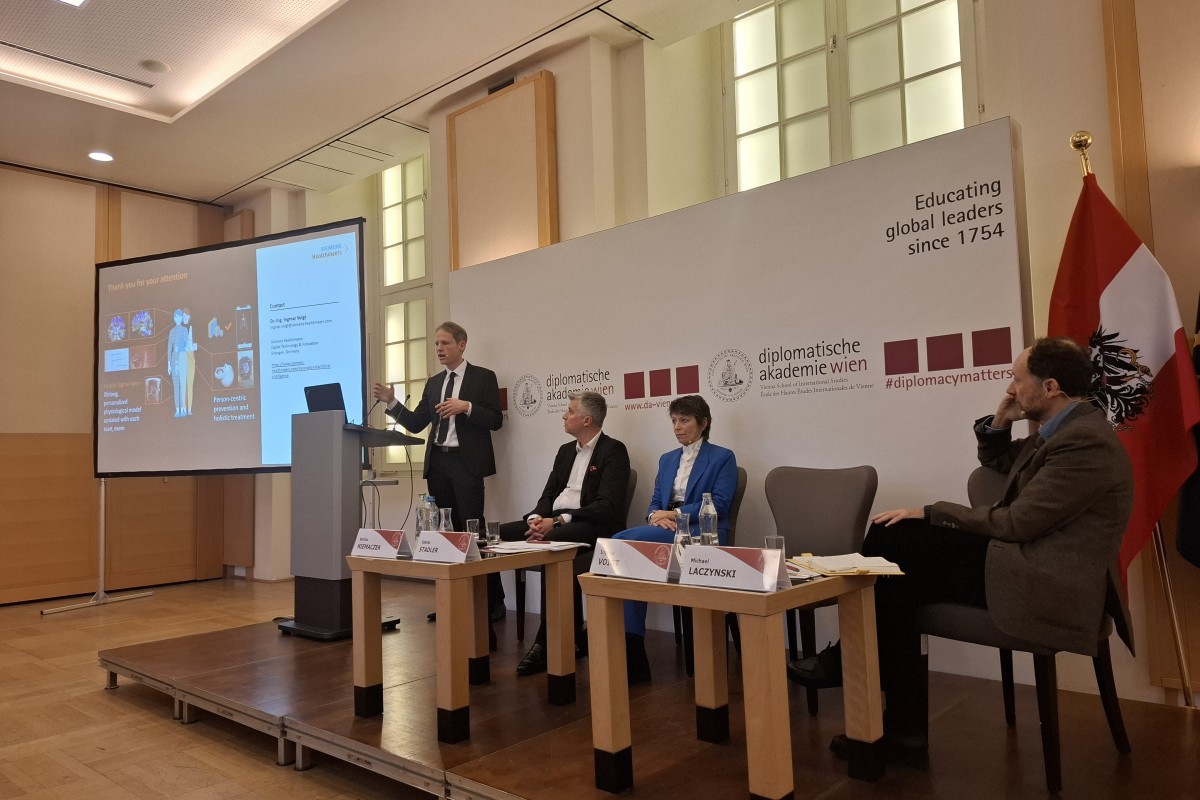 Experts from Poland, Slovenia, and Austria discussed the global prospects, innovation, and legal framework of artificial intelligence. / Picture: © Embassy of the Republic of Poland in Austria (CC BY 3.0 PL)
The aim of the meeting at the Diplomatic Academy was to highlight Poland's active role in shaping AI policy and developing innovative economic applications. The discussion, moderated by Michael Laczynski, journalist for the Austrian daily newspaper “Die Presse,” was divided into two main panels: legislation and practical applications.
In the first panel, which focused on the legal and regulatory framework, Poland was represented by Jakub Derulski from PwC Poland. He presented Poland's legal and regulatory expertise and the concrete steps taken to implement the EU AI Act.
The implementation of this groundbreaking EU law is in full swing. Important regulations, particularly those relating to governance rules and obligations for general AI models, will come into force as early as August 2025. Experts emphasize that Poland faces the challenge of quickly establishing the necessary supervisory structures. Polish entrepreneurs who use AI-based tools are now subject to new legal, technical, and organizational obligations, and failure to comply can result in heavy penalties.
AI in customer service and marketing
The second panel focused on the practical applications of AI in business. Bartosz Niemaczek from the Orlen Group presented innovative AI-based solutions that the company uses in customer service and email marketing.
Representatives from the University of Vienna, the Jožef Stefan Institute in Slovenia, the Slovenian Ministry of Foreign and European Affairs, and Siemens Healthineers also took part in the debate.
The discussions were very well received by the audience, which consisted of members of the diplomatic corps, academics, and students from the Diplomatic Academy. Topics discussed included the competitiveness of the EU in the field of AI compared to the US and Asian countries, as well as the possible impact of AI on the labor market.