




Vienna Positioning Itself as a Global Hub for Ukraine's Reconstruction
At the end of February, 50 international special coordinators met in Vienna to set the course for the reconstruction of Ukraine. For the domestic economy, this is about more than just solidarity—it is an investment project of historic proportions.
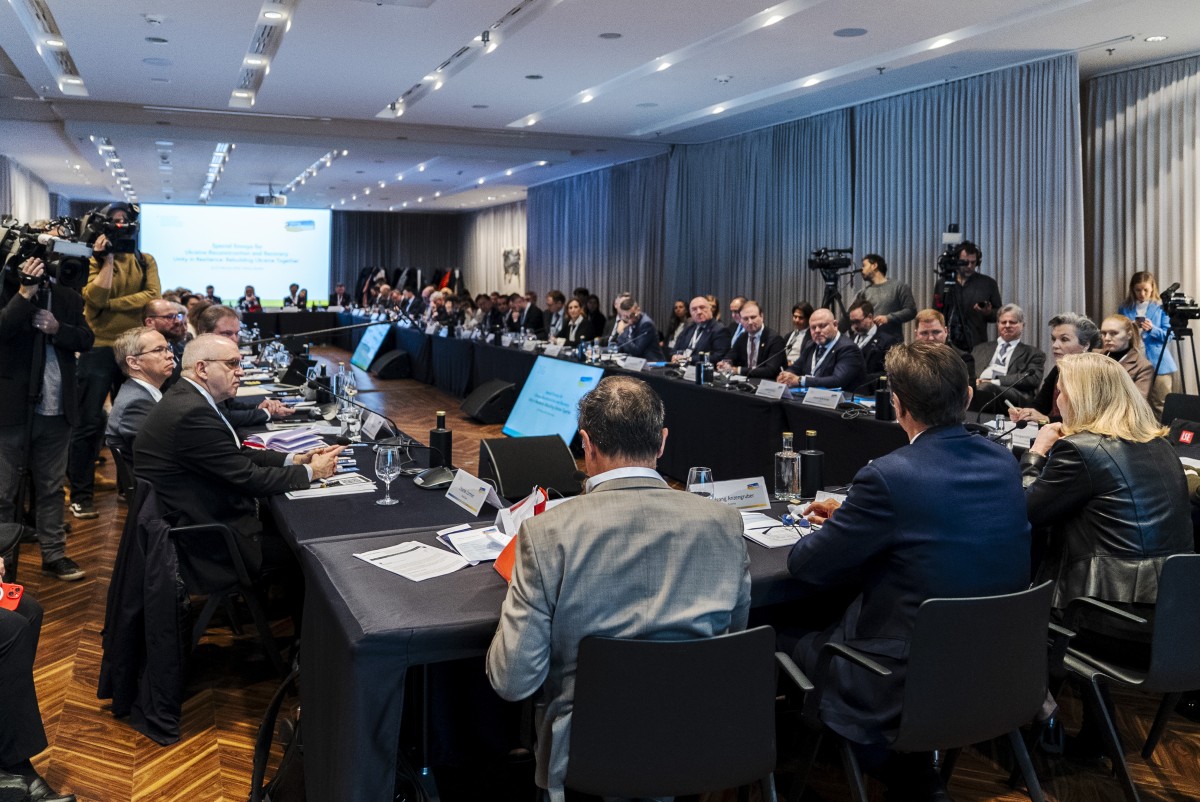 Following the summit in Vienna, it has become clear that Austrian expertise is not just a theoretical contribution but a practical engine for Ukraine's recovery. / Picture: © BMEIA/Auer-Grumbach / Flickr Attribution (CC BY 4.0 / https://creativecommons.org/licenses/by/4.0/deed.de)
It is a Herculean task, the dimensions of which defy conventional measurement. While fighting continues in parts of Ukraine, the architecture for the "day after"—and the time in between—is already being designed in the conference rooms of the Austrian Foreign Ministry. Vienna became the epicenter of these efforts. At the initiative of the Austrian government, nearly 50 high-ranking representatives from Europe, Japan, Canada, Korea, and Turkey, alongside leaders from the World Bank and the European Investment Bank (EIB), converged on the capital.
Cooperation Over Competition
The primary goal of this meeting of international special coordinators was a drastic increase in efficiency. To date, many aid and reconstruction projects have run parallel to one another with little overlap. A strengthened international coordination framework is now intended to ensure that funds reach exactly where they will have the greatest impact.
A "Matchmaker" for Billion-Dollar Projects
At the heart of the Austrian strategy is Wolfgang Anzengruber. The former CEO of Verbund has served as the government coordinator since April 2025, acting as the critical interface between politics, the private sector, and Ukrainian partners. Anzengruber sees his role primarily in mobilizing private capital and facilitating targeted "matchmaking."
The figures he is dealing with are staggering. While the World Bank estimated the need at 524 billion USD last year, recent data has revised this sum upward to approximately 588 billion USD.
"Reconstruction is not a project for two or three years; it is a project for a generation," Anzengruber stated. Austrian companies are in an excellent starting position, with around 200 branches of domestic firms continuing to operate in Ukraine despite the conflict. These are organized into six strategic clusters as follows Construction & Infrastructure, Energy & Transport (Focusing on hydropower and rail), Agriculture & Forestry, Financial & Insurance Services, Healthcare Sector and Raw Materials & Mining.
Export Engine Humming Despite War
Surprisingly, hard economic data shows significant dynamism. Despite the security situation, the volume of Austrian exports to Ukraine rose by a remarkable 16.7% in 2025. Products in the rail sector, mechanical engineering, and hydropower are in particularly high demand.
Furthermore, Austria has solidified its influence on the international stage. Since autumn 2025, the Republic has held observer status in the Multi-agency Donor Coordination Platform for Ukraine (UDP). This allows Vienna to directly influence the setting of tender conditions for major international projects, ensuring that European industrial interests and standards are upheld.
New Safety Nets for Businesses
To ensure that entrepreneurial courage does not fail due to financial risk, the federal government has significantly improved framework conditions. The Oesterreichische Kontrollbank (OeKB) has increased guarantee ceilings for Ukraine-related business from 90% to 95%.
Additional measures include the Ukraine Facility with a 500-million-euro package remains available. Requirements for state guarantees have been eased to facilitate business through Ukrainian state banks. All three major domestic insurers—Wiener Städtische, Uniqa, and GRAWE—now offer specialized insurance solutions for businesses operating in Ukraine. For infrastructure projects, payment terms have been extended up to 15 years, and for climate protection projects, up to 22 years.
Key Players by Industry Cluster
Following the summit in Vienna, it has become clear that Austrian expertise is not just a theoretical contribution but a practical engine for Ukraine's recovery. Below is a summary of the key companies and sectors currently leading the efforts, categorized by the strategic clusters established by the Austrian government and Advantage Austria.
- Energy & Hydropower
This is perhaps the most active sector, given the urgent need to repair and modernize Ukraine’s power grid.
Andritz Hydro: A global leader currently providing electromechanical equipment and services for hydropower plants, crucial for Ukraine's renewable energy stability.
Gugler Water Turbines: Specialized in Francis and Kaplan turbines, focusing on small to medium-sized hydropower projects.
Fronius International: Active in providing solar energy solutions, photovoltaics, and advanced welding technology for infrastructure repair.
Hargassner & Agro Forst: Leaders in biomass heating systems, offering decentralized energy solutions for local communities.
- Construction & Infrastructure
With 200 branches still active, Austrian construction firms are leveraging their long-standing local presence.
Röfix AG: A landmark example; despite the war, they invested €10 million in a new building materials factory in Lviv to supply local reconstruction projects.
Doka GmbH: Providing innovative formwork solutions for large-scale concrete construction, including bridges and high-rise repairs.
Delta AG: Acting as a full-service provider for architecture and construction management, helping navigate the complex planning phases of urban reconstruction.
Bernard Gruppe: Providing consulting and engineering services for transport and industrial infrastructure.
- Transport & Rail
Austria’s historical "bridge" function is reflected in its deep integration with the Ukrainian railway system (Ukrzaliznytsia).
voestalpine: A critical partner providing high-quality rails and specialized railway switches.
Plasser & Thurer: (Noted in broader industry reports) for their world-leading track maintenance machinery, essential for keeping supply lines open.
Austrian Federal Railways (ÖBB): Collaborating on "piggyback" transport and container routes (Kyiv–Budapest–Vienna) to integrate Ukraine into European logistics chains.
- Healthcare & Medical Technology
Focusing on both urgent care and long-term rehabilitation for veterans and civilians.
Vamed: (Traditionally strong in CEE) involved in hospital management and rehabilitation projects.
Saphenus Medical Technology: Providing innovative solutions for phantom limb pain, a critical need for the rising number of amputees.
Schrack Seconet: Equipping hospitals with advanced fire alarm and nurse-call systems.
- Finance & Insurance
The "enablers" that allow private investment to flow into a high-risk zone.
Raiffeisen Bank International (RBI): Maintaining one of the largest banking networks in Ukraine to facilitate local transactions.
Insurance Group (VIG / Wiener Städtische), Uniqa, and GRAWE: These three now provide the specific war-risk insurance frameworks mentioned in the summit.
Background information
As of March 2026, 95% of Austrian companies that were active in Ukraine before the full-scale invasion have maintained their presence, a testament to the "Generationenprojekt" (generation-defining project) mentality described by Coordinator Wolfgang Anzengruber.
With this summit, Vienna has proven that it takes its role as a bridgehead to the East seriously. For Ukraine, this means coordinated assistance; for Austrian industry, it is a chance to play a decisive role in the rebuilding of a modern, European state.
Summary of Support Mechanisms (2025–2026)
| Mechanism | Impact |
|---|---|
| OeKB Guarantee | Covers up to 95% of the risk for Austrian exporters. |
| Ukraine Facility | A €500 million credit line for infrastructure & energy. |
| UDP Observer Status | Influence on tender conditions for multi-billion euro projects. |