




Metropolitan Arsenios of Austria Warns Against “Hardening of the Heart” For the 4 Years of War in Ukraine
It is a sombre anniversary that the world is commemorating these days. For four years, Russia has been waging a large-scale war of aggression in Ukraine. What began as a “special military operation” has developed into a global turning point that is not only shifting borders but also shaking the foundations of the Christian faith in Eastern Europe. In a powerful statement, the Greek Orthodox Metropolitan of Austria, Arsenios (Kardamakis), has now spoken out, finding clear words for what he calls an “ecclesiological paradox.”
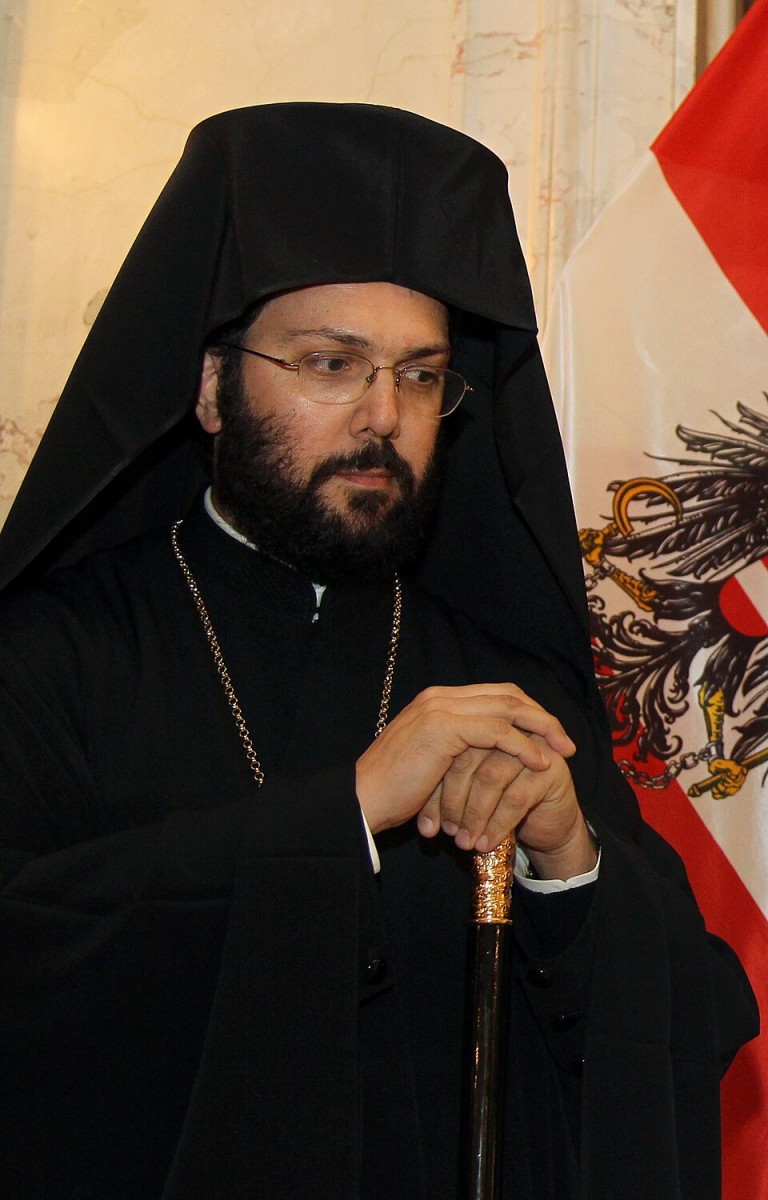 On the fourth anniversary of Russia's attack on Ukraine, the Greek Orthodox Metropolitan of Vienna, Arsenios (Kardamakis), warned against becoming accustomed to war. / Picture: © Wikimedia Commons / Mahmoud; Das österreichische Außenministerium / CC BY 2.5 (https://creativecommons.org/licenses/by/2.5/deed.en)
Four years of war mean four years in which the history of Ukraine is “written not with ink, but with blood,” according to the Metropolitan. The invasion has shattered certainties and calls into question the concept of the “one body” of Christ. Particularly painful is the fact that people who theoretically participate in the same Eucharist now find themselves at odds with each other.
Metropolitan Arsenios describes the death of each individual not only as a biological end, but as the breakdown of a “small ecumenism of love.” According to patristic anthropology, human beings are not isolated individuals, but beings of relationship. When a young person dies, an entire network of relationships collapses.
Criticism of Moscow: Faith vs. Ideology
Behind the theological arguments lies a sharp, albeit objective, criticism of the leadership of the Russian Orthodox Church under Patriarch Kirill I. He had repeatedly legitimized the war on religious grounds and attributed “metaphysical significance” to it.
Arsenios counters this: “When violence touches the limits of theological justification, faith threatens to become ideology. And ideology – even if it uses ecclesiastical language – remains a negation of Christ's cross-shaped logic.”
For the Metropolitan of Vienna, one thing is certain: Orthodoxy knows no “holy wars,” only “holy repentance.” Anyone who combines the Gospel with power politics distorts the ethos of the Church. This position coincides with the worldwide criticism of many Orthodox theologians of the so-called “Russkiy Mir” (Russian World) ideology, which portrays war as a defense of Christian values against the West.
The danger of habituation
A central point of the statement is the concern about the emotional numbness of the global public. Arsenios warns against the “hardening of the heart” – against cold winter nights without electricity, water, and heating being accepted as ‘normal’ for millions of Ukrainians. War is not an inevitable fate, but the “failure of freedom.”
He pays particular attention to the role of women. Thousands of mothers, wives, and sisters are keeping society going without weapons. Their steadfastness is a “silent testimony of love in the storm of history.”
Ecumenical prayer in St. Stephen's Cathedral
To commemorate the victims and send a message of unity, a significant liturgical event is taking place in Vienna. Believers gather for an ecumenical prayer in Vienna's St. Stephen's Cathedral. In German, Greek, and Hungarian, they pray for an end to the war and for peace.
This prayer in the heart of Vienna underscores Austria's role as a place of dialogue at a time when the Orthodox world is deeply divided internally. Since the Ecumenical Patriarch of Constantinople granted autocephaly (independence) to the Orthodox Church of Ukraine in 2019, tensions between Moscow and Constantinople (to which Arsenios is subordinate) have escalated massively.
Repentance instead of domination
According to Metropolitan Arsenios, the fourth anniversary should not be a day of remembrance alone, but a “starting point for repentance.” He appeals to political and spiritual leaders to finally separate faith from violence. True strength lies not in domination, but in reconciliation.
The Church will only remain the Church if it refuses to “bless hatred.” A sentence that will probably resonate for a long time in the ears of those who want to exploit religion for geopolitical purposes.