




Meinl-Reisinger Calls on U.S. Secretary of State Rubio in Washington for a Reliable Trade Policy
Ahead of Austria’s upcoming term on the UN Security Council in 2027–2028, Foreign Minister Beate Meinl-Reisinger and U.S. Secretary of State Marco Rubio are discussing global security crises in Ukraine and the Middle East—as well as significant differences of opinion regarding U.S. tariffs.
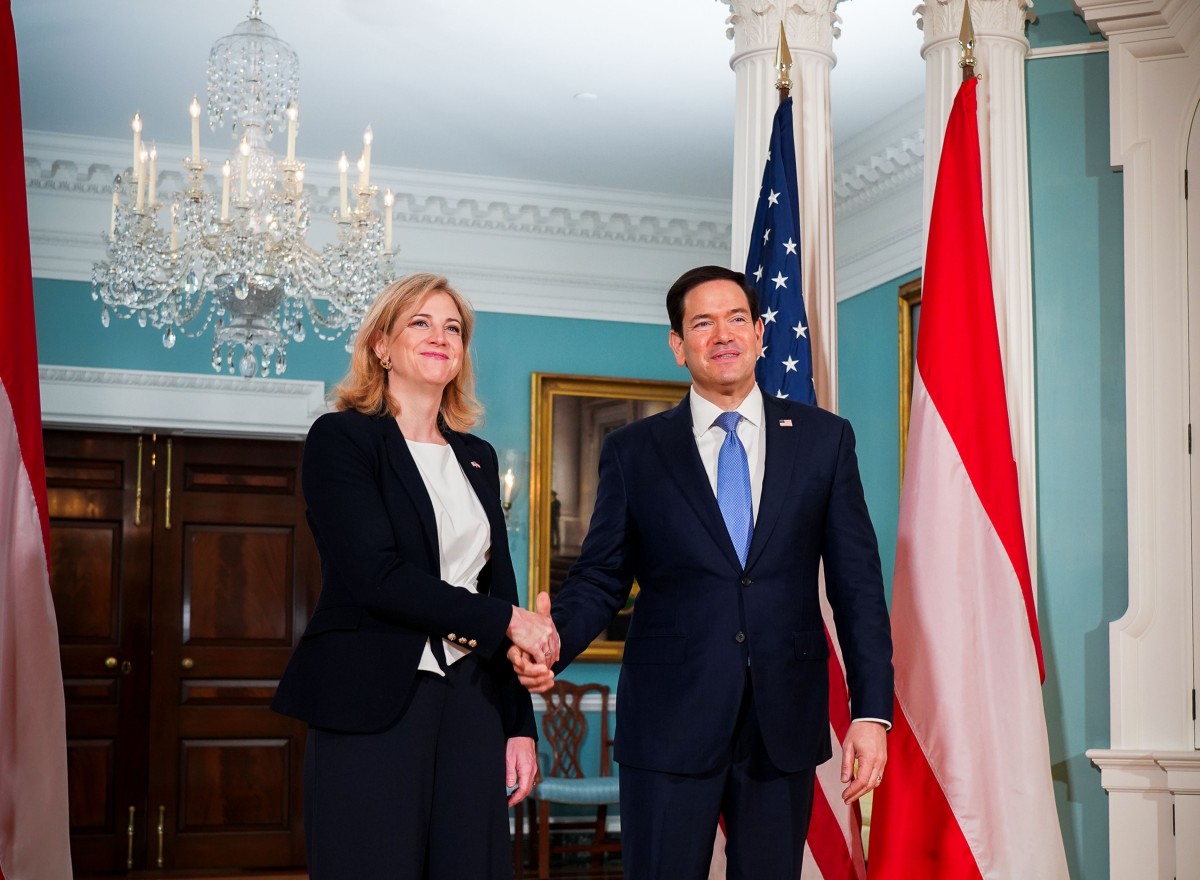 Austrian Foreign Minister Beate Meinl-Reisinger met with her counterpart, U.S. Secretary of State Marco Rubio, in Washington. / Picture: © BMEIA/Alina Steiner / Flickr Attribution (CC BY 4.0 / https://creativecommons.org/licenses/by/4.0/deed.de)
About six weeks after her working visit with Chinese Foreign Minister Wang Yi in Beijing, Austrian Foreign Minister Beate Meinl-Reisinger has now completed another key stop on her diplomatic tour in August 2026. In Washington, D.C., the Austrian foreign minister met with U.S. Secretary of State and National Security Advisor Marco Rubio. The meeting served as targeted preparation for Austria’s two-year term as a non-permanent member of the United Nations Security Council, which begins on January 1, 2027.
Straight Talk on Trade Issues: Criticism of Protectionist Tariffs
Although both diplomats emphasized the close partnership between Vienna and Washington in the areas of security and the economy, Meinl-Reisinger used the bilateral talks to speak candidly about U.S. trade policy.
“We had an excellent, very open discussion. Austria and the U.S. are linked by a close partnership […]. It is precisely this closeness that allows us to openly address areas where we disagree, such as tariffs. Unpredictable and protectionist trade policies harm our companies and weaken the American economy,” Meinl-Reisinger emphasized after the meeting.
In a subsequent press briefing, the minister underscored that reliable and predictable framework conditions in international trade are essential to avoid jeopardizing Europe as a business location and the global recovery.
Agreement on Ukraine and the Middle East – Praise for Vienna as a Negotiation Venue
On the major geopolitical flashpoints, both sides were in agreement on key points. They agreed that a lasting European security order can only be achieved through close transatlantic cooperation.
Both foreign ministers discussed the situation regarding Russian aggression in Ukraine as well as the conflict in the Middle East. It emerged from the talks that Washington and Vienna currently assess Russian President Vladimir Putin as “playing for time.” Although U.S. Secretary of State Rubio does not currently see an immediate window of opportunity for peace negotiations, he paid tribute to Austria’s diplomatic tradition: “Vienna is doing a very good job as a venue for negotiations,” Meinl-Reisinger quoted her U.S. counterpart as saying.
Meinl-Reisinger reaffirmed Austria’s willingness to serve as neutral ground for technical discussions and diplomatic initiatives, particularly when other channels of communication have stalled.
The Western Balkans and the Protection of Critical Technologies
On the U.S. side, spokesperson Thomas Pigott emphasized in an official statement that the U.S. values Austria’s diplomatic expertise regarding the Western Balkans and wishes to deepen cooperation to ensure European security and protect critical technologies. Both countries are also major contributors of troops to the NATO-led KFOR peacekeeping mission in Kosovo, where Austria continues to be a strong advocate for the EU integration of the Western Balkan states.
Austria on the UN Security Council in 2027/2028
In June 2026, Austria was elected to the UN Security Council for the 2027–2028 term by the United Nations General Assembly in New York with 131 votes. Federal Chancellor Christian Stocker described the election as a clear mandate to strengthen multilateralism and the rule of law at the international level. Expanding contacts with the permanent members of the Security Council—such as the United States and China—is part of the Foreign Ministry’s targeted preparations for the term.