




55 Years of Diplomatic Relations: China and Austria Reaffirm Their Strategic Partnership in the Interest of Global Stability
This year marks the 55th anniversary of the establishment of diplomatic relations between the People’s Republic of China and the Republic of Austria. To mark the occasion, Chinese President Xi Jinping and Austrian President Alexander Van der Bellen exchanged congratulatory messages. The anniversary coincides with a period of intensive bilateral exchanges and also marks the end of a significant diplomatic era: Chinese Ambassador to Austria Qi Mei is leaving Vienna after several years in office.
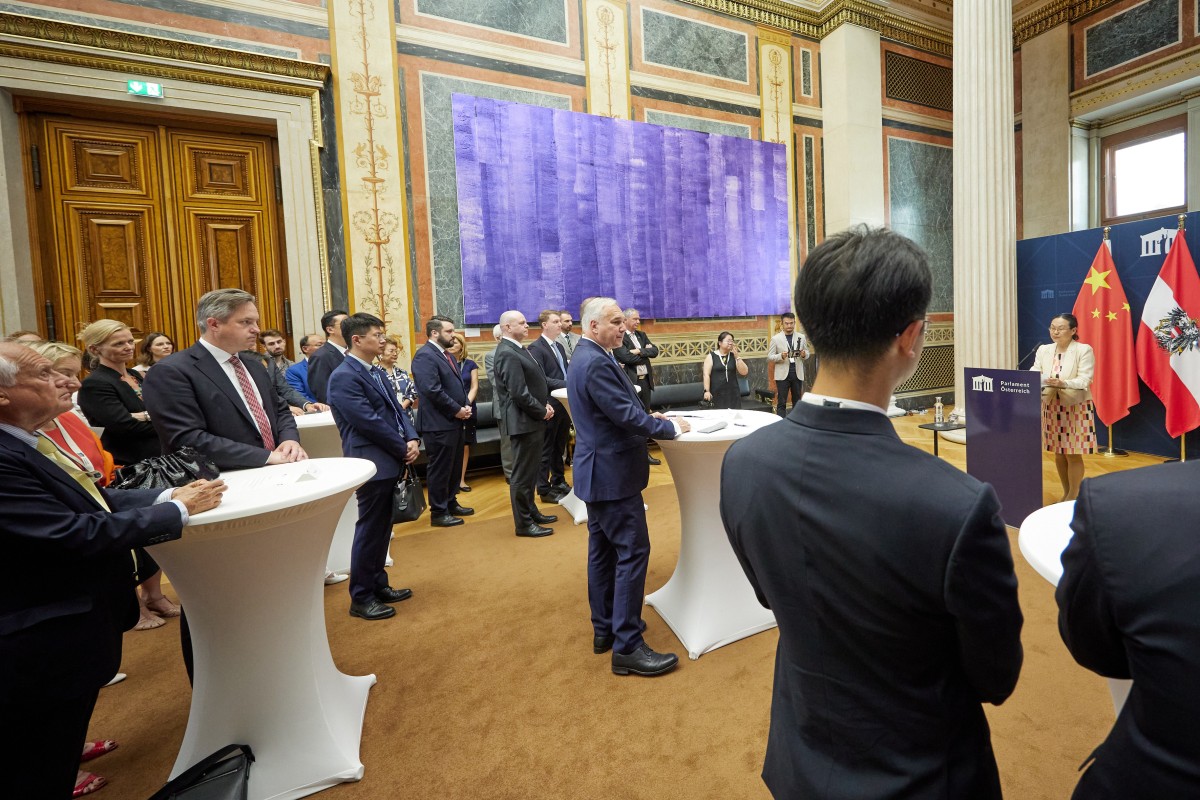 Ambassador Qi Mei discussed the future of the relationship in her remarks marking the 55th anniversary of diplomatic relations. / Picture: © Parlamentsdirektion/Thomas Topf/Bild ID: 20184754
President Xi Jinping said the two countries have weathered international storms over the past 55 years and developed in a healthy and stable manner. He recalled President Van der Bellen’s 2018 state visit to China, during which the foundation for the “Friendly Strategic Partnership” was laid. Xi also noted the arrival of the new “panda ambassadors” in Vienna last year in May, which further deepened the emotional bond between the two peoples. In light of a turbulent global situation, Xi called on both nations to work more closely together as advocates of multilateralism and free trade.
President Van der Bellen also described the 2018 state visit as a historic turning point. Since then, he noted, cooperation in the fields of economy, science, education, and culture has steadily deepened. Especially in times of global instability, he emphasized, it is of crucial importance to maintain dialogue, jointly preserve stability, and expand mutual understanding.
Ceremony at Parliament: Building Bridges in Times of Upheaval
The official ceremony held at the Austrian Parliament to mark the 55th anniversary highlighted the historical significance of the relations that were officially sealed on May 27, 1971, with the signing of the joint communiqué. In his welcoming address, National Council President Walter Rosenkranz drew a parallel between the founding year—in the midst of the Cold War—and today’s similarly turbulent global situation. He praised the foresight of the lawmakers of that era, who were guided by the principles of an active policy of neutrality and the realization that international politics were inconceivable without China. Since records began in 1992, there has been a remarkably continuous exchange, with a total of over 60 bilateral meetings at the parliamentary level. Rosenkranz also took the opportunity to express his sincere thanks to outgoing Ambassador Qi Mei for her dedicated service in Vienna.
In her remarks, the ambassador not only looked back on the pioneers of the past but also looked ahead to opening “a new chapter of friendship.” She described parliamentary dialogue as the driving force behind close bilateral and multilateral ties.
Christian Hafenecker (FPÖ), a member of the National Council, shed light on the foreign policy dimension from an Austrian perspective, representing Gernot Darmann, the chair of the Austria-China Bilateral Parliamentary Group, who was on a trip to China at the time. Hafenecker particularly highlighted the successful government initiatives from 2017 to 2019 and emphasized that the true strength of the partnership lies in direct people-to-people exchanges—supported by businesses, cultural and scientific institutions, as well as numerous civil society organizations. Referring to Austria’s neutrality, he emphasized that a balanced relationship with global actors such as China, focused on mutual understanding, is a core component of a responsible Austrian foreign policy.
The close ties currently woven between Vienna and Beijing were also evident in the personal congratulations that Rosenkranz had exchanged in advance with Zhao Leji, Chairman of the Standing Committee of the National People’s Congress. Another milestone has already been set: At the end of August 2026, National Council President Rosenkranz will embark on an official trip to the People’s Republic of China together with a delegation from the bilateral parliamentary group.
Farewell to Ambassador Qi Mei
For Chinese Ambassador Qi Mei, who had held the post since March 2023 and had previously served in Sweden, Norway, and Equatorial Guinea, among other places, the reception also served as the setting for her farewell tour. In the days that followed, she made official farewell visits to Austria’s top leaders—including President Van der Bellen, Chancellor Christian Stocker, National Council President Walter Rosenkranz, and Foreign Minister Beate Meinl-Reisinger (NEOS). Qi Mei thanked the Austrian government and society for their support during her tenure and emphasized that China’s confidence in cooperation, particularly in the areas of green development and technological innovation, remains unshaken. For its part, the Austrian side praised the achievements of China’s development and the work of the embassy.
Special editions in Austrian media
The diplomatic anniversary also received significant coverage in the Austrian media. In early June, the diplomatic magazine “Social” and the news magazine “International Affairs” published comprehensive special supplements. The newspaper “Heute” also dedicated a special report to the anniversary, outside of its regular China editions. The publications featured in-depth guest contributions by Ambassador Qi Mei, exclusive interviews, and reports from representatives of Austrian politics, business, and academia. These highlighted China’s modern development path and offered the Austrian public a multifaceted insight into Chinese culture, the economy, and the model of bilateral cooperation.