




Wachau European Forum as the Epicenter of Europe's New Security and Cconomic Architecture
The 2026 Wachau Europe Forum concluded with record attendance. Against the backdrop of major geopolitical shifts, more than 1,500 participants and 120 speakers discussed the future of the continent. The three-day conference focused on a tougher stance on migration policy, the strengthening of regional powers, and a drastic shift in European defense and economic policy.
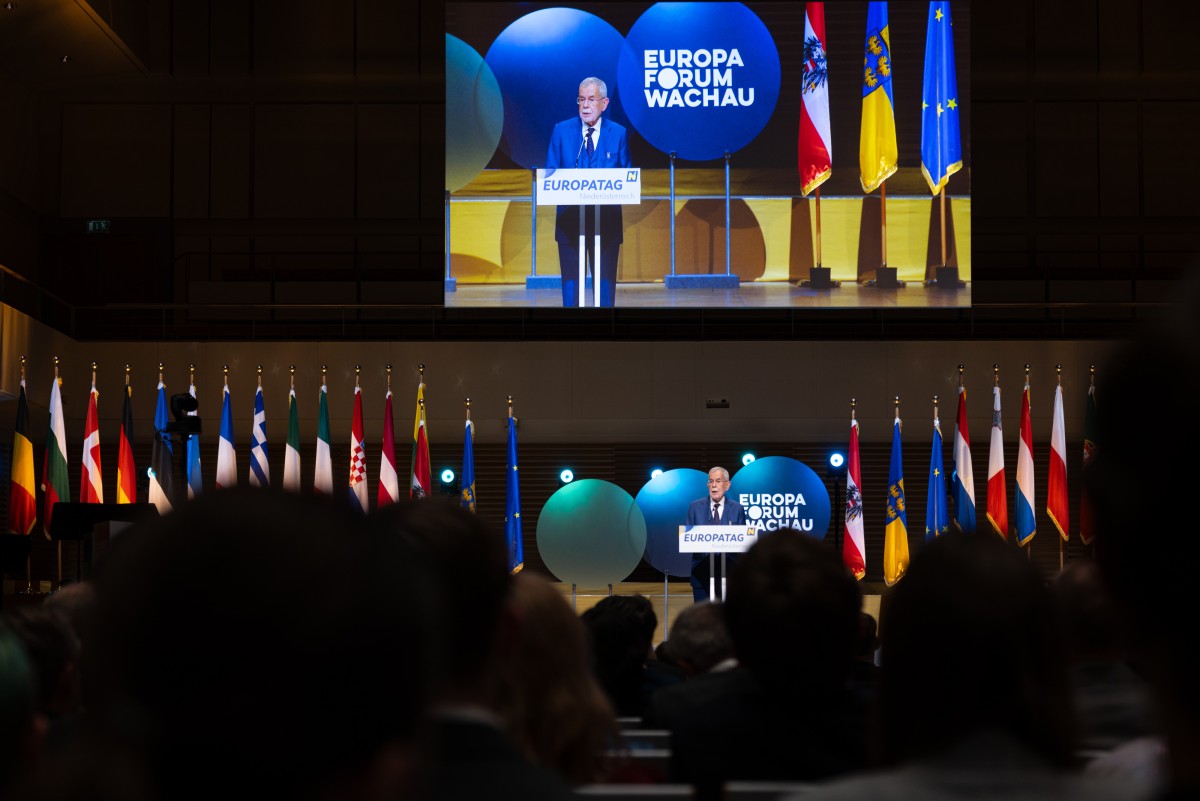 Speech by Alexander Van der Bellen on the occasion of the “30th Anniversary of the Europa-Forum Wachau." / Picture: © Österreichische Präsidentschaftskanzlei/Peter Lechner/HBF
The long-standing Forum, founded in 1995 to mark Austria’s accession to the EU, has long since evolved from a regional platform into a Central European center for dialogue. Over the course of its 30-year history, the Forum has welcomed more than 30 prime ministers and over 50 foreign and European affairs ministers. On the occasion of the anniversary, Federal President Alexander Van der Bellen also emphasized in his opening address the Forum’s historic role as an indispensable bridge-builder between East and West.
Security and Rearmament: The End of an Era of Peace
Geopolitical realities formed the central theme of the multi-day conference. Lower Austria’s Governor Johanna Mikl-Leitner drew a clear conclusion: “Today, more than ever, the task is to rethink Europe—as an economic area, but above all as a security and protection project.” Europe must take responsibility for its own security much more quickly.
Chancellor Christian Stocker echoed this sentiment, stating unequivocally that the peaceful period between 1990 and 2020 is over. “Our neutrality is a legal guideline, but it is not a defense concept,” said Stocker. He announced that the Austrian Armed Forces are to be massively rearmed by 2032, including through participation in the European air defense system Sky Shield. The goal is to raise defense spending to two percent of GDP and extend military service.
Former NATO Secretary General Anders Fogh Rasmussen warned of a “dangerous disintegration of the European security architecture” and called for a global “Alliance of Democracies” (the so-called “D7” comprising the EU, the UK, Canada, Japan, Australia, New Zealand, and South Korea) to counter the power bloc formed by China and Russia.
Asylum and Migration: Focus on June 13 and Reform of the ECHR
A dominant topic of the panels was European migration policy. Interior Minister Gerhard Karner and the new EU Commissioner Magnus Brunner provided detailed insights into the new EU Asylum and Migration Pact, whose concrete implementation and the establishment of processing centers at the EU’s external borders are set to begin on June 13. Brunner noted a 40 percent decline in asylum applications during the first four months of 2026, but simultaneously called for strengthened agreements with third countries.
Chancellor Stocker caused a stir with his call for a modern interpretation of the European Convention on Human Rights (ECHR). It must be legally possible to swiftly deport criminal migrants without the right to remain, without the protection of privacy taking precedence over national security. Stocker expressed his satisfaction that this initiative is now supported by all 46 member states of the Council of Europe in a joint declaration.
Economy and Regionalism: The “Göttweig Declaration”
In addition to security and migration, the discussion focused on European competitiveness, which has been stagnating significantly compared to the United States. Business representatives such as Sabine Herlitschka (CEO of Infineon Austria) and Eva-Maria Liebmann (WKO) called for a drastic reduction in bureaucracy and faster decision-making processes to give companies more freedom again.
The European regions set a concrete political agenda. Under the leadership of Mikl-Leitner, the so-called “Power Regions” (including Lower Austria, Bavaria, South Tyrol, Bratislava, Emilia-Romagna, and Catalonia) signed the “Göttweig Declaration.”
“A strong Europe is only possible with strong regions. We need less micromanagement from Brussels, but more capacity to act,” Mikl-Leitner demanded.
The signatory states made it clear that, as Europe’s economic engines, they are indispensable. Together, the participating “Power Regions” represent around 204 million people. The fact that they account for over 60 percent of European economic output underscores the enormous shift of economic power toward strong, innovative core regions.
The 30th Europa-Forum Wachau concluded with a clear mandate for Brussels and the nation-states: Only an economically stable, geopolitically united, and resilient Europe will be able to hold its own in the new, multipolar world order.