




Poland to Assume the ICMPD Presidency in 2026
In a formal ceremony, Poland assumed the chairmanship of the Steering Group of the International Centre for Migration Policy Development (ICMPD). Amid geopolitical tensions, one of the most important host countries for Ukrainian refugees has thus taken the helm of the organization. Polish representative Paweł Dąbrowski took over the position from Eva Åkerman Börje of Sweden.
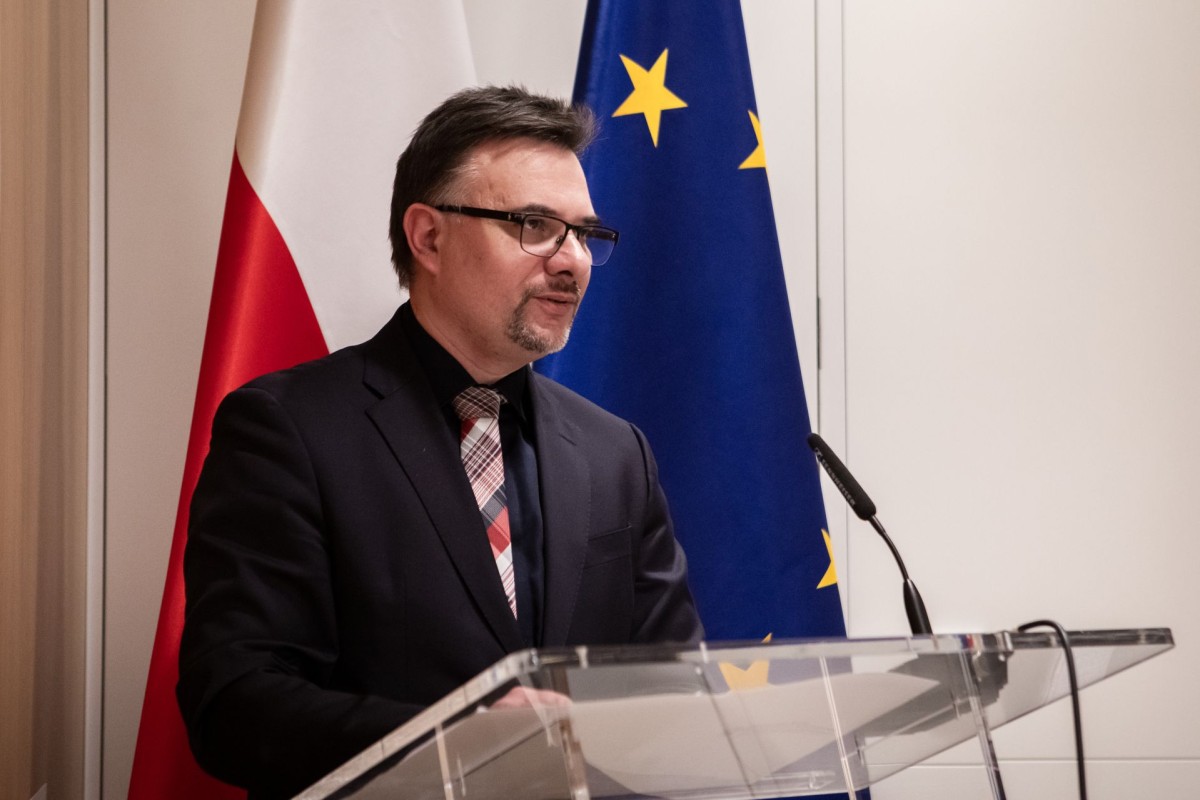 Mr Paweł Dąbrowski, Plenipotentiary of the Polish Ministry of the Interior and Administration for International Cooperation assumes the Chairmanship of the ICMPD for Poland. / Picture: © ICMPD - International Centre for Migration Policy Development / Internationales Zentrum für Migrationspolitikentwicklung
A key issue in the transition is the future of the millions of Ukrainians in the EU. Since the current EU directive on temporary protection expires in March 2027, time is running out to find follow-up solutions.
Poland is calling above all for long-term prospects and aims to promote coordinated approaches to facilitate the transition from temporary protection to sustainable residence permits. Ylva Johansson, EU Special Representative for Ukrainians in the EU, emphasized in her keynote address: “We must change the narrative—away from temporary protection, toward empowerment.” The Ukrainian diaspora should serve as a “bridge” for Ukraine’s future EU accession. According to Eva Åkerman Börje, supporting Ukraine is not only a moral obligation but also a security policy commitment.
Innovation and New Infrastructure
Under the Polish Presidency, the ICMPD will further expand its operational presence. A milestone for 2026 is the opening of a so-called Unity Hub in Stockholm. These centers serve as counseling and community spaces for refugees. A similar model has already been successfully piloted in Prague, where the “Ukrainian Consultation and Community Centre” (UCCC) became fully operational in March 2026.
Poland’s strategic priorities
Paweł Dąbrowski outlined three key areas for the coming twelve months: legal certainty as a basis for developing sustainable solutions for Ukrainians after 2027; and cooperation to strengthen collaboration with partner countries on return, reintegration, and legal mobility. As the final key area, Poland calls for improved migration management to promote innovative solutions that strengthen both responsibility and solidarity within the EU.
Susanne Raab, Director General of the ICMPD, who made her first official state visit to Poland earlier this year, expressed optimism: “We look forward to Poland’s strong support for the ICMPD’s institutional development.”
Poland, which currently hosts around one million Ukrainian refugees, already operates key infrastructure, including the Ukrainian Crisis Center (UCC) in Gdańsk and a call center in Warsaw. The next change of leadership is already set for 2027: Serbia will then assume the presidency, bringing in particular the experiences of the Western Balkans.