




How Austria's Economy Is Getting Involved in the EU's “Global Gateway” Megaproject
Through a collaborative initiative unlike any seen before, the German government is aligning domestic industrial expertise with the European Union’s 400-billion-euro investment strategy. The focus is primarily on green hydrogen and rail technology.
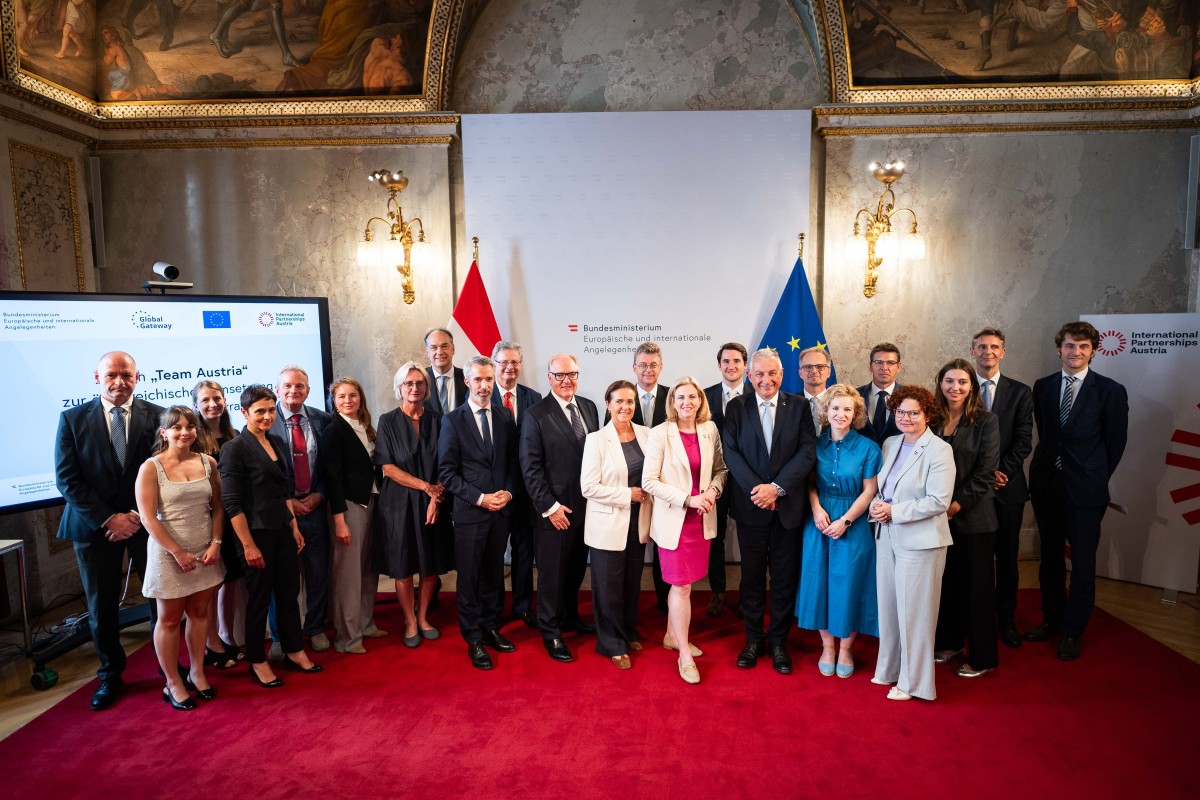 Foreign Minister Beate Meinl-Reisinger opened the Global Gateway “Team Austria” event in Vienna. / Picture: © BMEIA/ Michael Gruber / Flickr Attribution (CC BY 4.0 / https://creativecommons.org/licenses/by/4.0/deed.de)
In times of shifting geopolitical power dynamics, geopolitical tensions, and fragile supply chains, Austria is taking the bold step of forming a strategic alliance with the European Union: Austrian Foreign Minister Beate Meinl-Reisinger and EU Commissioner for International Partnerships Jozef Síkela presented the “Team Austria” platform in Vienna.
The event, held in the ballroom of the Federal Ministry for European and International Affairs (BMEIA), was also attended by Federal Minister Eva-Maria Holzleitner (representing the Minister of Finance) and Elisabeth Zehetner, State Secretary for Energy, Startups, and Tourism.
Pragmatic Geopolitics Instead of Old Certainties
“Power dynamics are shifting, supply chains are being reorganized, and old certainties no longer apply,” Foreign Minister Beate Meinl-Reisinger clarified during the presentation. In this new world order, many emerging and developing countries are seeking reliable partners on an equal footing. Austria offers excellent conditions for this—particularly in technological fields such as hydropower, environmental technology, and rail infrastructure. “Team Austria ensures that this strength translates into contracts, because each of these contracts secures value creation and jobs in Austria.”
EU Commissioner Jozef Síkela underscored the geopolitical paradigm shift within the European Union: “Pragmatic geopolitics is back, and Europe must respond accordingly. Externally, we must present a strong, strategic, and united front, while maintaining a clear focus on what matters to Europe: economic security, stability, and competitiveness.”
The EU’s Global Gateway Initiative: 400 Billion Euros to Counter China’s Influence
The EU’s Global Gateway Strategy is Europe’s counter-model to China’s “Belt and Road Initiative” (New Silk Road). By 2027, the EU will mobilize approximately 400 billion euros in public and private investment worldwide for sustainable infrastructure in partner countries (including in Africa, Latin America, Asia, and the Western Balkans). The goal is to make investments according to transparent, environmental, and social standards without driving partner countries into debt traps, while simultaneously opening up new markets for European companies.
An Alliance of All Relevant Stakeholders
What sets “Team Austria”—which was launched in December 2025 and is now becoming fully operational—apart is the seamless integration of Austrian support and financing instruments with European funds. Under the coordination of the BMEIA, all key stakeholders are collaborating in an institutionalized manner for the first time:
- Federal Ministry for European and International Affairs (BMEIA)
- Federal Ministry of Finance (BMF)
- Federal Ministry of Labor and Economy (BMAW)
- Austrian Control Bank (OeKB)
- Austrian Development Bank (OeEB)
- Austrian Development Agency (ADA)
- Austrian Federal Economic Chamber (WKO)
This provides domestic companies with one-stop support—from the initial project idea through funding questions to closing complex financing gaps.
Pilot Phase: Green Hydrogen & Southern Hydrogen Corridor
During the pilot phase, which runs through the end of 2026, Team Austria is focusing on two core areas. One is renewable energy, including hydropower and green hydrogen, and the other is connectivity in the form of rail technology and rail infrastructure.
The “Southern Hydrogen Corridor” (SoutH2 Corridor) (SoutH2 Corridor Initiative) is considered the first flagship project. This pipeline initiative, stretching over 3,300 km, is designed to transport green hydrogen from North Africa through Italy and Austria to southern Germany. For Austria, this megaproject not only ensures a cost-effective supply of green hydrogen for the decarbonization of the domestic heavy industry but also opens up direct business opportunities for Austrian plant manufacturers and engineering firms within the framework of Global Gateway.