




Europe Between Turmoil and Reorganization: Coface’s 23rd Country Risk Conference in Schönbrunn
Global power dynamics are shifting rapidly, and old certainties are proving to be fragile. Under the striking title “World Order. World Disorder. World Reorder,” approximately 170 high-profile guests from the business and financial worlds gathered in the Apothecary Wing of Schönbrunn Palace. The 23rd Country Risk Conference, hosted by the leading credit insurer Coface, provided a forum for an in-depth analysis of the multiple crisis hotspots while also outlining strategic paths forward for the European and Austrian economies.
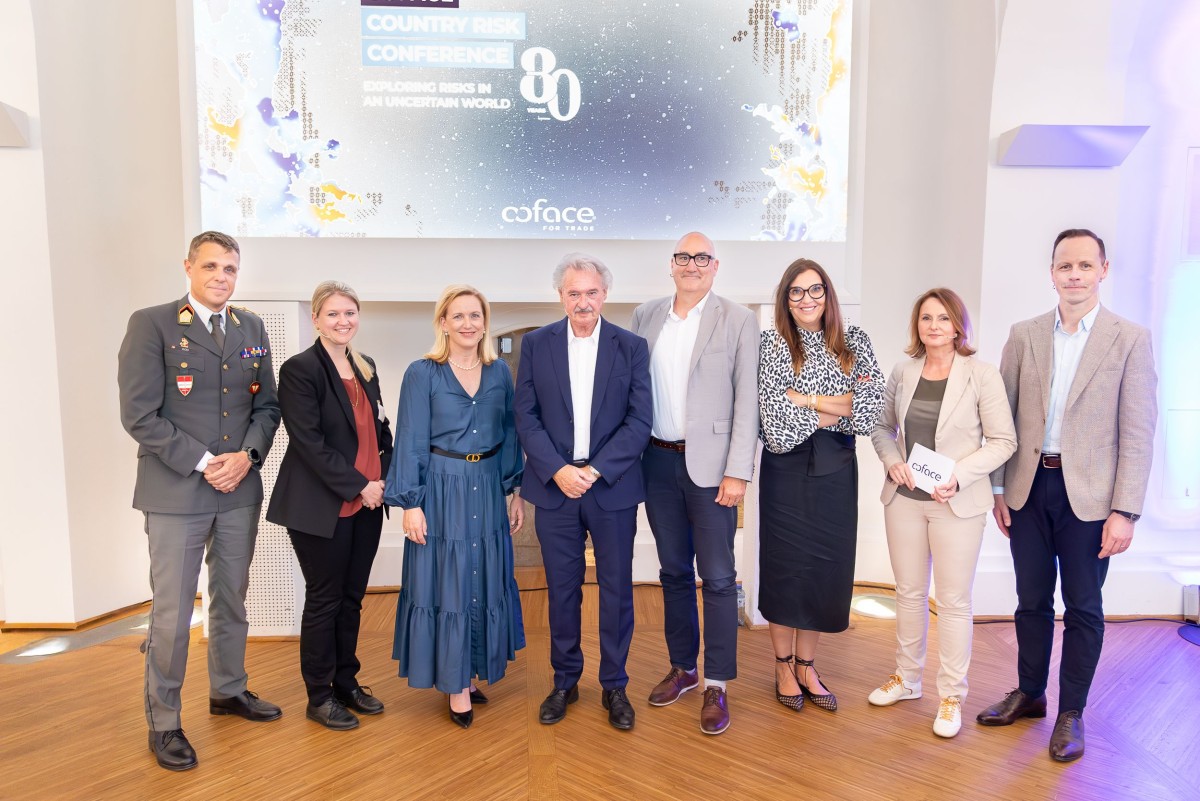 Coface’s 23rd Country Risk Conference in Schönbrunn: High-profile experts focus on global geopolitics and economic strategies for Austrian companies. / Picture: © Christian Mikes
“How do we intend to deal with the upheaval and profound changes taking place in the world?” asked Mag. Dagmar Koch, Country Manager of Coface Austria and host of this long-standing conference, posed the central question at the opening. Koch called for proactive action and a healthy sense of self-confidence: Europe still has the historic opportunity to play a leading and shaping role in an emerging new world order.
A Plea for Diplomacy and International Values
Jean Asselborn, the long-serving Luxembourgish Foreign Minister and experienced European politician, took the audience on a historical journey in his highly acclaimed keynote address. Despite the currently overwhelming number of conflict hotspots, he vehemently argued for making room for optimism. “As an optimist, one can say now that diplomacy has regained a foothold. This is a signal for Putin to come to the negotiating table,” Asselborn explained, referring to recent diplomatic developments.
At the same time, he issued an urgent warning to the international community not to sacrifice international law and the rule of law: “We must be careful not to slip into a world without values.” Europe must consistently stand by its principles. “We have lived in peace in the EU for 80 years. I want that for my children and my children’s children for the next 80 years,” Asselborn said emotionally.
Economic Policy in Permanent Crisis Mode
National Bank Governor Univ.-Prof. Dr. Martin Kocher shed light on the economic realities of this “world disorder.” He noted that the first half of the current decade had been marked to an extraordinary degree by instability and uncertainty. “The range of possible scenarios is very broad,” said Kocher. While there are geopolitical risks beyond direct control, he noted, it is all the more important to secure the conditions that can be influenced. There is a noticeable effort by all relevant actors to return to reliable economic stability.
Markus Kuger, Coface’s chief economist for the DACH region, backed this up with hard data on global risk analysis at the country and industry levels. He tempered overly optimistic expectations of a rapid easing of tensions in the energy markets: “Even after the conclusion of a rather vague memorandum of understanding, it will take some time for oil and gas prices to fall back to pre-war levels.” Supply chains and production costs will therefore remain volatile for the foreseeable future.
The Security Policy Dimension
Christoph Göd contributed a sober military-strategic analysis titled “The World Out of Joint.” He noted that the U.S.’s strategic shift toward Asia is not a new phenomenon, but has been consistently pursued since 2014—with far-reaching consequences for the transatlantic partnership. “Every U.S. president has emphasized that Europe spends too little on its defense,” Göd noted. He explained that Russia’s stated strategic goal is to permanently weaken this very transatlantic axis. The strategist currently sees no immediate solutions for the war in Ukraine or for the conflicts in the Middle East.
Panel Discussion: Calls for Innovation and “Buy European”
A high-profile panel led by business journalist Eva Komarek (“Die Presse”) discussed how the domestic economy can navigate this challenging environment. Dagmar Koch highlighted Austria’s specific strengths: “Austria is a country of precision, not mass production. We excel at precision work, not mass production.” The highly educated workforce is a decisive asset. Claudia Beermann, CFO of iSi Automotive Holding, agreed and called for more entrepreneurial courage: “We need to be more confident in our ability to find solutions.”
Lisa Smith, co-founder of the successful company Prewave, identified speed and agile scenario planning as key strategies for addressing global supply chain risks. Alexander Mülhaupt, General Manager of Roche Pharma Austria, voiced criticism of Europe’s sluggishness: “While China and the U.S. are changing the rules of the game, Europe is sticking to its maintenance therapy.” Given the vast size of the EU single market, the value of innovation must be recognized much more radically.
Michael Schütz, CFO of Prinzhorn Holding, ultimately distilled these demands into a clear economic policy proposition: He called for a genuine European industrial strategy. “We need to recognize where the train has already left the station and what we want to promote,” said Schütz. His pointed call for strategic prioritization of domestic value creation—“Buy European”—was met with spontaneous applause from the audience at Schönbrunn Palace.
About the organizer: For 80 years, Coface has been one of the world’s leading companies in credit and risk management. With approximately 5,511 employees (as of 2025), the group protects around 100,000 customers in approximately 200 markets against payment defaults and supports companies in achieving secure international growth through economic data and debt collection solutions. Annual revenue most recently stood at around 1.84 billion euros.