




Austria's New Foreign Policy Toward the South: National Council Adopts Austria's First Africa Strategy
By taking note of the “Africa Strategy 2026–2029,” the Austrian National Council has set a milestone in foreign policy. For the first time in the history of the Republic, foreign, security, development, and economic policy priorities regarding the African continent are being consolidated within a unified, nationwide framework. The strategy represents a radical break with the traditional, historically rooted “donor-recipient model” and aims instead to establish an interest-driven “partnership on equal footing.”
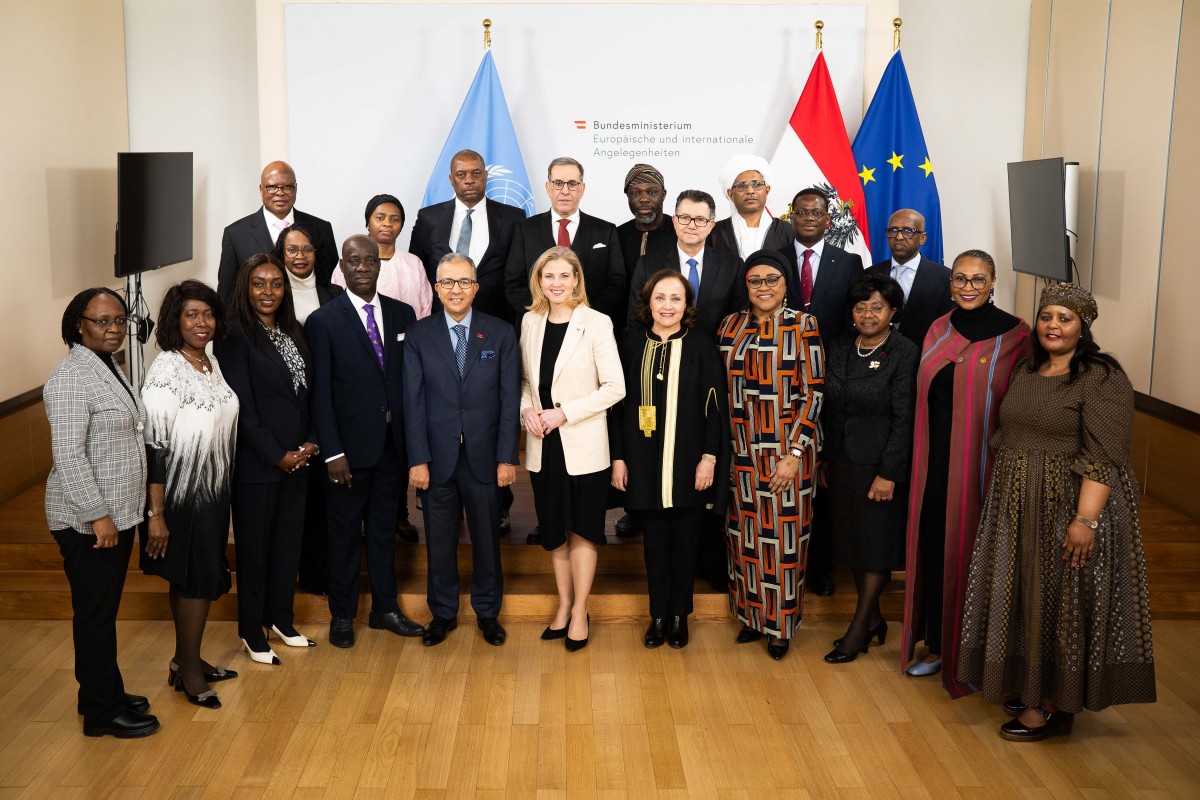 Earlier this year, Foreign Minister Beate Meinl-Reisinger welcomed ambassadors from several African countries to Vienna to discuss the strategy. / Picture: © BMEIA Bundesministerium für Europa, Integration und Äußeres / Michael Gruber / Flickr Attribution 2.0 Generic (CC BY 2.0 DEED)
According to Foreign Minister Beate Meinl-Reisinger, whose ministry (BMEIA) took the lead in drafting the strategy, this is not a “project about Africa, but a project with Africa.” The paper is based on the so-called “Whole-of-Austria” approach, which brings the public sector closer together with the private sector and civil society across all ministries. The decision was preceded by an intensive consultation process launched by the federal government on October 1, 2025, which also involved African governments, regional organizations, and academic and business stakeholders.
The rationale behind this reorientation is Africa’s enormous demographic and geopolitical dynamism. Eleven African countries are currently among the twenty fastest-growing economies in the world. In light of global shifts and the massive expansion of other major powers such as China and Russia, Meinl-Reisinger states that it is in the “very best interest” of Austria and Europe to build reliable alliances in their immediate neighborhood.
The Four Pillars of Cooperation
The strategic architecture is based on four key priority areas, which are aligned with the UN 2030 Agenda and the African Union’s Agenda 2063. The plan is to focus on conflict prevention, the protection of human rights, and the rule of law. Austria intends to increase its participation in civilian and military EU and UN missions and to strengthen the so-called humanitarian sector. Domestic companies are also to tap into new markets in the fields of renewable energy, environmental technology, health, and infrastructure. Central to this is the promotion of local value chains and decent working conditions on the ground to reduce one-sided supply chain dependencies.
Another goal is strict control. Irregular migration and human smuggling are to be combated, repatriation agreements optimized, and asylum capacities in countries of first reception strengthened. At the same time—in response to the domestic shortage of skilled workers—an orderly pathway for legal, skills-based immigration will be established, while taking care to avoid a harmful “brain drain” for Africa. In addition to expanding university networks (such as Africa-Uni-Net) and dual vocational training systems, the strategy calls for scholarly provenance research on African art and cultural artifacts in Austrian museums. Furthermore, the fight against the climate crisis is considered a priority, as Africa suffers disproportionately from global climate change despite its minimal emissions.
New Oversight Body: The Volunteer Africa Envoy
To ensure operational coordination and quality assurance, the position of Africa Envoy will be established within the Ministry of Foreign Affairs. This role will be held on a voluntary basis. In addition to interministerial coordination, the main task will be to prepare regular implementation reports that measure progress through clear key performance indicators (KPIs) in the areas of the economy, stability, and migration. The strategy will be financed through a more efficient reallocation of existing budget funds.
Fierce Criticism from Opposing Camps
Despite the broad parliamentary majority, deep divisions were evident among the opposition benches, with criticism of the strategy stemming from completely opposing motives, as reported by ORF. The FPÖ categorically rejected the proposal. Member of Parliament Susanne Fürst criticized the fact that Austrian taxpayer money was flowing to Africa at the expense of the Austrian people. She also rejected the idea of opening pathways for skilled migration, arguing that there was simply no need for skilled immigration from Africa to Austria. On the other hand, the Greens expressed dissatisfaction, viewing the strategy as a purely “pink economic program” and accusing the federal government of failing to live up to its proclaimed “partnership on equal terms.” Green Party Representative David Stögmüller criticized the fact that Africa is viewed primarily through the lens of national self-interest—particularly with regard to securing raw materials and preventing migration. He argued that the actual focus should have been much more on fair trade policy, poverty reduction, and concrete measures to combat the climate crisis.
With this parliamentary resolution, the Africa Strategy now enters the implementation phase. The coming years will show whether the balancing act between Austria’s pursuit of its own interests and genuine, equal development cooperation can succeed in practice.