




Austria's Charm Offensive for the UN Security Council in New York
At a time when geopolitical fault lines are deeper than ever before, Austria is committed to the principle of cooperation. Foreign Minister Beate Meinl-Reisinger used her three-day visit to New York to campaign for Austria’s candidacy as a non-permanent member of the UN Security Council (2027–2028), ten weeks ahead of the decisive election on June 3.
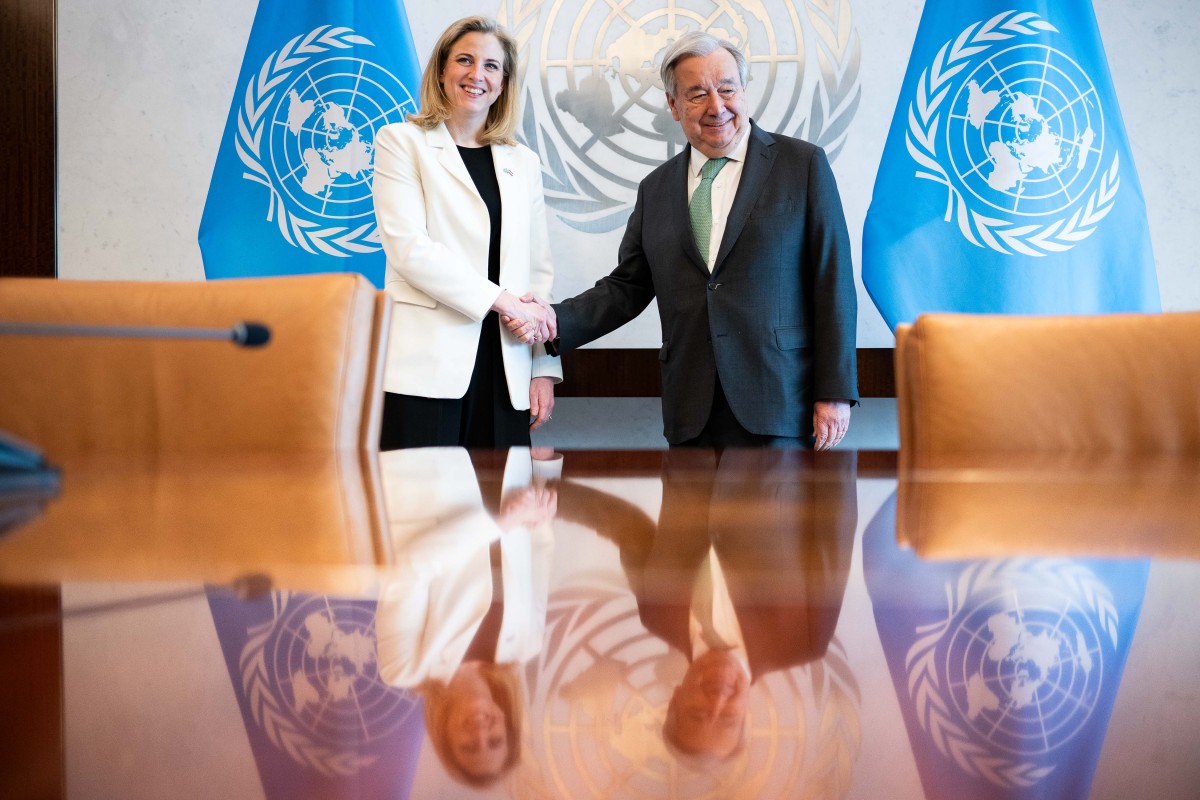 Austrian Foreign Minister Beate Meinl-Reisinger (l.) met with UN Secretary-General Antonio Guterres (r.) in New York. / Picture: © BMEIA Bundesministerium für Europa, Integration und Äußeres / Gruber / Flickr Attribution 4.0 (CC BY 4.0)
The sign on the lectern at UN Headquarters spoke volumes: “Austria for the United Nations Security Council 2027–2028.” Flanked by terms such as “partnership” and “trust,” Meinl-Reisinger emphasized to representatives from over 70 UN member states that security is not a solo endeavor. “For peace, we need more cooperation, not less,” said the minister. “Only cooperation and an international legal framework can create sustainable security—whether in our neighborhood, at the European level, or internationally.”
The Middle East as a Hotspot: Diplomacy to Prevent Escalation
The visit took place against the backdrop of a highly volatile situation in the Middle East. The minister met with UN Secretary-General António Guterres and the High Representative for Gaza, Nickolay Mladenov. The latter had just briefed the Security Council on the progress of a U.S.-led 20-point peace plan, which is seen as a glimmer of hope despite ongoing tensions and allegations of smuggling dual-use goods.
Austria is clearly positioning itself alongside international partners with a resolution against Iran. Vienna supports a resolution introduced by Bahrain condemning Iranian attacks on Gulf states such as Saudi Arabia, the UAE, and Jordan. These attacks marked a new level of regional escalation in the spring of 2026. Meinl-Reisinger called for a “return to a rules-based world order” . De-escalation is the order of the day.
Focus on Africa and Peacekeeping Missions
Beyond the major headlines of the Middle East conflict, Austria is pursuing a long-term strategy of network-building. A roundtable with representatives from Zimbabwe underscored the goal of deepening security cooperation with African states. Austria aims to distinguish itself in the Security Council as a bridge-builder that takes the concerns of small and medium-sized states particularly seriously.
Early in her campaign, Meinl-Reisinger emphasized that for countries the size of Austria, “it would be dangerous if the law of the strongest prevailed over the security of the law.”
The Road to June 3
The election in June is seen as a litmus test for Austrian diplomacy. The federal government had already intensified its efforts in the summer of 2025 by appointing four special envoys to secure a seat at the most important table in world politics for the fourth time, following 1973/74, 1991/92, and 2009/10.
For Meinl-Reisinger, the candidacy is also an act of “patriotism in a networked world.” As a reliable and supportive partner, she said, Austria wants to take on responsibility in New York to protect liberal democracy and global stability.