




A Turning Point in Migration Policy: EU Rolls Out Historic Asylum Pact with the Help of the ICMPD
With the official rollout of the EU Asylum and Migration Pact, the European Union is undergoing the most far-reaching reform in its history in this policy area. While Brussels speaks of a historic breakthrough, behind the scenes, the Herculean logistical and legal task is in full swing in the member states. The International Centre for Migration Policy Development (ICMPD) is taking stock of the practical implementation so far—and is already looking ahead to the next major hurdles.
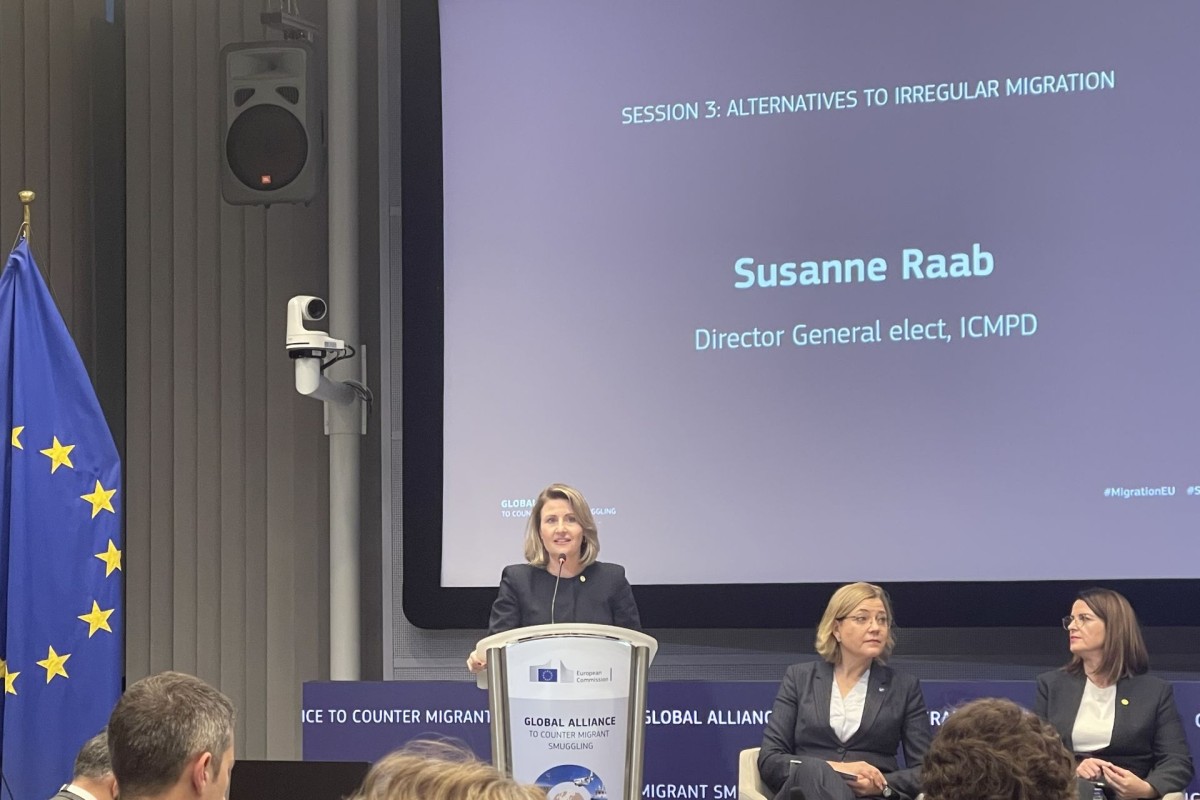 Susanne Raab gave a positive assessment of the pact, “That this was achieved on such a large scale and with such intensity in just two years is a major European achievement. The Member States are the driving force behind this change.” / Picture: © ICMPD - International Centre for Migration Policy Development / Internationales Zentrum für Migrationspolitikentwicklung
It is the most comprehensive and far-reaching reform the European asylum and migration system has ever undergone: the EU Asylum and Migration Pact officially entered into full force. After years of tough negotiations, the package of ten binding legal acts establishes a unified framework for how the European Union protects its external borders, streamlines asylum procedures, and shares responsibility among member states. But while the political course was set in Brussels, the real mammoth task took place behind the scenes: operational implementation in the individual countries.
For the Vienna-based International Centre for Migration Policy Development, the finalization of the pact marks a historic opportunity. “The Pact offers a new opportunity for cooperation and charts a clearer course for the future of the EU,” explains ICMPD Director General Susanne Raab, who has been the first woman to lead the organization since January 2026 and previously gained extensive political experience in this field as Austria’s Minister of Integration.
According to Raab, numerous member states have harnessed the momentum of the Pact to initiate far-reaching national reforms. “The fact that this was achieved in such a short time and on such a large scale over just two years is a major European success,” emphasizes the Director General. She notes that the member states are the real drivers of this change.
The New Set of Rules: What Will Change at the Borders?
The pact aims to manage and normalize migration in the long term. Key elements of the reform include mandatory screenings. All individuals arriving at the external borders without a visa will be registered within seven days. This includes identity, security, and health checks, as well as the collection of biometric data in the expanded Eurodac database.
For migrants from countries with a low recognition rate (below 20 percent), an expedited border procedure applies directly at the external border. If the asylum application is rejected, a deportation order is issued automatically. Member states must either accept a certain number of asylum seekers or provide financial compensation (approximately 20,000 euros per migrant not accepted) or personnel support.
ICMPD as the Operational Driving Force for Member States
The development of National Implementation Plans posed enormous administrative and logistical challenges for the member states. This is where the ICMPD stepped in. Through the EU-funded Technical Support Instrument (TSI), the organization has worked closely with the European Commission’s Task Force (SG REFORM) over the past two years to bring national systems into compliance with the Pact.
As part of its Member State Program (MSP), the ICMPD supported very concrete reform efforts in several countries, such as the Czech Republic. There, the ICMPD helped develop materials to improve the asylum process, particularly regarding the use of country of origin information in appeal proceedings. In Estonia, the focus was on identifying vulnerable persons and providing training on how to handle unaccompanied minors and victims of human trafficking.
In Ireland, although the country is not part of the Schengen Area, new standard procedures for screenings and border processes were developed with the support of the ICMPD to ensure interoperability with Schengen states. In Lithuania, the focus was on border management, situational awareness, and knowledge exchange through study visits to Finland and Poland.
In Romania, in addition to adjustments to the legal framework, the ICMPD helped establish an independent monitoring mechanism for fundamental rights in cooperation with the Romanian Ombudsman’s Office. A large-scale simulation conducted in the spring of 2026 at Romania’s external border demonstrated how well the preparations work in practice. Over 200 representatives from national authorities, EU agencies (such as Frontex and the EUAA), international organizations, and civil society rehearsed a real-life emergency scenario: What happens when arrival numbers exceed the capacity of asylum centers? The exercise tested coordination chains, the new screening rules, the identification of vulnerable persons, and security checks under the terms of the new pact.
Looking Ahead: The External Dimension
However, the official launch in June 2026 does not mark the end of the work. “The challenges remain and will continue to exist even after tomorrow,” Raab emphasized, referring to the European Commission’s report.
A key factor in the pact’s success—particularly with regard to expedited border procedures—will be its so-called “external dimension.” Without stable migration partnerships with third countries outside the EU, returns can hardly be organized effectively. Here, too, the ICMPD is already building bridges. Through regional migration dialogues and flagship operational initiatives, experts are collaborating closely with non-EU countries. Examples include the fight against human trafficking, the establishment of Migrant Resource Centers, so-called “Talent Partnerships,” and the recently opened Legal Gateway Office in India, which aims to promote legal and controlled migration pathways.
The Dark Side of the Reform: Massive Resistance from NGOs and Experts
But while the logistical successes are being celebrated in Brussels and Vienna, sharp criticism is pouring in from international aid organizations and legal experts. NGOs such as Amnesty International, Human Rights Watch, and the Swedish Refugee Law Center are warning of the humanitarian consequences of the pact.
At the heart of the criticism are the new, expedited border procedures for asylum seekers from countries with low recognition rates. During the procedure, which can last up to twelve weeks, these individuals are legally considered “not to have entered.” NGOs warn that in practice this leads to systematic, widespread detention at the EU’s external borders—under potentially substandard conditions and without adequate access to independent legal counsel. Even families with children are not generally exempt from these procedures.
Critics also fear that the so-called external dimension—cooperation with third countries—will lead to the externalization of refugee protection. They argue that the EU is becoming increasingly dependent on autocratic regimes in North Africa or transit countries to intercept migrants before they reach European soil, which jeopardizes the principle of non-refoulement under international law.
The new “mandatory solidarity mechanism” requires member states to either take in refugees from overburdened countries of first reception or, alternatively, pay a compensation fee (approximately 20,000 euros) for each migrant they do not accept. Human rights activists criticize this as a “commercialization of the right to asylum,” while some Eastern European countries reject the mechanism as an encroachment on their national sovereignty.
A political balancing act with an uncertain outcome
Logistics experts and migration specialists outside of NGOs also express skepticism as to whether this bureaucratic behemoth can even be implemented comprehensively in reality. The collection of biometric data (Eurodac), comprehensive screening, and the conduct of legally sound procedures in detention centers directly at the borders require an infrastructure that, despite EU aid, is still far from mature in many first-reception countries such as Greece or Italy. Even the European Commission acknowledges in its reports that “challenges exist and will remain even after the rollout.”
“The official rollout is not the finish line, but rather the starting point for ongoing efforts,” Susanne Raab of the ICMPD sums up pragmatically. However, whether the pact will deliver what Brussels hopes for—namely, orderly, humanitarian, and at the same time restrictive procedures—or whether it will lead to a lasting humanitarian crisis on Europe’s borders remains to be seen in the coming months under real-world conditions.
With the pact’s entry into force, Europe has turned a new page. Whether these ambitious rules will stand the test of practice at the borders in the long term remains to be seen in the coming months—but the logistical foundations for this have certainly been laid.