




Fico Reported in Bratislava to Van der Bellen About His Visit to Moscow
What was planned as a brief courtesy call turned into an hour-long political drama. Austrian President Alexander Van der Bellen used his state visit to Slovakia to give Prime Minister Robert Fico a stern talking-to. The main topic: Fico’s controversial trip to Moscow.
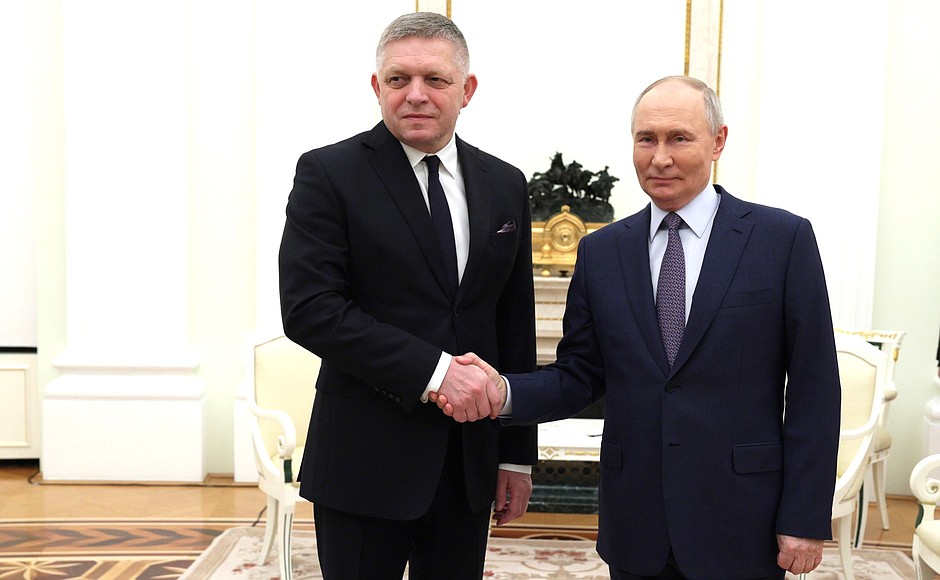 President of Russia Vladimir Putin met with Prime Minister of Slovakia Robert Fico during Fico's first surprise visit to Russia in 2024. / Picture: © Wikipedia / Presidential Press and Information Office / Kremlin.ru (CC BY 4.0; https://creativecommons.org/licenses/by/4.0/deed.en)
Van der Bellen traveled to Bratislava to meet counterpart Peter Pellegrini, with the official schedule also including Slovak Prime Minister Robert Fico. Meetings of this type rarely last an hour, which underscores the urgent need for dialogue between Vienna and Bratislava.
Straight Talk on the Ukraine Issue
The lengthy discussion was prompted by Fico’s recent meeting with Kremlin leader Vladimir Putin. Van der Bellen had announced he would question Fico about it. That evening, Fico confirmed: “One topic of the meeting was also the content of the talks with the President of the Russian Federation, Vladimir Putin.”
WHAT DIDN’T FIT INTO THE PRESS CONFERENCE LIVESTREAM.
— Robert Fico (@RobertFicoSVK) May 9, 2026
Just a few hours ago, I concluded my visit to Moscow. This week, I also managed to attend the summit in Armenia, visit Bavaria, and I am pleased with the good news for Slovakia. pic.twitter.com/FM6yJ0o33f
The Federal President left no doubt about the Austrian and European position. While he emphasized that channels of communication must remain open in principle, he made it unmistakably clear: “As far as the war is concerned, it is both important and right that the European Union speak with one voice.”
Van der Bellen also cautioned that Russia’s war of aggression continues to pose the greatest security threat to Europe and that the EU must demonstrate even more “responsibility and initiative” in this regard.
Disagreements on EU Reforms, Consensus on Infrastructure
While Fico praised the visit as evidence of strong bilateral relations and highlighted projects related to cross-border transportation infrastructure and energy security, points of friction emerged in other areas.
In talks with President Pellegrini, it became clear that Slovakia is skeptical of the EU’s efforts to abolish the unanimity principle (right of veto) in foreign and defense policy. Pellegrini warned that small states like Slovakia could lose their influence as a result—a position that contrasts with calls for a more effective, more integrated EU, as often heard from Vienna and Brussels.
Criticism of Fico’s Moscow Course
Robert Fico is under international pressure because, since taking office, he has adopted a significantly more pro-Russian rhetoric than his predecessors. His meeting with Putin last weekend was the first by an EU head of government (besides Viktor Orbán) in quite some time and was viewed in Brussels as a diplomatic solo move.
Despite political disagreements, Austria and Slovakia are inextricably linked economically. Austria is the third-largest investor in Slovakia. Over 2,000 Austrian company locations there provide around 45,000 jobs. Austrian influence is particularly strong in the banking sector (Raiffeisen, Erste Bank) and in the construction industry (Strabag).