




Austria Expels Three Suspected Russian Spies Disguised as Diplomats
A “forest of antennas” on Vienna’s rooftops has sparked a row between the Foreign Ministry and the Kremlin. Because Moscow refused to waive diplomatic immunity, three embassy staff members were forced to leave the country. The government is signaling a change of course—but Russia is already threatening retaliation.
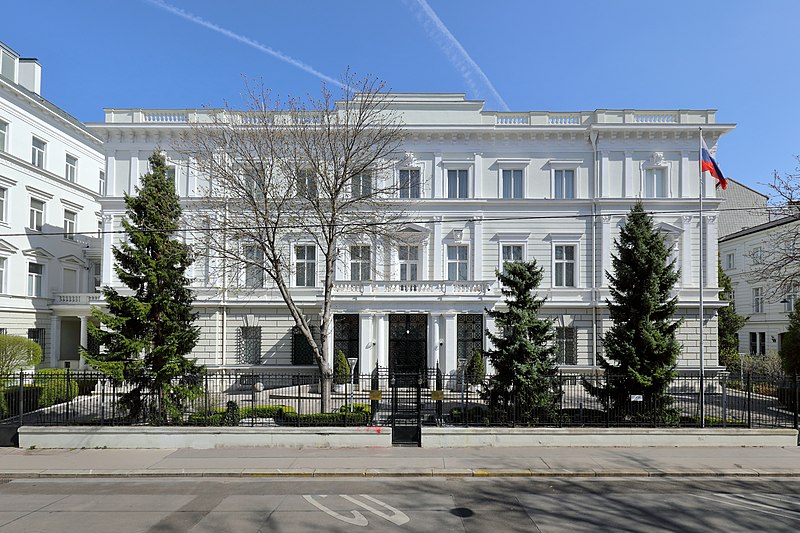 The surveillance equipment on the roofs of the Russian Embassy in the 3rd district and at the Russian diplomatic compound in Donaustadt is a thorn in the side of the Austrian intelligence service. / Picture: © Wikimedia Commons / C.Stadler/Bwag / CC BY-SA 4.0 (https://creativecommons.org/licenses/by-sa/4.0)
This move has driven the already-strained relations between Vienna and Moscow to a new low. After years of surveillance by the Federal Office for the Protection of the Constitution, the Austrian Ministry of Foreign Affairs (BMEIA) took action in mid-April: Three employees of the Russian Embassy were declared “personae non gratae” and expelled. The allegations are serious: They are accused of conducting systematic signals intelligence (SIGINT) under the guise of diplomacy and siphoning off sensitive data from international organizations.
The “forest of antennas” above the city’s rooftops
The investigation focuses on the massive technical installations on the rooftops of Russian properties, as reported by ORF. Particular attention is being paid to the embassy in Vienna’s third district and a diplomatic compound in Donaustadt. Experts and intelligence officials have observed a massive expansion of these capabilities since the start of Russia’s war of aggression against Ukraine.
As journalist and IT expert Erich Möchel has explained in earlier analyses, these installations monitor communications in Vienna’s government district and at the international organizations based there (such as the OSCE or the UN). By intercepting satellite signals, Russia can gain valuable information about diplomatic correspondence and security policy strategies.
The Federal Office for the Protection of the Constitution had already explicitly warned that these activities were causing massive damage to “Austria’s international reputation.” Vienna has traditionally been regarded as a “hub for spies,” but pressure from Western partners on the federal government to take action against Russian activities had recently grown significantly.
Ultimatum expired: Immunity remains in place
The current expulsion is the result of months of preparatory work by the judiciary. The public prosecutor’s office had launched an investigation into the three suspects, but ran into the limits of international law. Since diplomats are protected by the Vienna Convention, the Russian ambassador was summoned to the Ministry of Foreign Affairs. The demand was clear: Moscow should lift the suspects’ immunity to allow for proper criminal proceedings.
Austria set a deadline of 14 days. As expected, the Kremlin ignored this request. Only the sharpest diplomatic weapon remained: expulsion. The three officials have since left Austria. According to reports, pressure from the authorities has already led to the dismantling of the first technical installations on rooftops. Whether this signifies a permanent reduction in espionage capabilities remains a matter of debate among experts such as Erich Möchel.
A Shift in Foreign Policy
Foreign Minister Beate Meinl-Reisinger (NEOS) underscored the government’s new tough stance, as reported by ORF: “It is unacceptable that diplomatic immunity is used to engage in espionage,” the minister said. A change of course has been implemented, and authorities are now taking decisive action against the “forest of antennas.” This policy is to be accompanied by a tightening of the so-called espionage provision (§ 256 StGB), which will in future also criminalize espionage against international organizations in Austria—an area that has previously constituted a legal gray zone.
Despite the 14 expulsions since the start of the war, the Russian presence in Vienna remains substantial: around 220 people are still accredited to Russia’s various diplomatic missions.
Angry reaction from Moscow
The response from the Kremlin was not long in coming and was, as usual, sharp. In an official statement, the Russian Embassy described the decision as “outrageous” and “categorically unacceptable.” Vienna was acting “solely out of political motives” and had presented no evidence of violations of the Vienna Convention.
“A harsh reaction from Moscow will undoubtedly follow,” the statement continued. In diplomatic circles, the imminent expulsion of Austrian diplomats from Moscow is now expected—a standard procedure based on the principle of reciprocity that will further freeze bilateral relations.