




“Don't Forget Your Humanity”: Hiroshima Survivor Shakes Up Vienna's Tech Scene
During an emotional event in Vienna, Nobel Peace Prize laureate Setsuko Thurlow urged young technology developers to place ethics and human experience at the heart of innovation. The newly founded “PeaceTech Alliance” now aims to put this call into action.
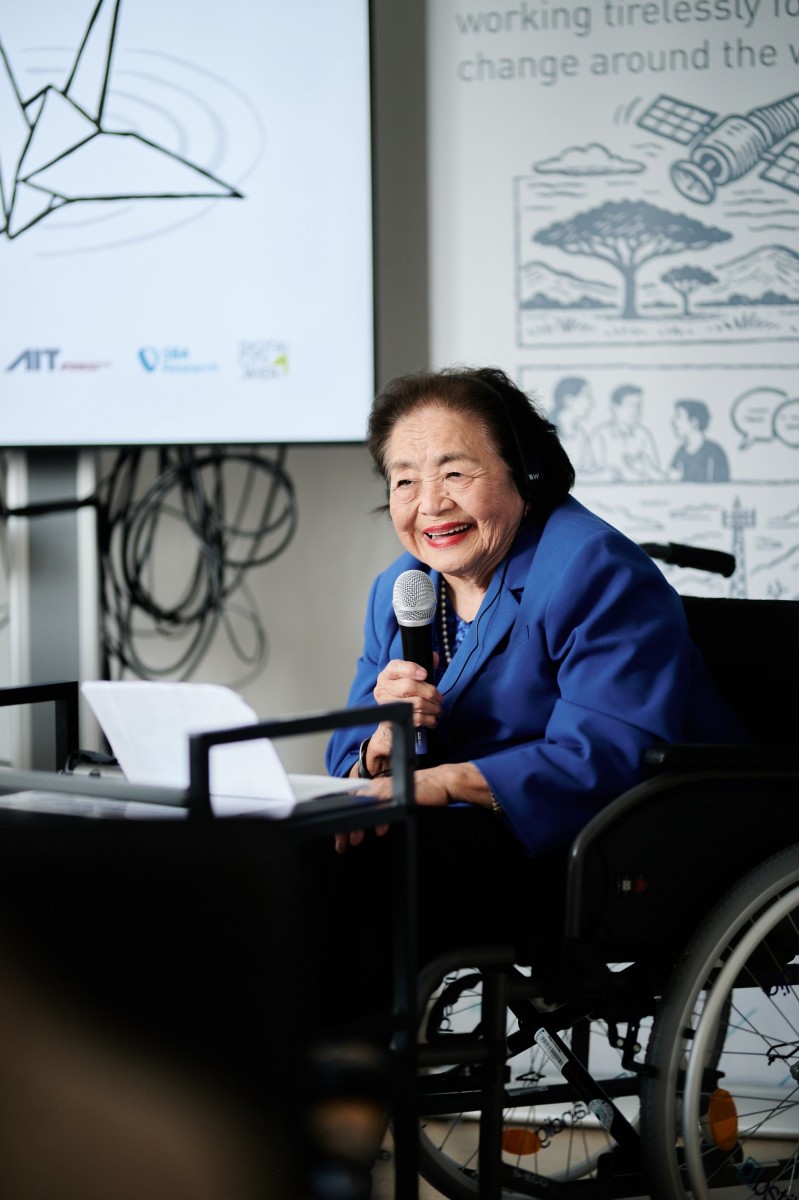 Setsuko Thurlow, a Hiroshima survivor and Nobel Peace Prize laureate, delivered a poignant speech reflecting on the atomic bombing of Hiroshima. / Picture: © Valerie Maltseva/Agenda Studio
It was a clash of extremes that took place in Vienna. On one side was Setsuko Thurlow—now in her twilight years—one of the last “hibakusha” (survivors of the atomic bombing of Hiroshima), who witnessed the apocalypse as a 13-year-old and has since dedicated her life to nuclear disarmament. On the other side, the next generation of Austrian software developers, researchers, and tech innovators.
Under the title “Hiroshima’s Message for Tech Students and Innovators Today,” the PeaceTech Alliance, together with the AIT Austrian Institute of Technology and SBA Research, hosted a cross-generational dialogue. The goal: to link technological progress with global responsibility.
A Passionate Appeal to the Future
At the heart of the event, moderated by human rights activist Heather Wokusch, was Thurlow’s personal and moving speech. Her message to the tech community—which, in the age of artificial intelligence and advancing digitalization, often operates in a purely data-driven manner—was disarmingly simple: “Remember your own humanity.”
Thurlow passionately argued that security should not be viewed as a system of “rule by fear.” Instead, she said, true peace is founded on cooperation, international law, justice, and the inviolable dignity of the human person. Her appearance was accompanied by the Austrian premiere of the documentary “The Vow from Hiroshima,” which impressively chronicles her decades-long commitment to the Treaty on the Prohibition of Nuclear Weapons.
PeaceTech: People as the Starting Point, Not the Tool
For the host organization, the PeaceTech Alliance, this visit is far more than a historic moment of remembrance. Launched by the AIT in 2025, the Alliance sees itself as a bridge-builder between diplomacy, civil society, and cutting-edge technology.
“PeaceTech is nothing without lived experience. If technology doesn’t reflect the peacemakers, it’s meaningless,” emphasized Nathan Coyle, head of the PeaceTech Initiative at the AIT and co-founder of the Alliance. The organization’s credo is therefore unambiguous: “People first, technology second.”
Michael Mürling of the AIT Center for Digital Safety & Security also believes the technology industry has a responsibility: “All too often, discussions about new technologies take place without sufficiently involving people and communities who have experienced conflict firsthand. Innovation must serve people.”
The Three Pillars of a Responsible Tech Future
The Alliance defines what such “peace-promoting technology” might look like in practice through three core principles:
- Grassroots Inclusion (Grassroots Engagement): Tools must not be developed solely in the Global North for the Global South. Local peacemakers must act as co-developers on an equal footing from the very beginning.
- Accessible Innovation: Technology must not be an elitist form of knowledge used to exert control. The focus is on open-source tools, decentralized systems, and multilingual resources that are resilient to local realities.
- Data Sovereignty & Ethical Infrastructure: Those affected must retain control over their own data. Austria’s leading role in initiatives such as Gaia-X provides a strong technological foundation for this, one based on digital self-determination.
A Message from Vienna to the World
Based in Vienna, the AIT draws on Austria’s traditional values of neutrality and multilateralism to drive global change. In light of growing geopolitical tensions and global conflicts, this event makes one thing very clear: The humanitarian consequences of crises cannot be captured by algorithms or data packages alone.
Surprisingly, the lasting takeaway from that evening had nothing at all to do with software or code. It was the realization that true peace comes from listening and protecting human dignity—a code that no computer in the world can ever replace.