




Council of Europe and the OSCE Call for a United Front Against Disinformation and for Security in Moldova
The Moldovan capital, Chișinău, has become a hub of European diplomacy. The 135th Ministerial Council of the Council of Europe and high-level meetings of the Organization for Security and Co-operation in Europe (OSCE) focused on Russia’s war of aggression, migration issues, and hybrid threats. While European states took concrete steps toward establishing a special tribunal against Russia, the OSCE simultaneously sought to promote stability in the deadlocked Transnistria conflict.
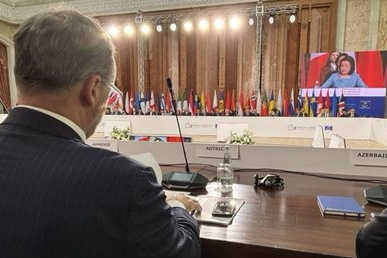 Accountability for the Russia-Ukraine war, combating disinformation, and European integration were the focus of the Council of Europe’s meeting of foreign ministers in Chișinău. / Picture: © BMEIA Bundesministerium für Europa, Integration und Äußeres
The Republic of Moldova concluded its six-month presidency of the Committee of Ministers of the Council of Europe with a high-level meeting of foreign ministers at the Palace of the Republic. The conference was opened by Moldovan President Maia Sandu and Council of Europe Secretary General Alain Berset. Over 50 delegations traveled to the event to find common European solutions amid geopolitically turbulent times. The Principality of Monaco subsequently assumed the chairmanship in accordance with the rotation.
Combating Disinformation and Strengthening Accountability
A central theme of the conference was the legal assessment of Russia’s war of aggression against Ukraine. Austrian State Secretary Sepp Schellhorn emphasized the importance of international oversight mechanisms during his remarks: “Violations of international law must not go unpunished,” Schellhorn stated, referring to the international register of damages for documenting war damage. Furthermore, support is growing for a special tribunal to address the conflict—Italy recently joined this group, bringing the total number of supporting states to 37. In addition to progress on supporting Kosovo’s accession to the Council of Europe, Austria called for a comprehensive framework agreement against foreign information manipulation and influence (FIMI) to make democracies more resilient to manipulative campaigns.
A political declaration on migration that was adopted was also a central focus of the negotiations. This declaration is intended to ensure a balanced approach that combines effective migration management with the uncompromising protection of fundamental human rights under the European Convention on Human Rights (ECHR), even though human rights organizations such as Amnesty International had warned in the run-up to the meeting that standards might be watered down.
OSCE Leaders Demonstrate Presence in the Transnistria Conflict
Parallel to the Council of Europe meeting, OSCE leaders sent a strong signal in support of regional stability in Moldova. The OSCE Chairperson-in-Office, Swiss Federal Councilor Ignazio Cassis, and OSCE Secretary General Feridun H. Sinirlioğlu undertook an intensive working visit to the country. In addition to talks in Chișinău with President Sandu and Prime Minister Alexandru Munteanu, the delegation traveled directly to the conflict region of Transnistria.
In Bender, Cassis and Sinirlioğlu met with Transnistrian leader Vadim Krasnoselsky and chief negotiator Vitaly Ignatiev. Given the enormous tensions in the region, OSCE leadership reaffirmed the need to keep channels of communication open. “In these uncertain times, inclusive dialogue remains our most stabilizing force,” emphasized Secretary General Sinirlioğlu. The OSCE continues to insist on a lasting and comprehensive peace settlement that preserves Moldova’s independence, sovereignty, and territorial integrity within its internationally recognized borders, while at the same time providing for a special status for the breakaway region of Transnistria.
Switzerland, which will hold the OSCE Chairmanship in 2026, pledged to continue actively facilitating dialogue between Chișinău and Tiraspol.
Closer cooperation in the spirit of multilateralism
The events in Chișinău underscore how closely Western Europe’s security interests are linked to stability along its eastern external borders. In an expanded high-level meeting held in the run-up to the ministerial conference, the Council of Europe and the OSCE agreed on closer coordination in combating hybrid threats and protecting minorities. Germany also dispatched Minister of State Gunter Krichbaum to Moldova, who emphasized the need to actively safeguard the country against Russia’s ongoing attempts at destabilization. Moldova, which has been an official EU candidate country since 2022, has demonstrated this week that, despite immense pressure, it can be a capable host for the European security architecture.