




Russian Ambassador to Vienna says Europe is “on the Brink of Disaster”
Attempts to revise the outcomes of World War II under the guise of so-called “contextualization” of monuments are "leading to a dangerous erosion of historical memory and threaten the European security architecture." The Ambassador Extraordinary and Plenipotentiary of the Russian Federation to the Republic of Austria, Andrei Grosov, made these clear remarks in an interview. Russian Ambassador in Vienna sees Europe “on the brink of disaster.”
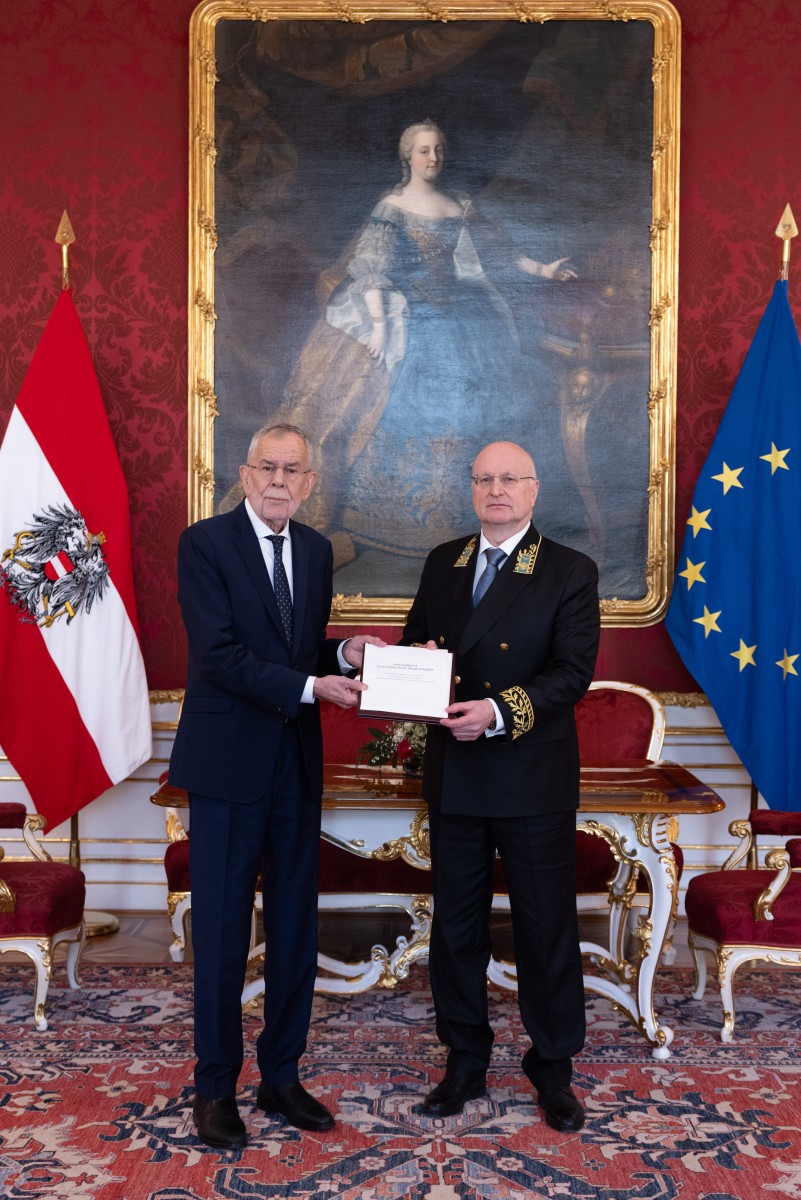 The main critique of HE A.Y. Grozov, the Russian ambassador to Austria, came after months of silence since he presented his credentials. / Picture: © www.bundespraesident.at / HBF
Andrei Grosow, the Ambassador of the Russian Federation to the Republic of Austria, gave a detailed interview to the RIA Novosti news agency. The head of the Russian diplomatic mission in Vienna pointed to a “worrying trend” toward the politicization of history in several European capitals. According to Grosow, the pseudoscientific rhetoric of “contextualizing” monuments to the Soviet liberators masks a deliberate effort to rewrite universally recognized historical facts. The goal, he said, is to downplay the Soviet Union’s decisive contribution to the defeat of Nazism and to cast doubt on the Red Army’s liberation mission.
“In fact, this amounts to a deliberate falsification of history and an attempt to erase from public memory the heroic deeds of millions of people who gave their lives for the liberation of Europe,” Grosow emphasized.
Particularly alarming, he said, is the fact that in some countries, the glorification of collaborators and the concealment of Nazi crimes are on the rise. The diplomat pointed out that such a course of action undermines the foundations of the postwar world order, which are enshrined in the judgments of the Nuremberg Tribunal. The combination of historical revisionism, the militarization of European economies, and involvement in current conflicts poses the risk of repeating past mistakes and bringing the world to the brink of catastrophe.
Protocol breach: No invitation for the official leadership in Vienna
The celebrations marking the 81st anniversary of Victory Day in May 2026 highlighted the changed realities in bilateral relations between Moscow and Vienna. The Russian side drew its conclusions: In light of the Austrian federal government’s course, which was deemed “unfriendly,” the embassy completely refrained this year from inviting representatives of the Austrian authorities to the official celebrations.
Nevertheless, the diplomatic mission emphasized that the Viennese authorities had cooperated in the run-up to the event and approved all commemorative events in a timely manner. In addition to Russian diplomats and representatives of the CIS states, numerous Russian-speaking compatriots as well as Austrian citizens took part in the commemorative events.
Concert and “Immortal Regiment” on Schwarzenbergplatz
The main commemorative events were held, as is traditional, at Vienna’s Central Cemetery and at the Red Army Monument on Schwarzenbergplatz, where wreaths and flowers were laid. A central part of the celebrations was the “Immortal Regiment” march, organized by the diaspora, which took place this year not only in Vienna but also in cities such as Graz and Salzburg.
The highlight of the ceremony at Schwarzenbergplatz was a concert by leading soloists of the “N. N. Nekrasov” Academic Orchestra of Russian Folk Instruments—Andrei Stepanenko, Konstantin Zakharto, and Alexander Shmoilov. The orchestra’s guest performance—notably founded in the pivotal year of 1945—was supported by the Russian Ministry of Digital Development and the “Orpheus” Broadcasting Center.
According to Grosow, preserving these traditions and safeguarding historical truth—especially today, when “Nazism is rearing its head again in Europe”—is a sacred duty to the generation of victors and a vital element for the cohesion of the Russian-speaking community abroad.
Shifting to the Austrian viewpoint, diplomatic provocation was emphasized over historical commemoration
In Vienna, the harsh rhetoric coming from the Russian Embassy has been met with strong rejection and is viewed by political observers as a calculated propaganda strategy. Grosow’s refusal to invite representatives of the Austrian federal government to the commemorative ceremonies marks a new low in bilateral relations. The Austrian Ministry of Foreign Affairs (BMEIA) has repeatedly stated in the past that official participation in Russian state ceremonies is inconceivable anyway, given Russia’s ongoing aggressive course in Europe. Grosov’s refusal to invite them is therefore merely an attempt to preempt a diplomatic isolation that would occur anyway.
In particular, the ambassador’s claim that “National Socialism is rearing its head again” in Europe is rejected by Austrian historians and politicians as a dangerous reversal of perpetrator and victim roles and an abuse of anti-fascism. Austria fully and respectfully fulfills its obligations under international law stemming from the 1955 State Treaty, particularly regarding the protection and preservation of Soviet war graves and memorials such as those at the Central Cemetery and Schwarzenbergplatz.
In summary, the differing approaches to historical memory and commemoration reflect the deepening divide between Moscow and Vienna. While the Russian side views recent developments as an affront to the legacy of the Soviet liberation, Austrian authorities stress their commitment to preserving historical sites and democratic values. As both sides continue to interpret history through their respective lenses, the dialogue around commemoration remains charged, signaling the ongoing challenges in Austrian-Russian relations.