




Canaletto and Bellotto Go on a Journey Back in Time to the 18th Century at the Museum of Art History in Vienna
From Venice to London to Vienna: The Kunsthistorisches Museum or Museum of Art History (KHM) is dedicating a comprehensive exhibition to the giants of veduta painting. It is an exhibition that balances scholarly precision, artistic freedom, and political sensitivity.
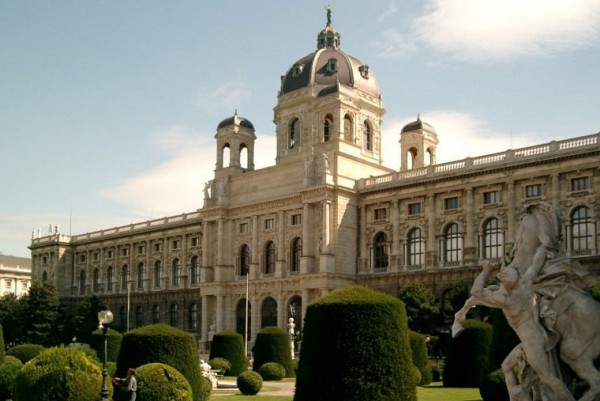 They are the renowned 18th-century cityscape artists, Canaletto and his nephew Bellotto, featured in a major exhibition at the Kunsthistorisches Museum. / Picture: © Wikimedia Commons / GNU Free Documentation License. [GFDL (https://commons.wikimedia.org/wiki/Commons:GNU_Free_Documentation_License,_version_1.2)]
When you look out over the rooftops of Vienna from the Upper Belvedere today, you see not just a city, but a protected World Heritage Site. We owe the fact that this view is now almost sacrosanct to a man who, over 260 years ago, captured the essence of the imperial city with his brush and camera obscura: Bernardo Bellotto, known as Canaletto. Starting March 24, 2026, the Kunsthistorisches Museum Vienna will spotlight this master and his equally famous uncle, Giovanni Antonio Canal vulgo Canaletto, in a spectacular special exhibition.
A Name as a Trademark
The story of these two artists is also a story of clever marketing. Giovanni Antonio Canal (1697–1768) rose to become the undisputed star of the “vedute”—the detailed cityscapes—in Venice. His works were the most sought-after souvenirs among British aristocrats on their “Grand Tour.” Anyone of note brought a piece of Venice by Canaletto home with them.
His nephew Bernardo Bellotto (1722–1780) trained in his uncle’s studio and adopted not only his technique but also his artist’s name. “Canaletto” became a seal of quality. “Anyone who owned a Canaletto had made it into the upper class,” explains curator Mateusz Mayer. But while the uncle remained faithful to the light of Venice and later London, the nephew was drawn to the centers of Central Europe: Dresden, Vienna, and Warsaw.
More than a photograph: “Fantastic Realism”
The exhibition at the KHM, which features 32 masterpieces, dispels a common misconception: the images are not mere documentations. While both artists used the camera obscura—an optical device that projected reality onto a screen—the result was always a “carefully composed visual creation.”
“They do not depict the cities as they were, but as they wanted to show them,” emphasizes KHM Director General Jonathan Fine. This artistic freedom—the alteration of viewing angles or the idealization of lighting conditions—gave the works a dramatic impact that continues to captivate audiences to this day.
Bellotto in Vienna: 13 Masterpieces for Eternity
Although Bellotto spent only two years (1759–1760) in Vienna, this period was formative for the city’s history. Commissioned by Maria Theresa, he created 13 large-format views that today form the core of the Habsburg Collection. The exhibition features, among other things, the Liechtenstein Palace with its gardens—which have since been demolished—and Schönbrunn Palace, which at the time was still an isolated country estate surrounded by lush greenery.
In particular, the work “Vienna Seen from the Belvedere” is once again at the center of public debate. The “Canaletto view” is the main argument used by preservationists against the controversial high-rise project at Heumarkt. Bellotto’s brushstroke from 1759 thus continues to shape 21st-century urban planning to this day.
A Europe of Mobility and War
The artists’ flight from Venice was not solely of an economic nature. Wars in Europe cut off the travel routes of wealthy patrons, driving Canaletto to London and Bellotto to Dresden. The fact that Bellotto’s works were so precise took on tragic relevance in the 20th century. After the near-total destruction of Warsaw in World War II, his vedute served as the primary model for the faithful reconstruction of the historic Old Town.
Service & Information
The exhibition “Canaletto & Bellotto” invites visitors to immerse themselves in a Europe full of splendor, but also full of upheaval. It is a journey into the urban landscape of the 18th century that demonstrates how deeply images shape our conception of home and history.
Exhibition Details
| Dates: | March 24 – September 6, 2026 |
| Location: | Kunsthistorisches Museum Vienna, Maria-Theresien-Platz |
| Admission: | From €22.00 |
| Highlights: | International loans shown for the first time in Austria and the complete series of Bellotto's Viennese views. |