




Vienna's Stadthalle in a Frenzy: Eurovision Song Contest Grand Final in a Mix of Pop Spectacle and Political divides
The stage is set for the continent’s biggest music spectacle: On Saturday evening (May 16, 9:00 p.m.), the final of the 70th Eurovision Song Contest (ESC) will take place at the Wiener Stadthalle. After two emotional semifinals, the running order for the 25 remaining countries has been set. But while the host country, Austria, celebrates this festival of diversity, intense political tensions and unprecedented security measures are casting a shadow over the anniversary event.
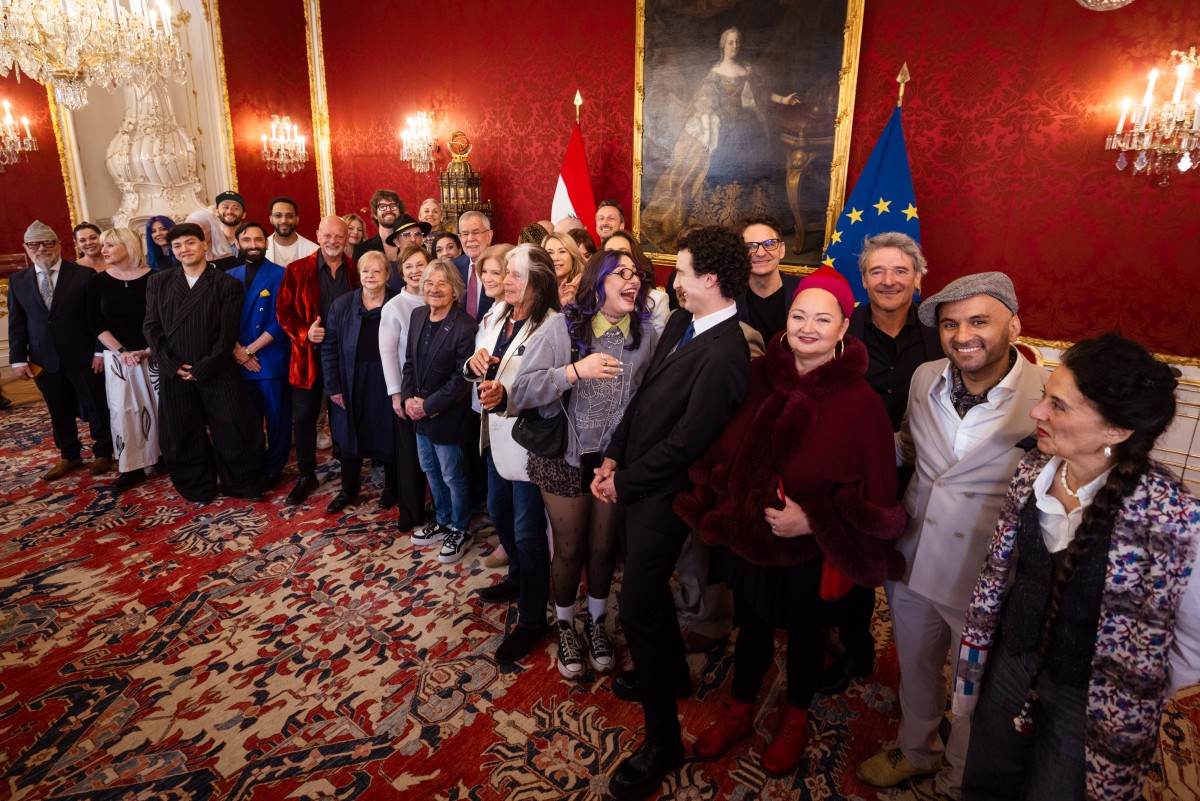 From Marianne Mendt to JJ – Alexander Van der Bellen meets Austria’s Eurovision artists at the Hofburg. / Picture: © Österreichische Präsidentschaftskanzlei/Peter Lechner/HBF
In the early hours of the morning following the second semifinal, ORF announced the official running order. This year, Denmark has the honor of opening the show with Søren Torpegaard Lund. Germany is sending Sarah Engels into the competition as the second artist with her song “Fire”—according to bookmakers, she is currently ranked in the bottom third.
Things get exciting at the back of the field: the Scandinavian favorites Sweden (Felicia with “My System,” starting position 20) and Finland (Linda Lampenius x Pete Parkkonen with “Liekinheitin,” starting position 17) are making a late bid for the crown. The emotional finale of the evening will be provided by the Burgenland newcomer COSMÓ, who is competing for the host country Austria with start number 25 and the song “Tanzschein.” He won the ORF preliminary round with around 10,000 votes.
| Pos. | Country | Artist | Song |
|---|---|---|---|
| 01 | Denmark | Søren Torpegaard Lund | Før Vi Går Hjem |
| 02 | Germany | Sarah Engels | Fire |
| 03 | Israel | Noam Bettan | Michelle |
| 04 | Belgium | ESSYLA | Dancing on the Ice |
| 05 | Albania | Alis | Nân |
| 06 | Greece | Akylas | Ferto |
| 07 | Ukraine | LELÉKA | Ridnym |
| 08 | Australia | Delta Goodrem | Eclipse |
| 09 | Serbia | LAVINA | Kraj Mene |
| 10 | Malta | AIDAN | Bella |
| 11 | Czechia | Daniel Zizka | CROSSROADS |
| 12 | Bulgaria | DARA | Bangaranga |
| 13 | Croatia | LELEK | Andromeda |
| 14 | United Kingdom | LOOK MUM NO COMPUTER | Eins, Zwei, Drei |
| 15 | France | Monroe | Regarde ! |
| 16 | Moldova | Satoshi | Viva, Moldova! |
| 17 | Finland | Linda Lampenius x Pete Parkkonen | Liekinheitin |
| 18 | Poland | ALICJA | Pray |
| 19 | Lithuania | Lion Ceccah | Sólo Quiero Más |
| 20 | Sweden | FELICIA | My System |
| 21 | Cyprus | Antigoni | JALLA |
| 22 | Italy | Sal Da Vinci | Per Sempre Sì |
| 23 | Norway | JONAS LOVV | YA YA YA |
| 24 | Romania | Alexandra Căpitănescu | Choke Me |
| 25 | Austria | COSMÓ | Tanzschein |
President Welcomes ESC Family to the Hofburg
The ESC week took on a touch of state dignity with a ceremonial reception at Vienna’s Hofburg. President Alexander Van der Bellen met with Austrian ESC legends ranging from Marianne Mendt to last year’s winner JJ, as well as this year’s entrant COSMÓ.
In a moving speech, the head of state emphasized the competition’s role in bringing people together: “The Eurovision Song Contest shows just how diverse our continent is. It shows what we’re capable of—and who we are. And that’s a lot!” said Van der Bellen. Referring to current geopolitical tensions, he added: “These differences are no reason to be afraid. No, they make us richer and stronger!” The President symbolically awarded all artists the highest score: “From me, you all get: Douze points!”
Ring aus Stahl: Between Party Atmosphere and Protests
But this year’s motto, “United by Music,” is crumbling in the face of reality outside the arena. Israel’s participation—which was successfully voted into the final in the first semifinal by Noam Bettan (“Michelle”)—is causing massive controversy. In the run-up to the 2026 ESC, five countries—Iceland, Ireland, the Netherlands, Slovenia, and Spain—had already completely withdrawn their participation in protest against Israel’s actions in the Gaza conflict. In Vienna, this has divided the city.
Security measures at the Stadthalle are extremely tight. Entry checks using scanners and a strict ban on bags are in place to ensure the safety of the 10,000 fans. The Vienna police have deployed a large contingent, partly in light of the foiled terrorist plot targeting a Taylor Swift concert in Vienna in 2024. During the first semifinal, four people were ejected from the venue for disruptive behavior while Bettan was performing.
Pro-Palestinian groups are, however, gathering in the streets, as reported by "Mein Bezirk". Under the slogan “No Stage for Genocide!”, a rally will take place on Friday (May 15) at Maria-Theresien-Platz, supported by Pink Floyd musician Roger Waters, among others. A large demonstration has been announced for the final on Saturday, starting at Christian-Broda-Platz and marching directly toward the Stadthalle.
A Coffeehouse as a Political Refuge
An incident from Vienna’s cultural scene, as reported by “The Times of Israel,” illustrates just how deep the rifts run: Israeli fans were initially excluded from the official list of “Eurofan Cafés.” In response, the “MQ Kantine” in the Museumsquartier stepped in and promptly declared itself an Israeli fan café. Now Israeli flags hang there, falafel and kosher wine are served—all under the watchful eye of armed police. “It’s sad that a police officer has to stand at the door to show that things aren’t quite normal,” notes PR consultant Daniel Kapp on site, though he praises the solidarity of the Viennese public.
The situation is also taking its toll on international fans. Longtime ESC attendees report that the wounds in the fan community run deep. Nevertheless, for many, the hope prevails that on Saturday night, at least for a few hours, the music and diversity will take center stage.
Furthermore, the Eurovision Song Contest, now in its 70th edition, looks back on a history marked by records and scandals.
The eternal battle at the top
With the final in Vienna, the historic battle for the title of the most successful Eurovision nation is back in the spotlight. Sweden and Ireland lead the all-time rankings with seven wins each. While Sweden is once again among the favorites this year with Felicia, Ireland is not in the running to reclaim sole leadership following its politically motivated boycott in 2026.
The “Big Five” and the financial advantage
The fact that Germany, France, Italy, and the United Kingdom always secure a spot in the final despite often mediocre placements (Germany and Norway historically share the most last-place finishes) is due to the rules of the European Broadcasting Union (EBU). As the association’s largest financial backers, these five nations have a guaranteed spot. Together with the respective host country—this year, Austria—they do not have to face the nail-biting suspense of the semifinal shows.
Controversy surrounding Romania’s entry
The Romanian entry “Choke Me” by Alexandra Căpitănescu also caused a media stir in the run-up to the contest. The provocative title drew the ire of youth protection advocates and critics, who denounced it for trivializing dangerous sexual practices. However, the Romanian broadcaster TVR firmly rejected these claims and emphasized that the lyrics should be understood purely metaphorically.
Whether it’s metaphors, pop anthems, or political statements, on Saturday night, the judges and millions of viewers around the world will decide who gets to take home the coveted glass trophy from Vienna.