




The Vienna City Temple is Gearing Up for its 200th Anniversary
It is a race against time, driven by a deep sense of historical responsibility and cutting-edge architecture. On Seitenstettengasse, hidden behind the unassuming facade of a residential building, one of Austria’s most significant restoration projects is currently underway: the comprehensive renovation of the Vienna City Temple.
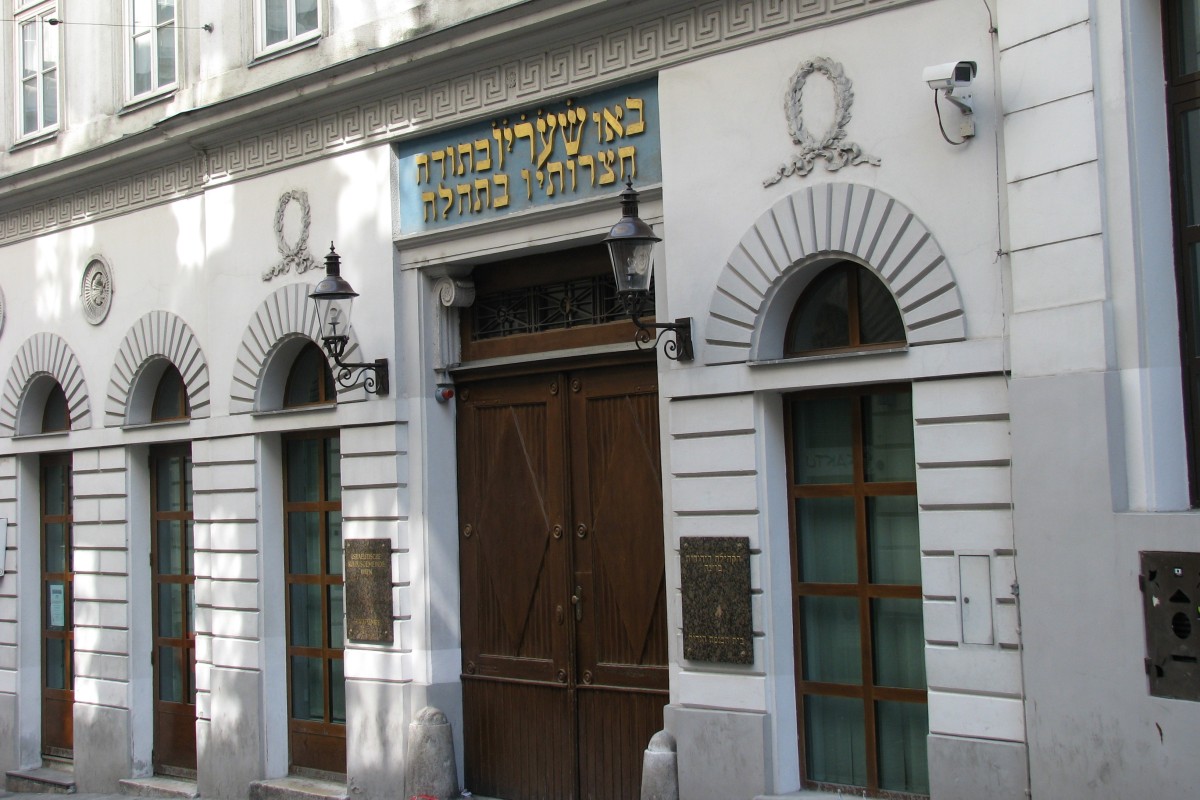 The City Temple is the spiritual center of Vienna's Jewish community and the largest synagogue in Austria. / Picture: © Wikimedia Commons; Bella47, CC BY-SA 3.0 (https://creativecommons.org/licenses/by-sa/3.0/deed.en)
Built in 1826 by Josef Kornhäusl, the building is not only the spiritual center of the Jewish Community of Vienna (IKG) but also a silent witness to the city’s darkest hours. As Vienna’s only major synagogue, it survived the November pogroms of 1938, solely because burning it down would have destroyed the entire neighborhood due to the dense residential buildings adjacent to it. Today, just under two years before its 200th anniversary in 2026, the synagogue is undergoing a major renovation intended to make it “ready for the future.”
Construction Site Report: Between Dust and History
Since the official start of construction on October 20, 2025, there has been a flurry of activity inside the temple. A monumental scaffolding fills almost the entire interior up to the famous dome. The impact of this work is already evident: during the initial demolition, historical treasures were uncovered. The original stone pedestals and the historic stone flooring, hidden for decades under later layers, came to light.
Building on these discoveries, the project’s progress is on track according to the current status as of December 2025. “Costs are currently within the estimated budget,” according to the construction management. At present, the technicians are focusing on the “lantern”—the light outlet at the top of the dome—to invisibly integrate modern technology there.
A Master Plan for Acoustics and Accessibility
The architectural firm KENH, represented by Natalie Neubauer and Eric-Emanuel Tschaikner, is responsible for the ambitious design. The goal is a balancing act: the “historic character” is to be preserved, while the building is brought up to 21st-century technical standards.
The most important innovations—a new heating and cooling system as well as optimized room acoustics—are intended to make the space more pleasant. Accessibility was also a central concern for the IKG to ensure access for all community members. A new interior design was also incorporated, featuring new, ergonomic pews with integrated reading lamps. The dome’s characteristic blue color will be preserved but will be highlighted anew through a sophisticated lighting concept.
Financing: A Joint Effort by the State and Society
The total cost for the first phase—the complete renovation of the temple—amounts to approximately 10.5 million euros. The financing model is a prime example of successful cooperation: one-third each is covered by the City of Vienna and the Austrian federal government. The remaining third must be raised by the congregation itself through donations and fundraising.
Mayor Michael Ludwig already emphasized the project’s significance for the city’s history during a visit in January 2025. To bridge the funding gap, a special initiative was launched: Donors contributing 2,500 euros or more can have a star dedicated on the temple dome.
Art for a Good Cause: Gottfried Helnwein Contributes
A special highlight of the renovation phase is the collaboration with world-renowned artist Gottfried Helnwein. He is currently painting a portrait of one of ten children from the community selected for a large-scale painting. This work will be displayed on original wooden panels from the Stadttempel and auctioned off in 2026 to benefit the restoration.
Community life continues
Despite the heavy machinery, Jewish life on Seitenstettengasse continues unabated. Services have been moved to the adjacent community center. The popular restaurant Alef Alef has also adapted its operations to continue offering Shabbat meals and celebrations on a smaller scale. Visitors and suppliers are currently being directed to the alternative entrance at Rabensteig 3.
When the scaffolding comes down, the Stadttempel will not only shine in new splendor but will enter its third century as a modernized symbol of the enduring strength and vitality of Jewish Vienna.