




Silk Road Meets Vienna: Turkic Week Provides Impulse for Global Networking
The Austrian capital becomes a center for Turkic-speaking diplomacy and culture. Under the patronage of the Organization of Turkic States (OTS) and the permanent missions of its member states to the United Nations (UN), “Turkic Week” was officially opened. The program combines centuries-old heritage with forward-looking infrastructure projects such as the “Middle Corridor.”
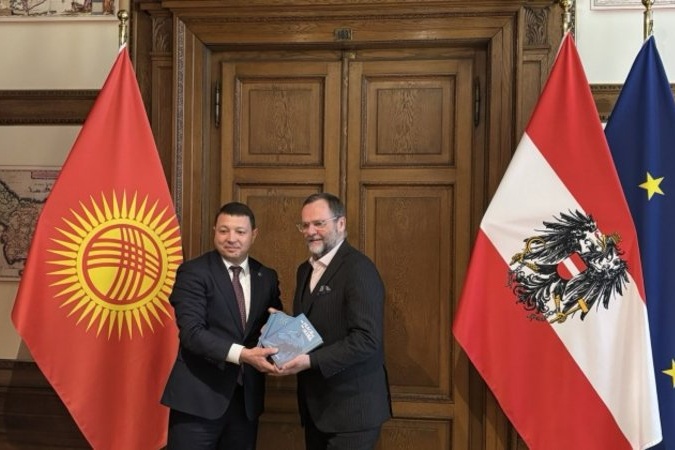 On the occasion of Turkic Week, Kyrgyz Minister of Culture Mambetaliev (left) also visited State Secretary Schellhorn (right) in Vienna. / Picture: © BMEIA/Auer-Grumbach
The celebrations began on January 12 in the rotunda of the Vienna International Center, the headquarters of the United Nations in Vienna. A photo exhibition entitled “The Turkish World on the Silk Road” was opened, showcasing not only the scenic beauty of the regions from Istanbul to Samarkand, but above all underscoring the historical depth and shared identity of the Turkish-speaking peoples. The exhibition was organized by the Permanent Mission of Azerbaijan in cooperation with the Turk Academy. In his opening speech, Samir Sharifov, Deputy Minister of Foreign Affairs of Azerbaijan, emphasized that the Organization of Turkic States is today a modern and forward-looking alliance with strong historical roots.
During the ceremony, OTS Secretary General Kubanychbek Omuraliev underscored the importance of cultural diplomacy. He emphasized that communicating shared history is an essential pillar for promoting mutual understanding and lasting peace in a multilateral world. The presence of numerous ambassadors and heads of international organizations made it clear that the Turkish world is now perceived as an integral and indispensable part of the global community. In addition to the diplomatic speeches, guests were able to experience traditional delicacies and handicrafts from the member countries in specially erected pavilions, filling the international character of the venue with lively tradition.
The Middle Corridor as a strategic lifeline
A key focus of the week was on economic networking, culminating in a high-level roundtable discussion at Hofburg Palace on January 13. Under the title “From the Silk Road to the Middle Corridor,” experts and government representatives discussed the strategic importance of the Trans-Caspian transport route. This route, which connects China with Europe via Central Asia and the Caucasus, is becoming increasingly important as a stable alternative to northern trade routes. In this context, Kubanychbek Omuraliev explained that the Middle Corridor is not only a logistical necessity but also a symbol of Eurasia's new connectivity.
The discussions were enriched by contributions from representatives of the World Bank and the International Road Transport Union (IRU), who pointed out the need for digitized customs procedures and improved border crossings. It became clear that the member states of the OTS are investing heavily in their infrastructure to increase the efficiency of trade flows. This modern continuation of the ancient Silk Road is intended not only to accelerate the movement of goods but also to strengthen the economic resilience of the entire region. The exchange at the Hofburg, moderated by representatives of the OSCE, made it clear that security and economic prosperity in this region are inextricably linked to a functioning infrastructure.
Multilateral partnerships and technological cooperation
In parallel with the public events, the OTS delegation used the Vienna platform for intensive bilateral talks with the international organizations based here. Particular attention was paid to the meeting with Rafael Mariano Grossi, Director General of the International Atomic Energy Agency (IAEA). The focus was on nuclear safety and the peaceful use of nuclear energy, as several OTS states are looking to modernize their energy programs. Cooperation with the United Nations Industrial Development Organization (UNIDO) was also deepened, with a focus on supporting small and medium-sized enterprises and promoting sustainable industrial standards in the Turkish world.
In addition, the delegation sought talks with the United Nations Office for Outer Space Affairs (UNOOSA). In view of the growing interest of Turkish states in satellite technologies and space-based research, opportunities for cooperation in the field of capacity building and the use of space data for sustainable development were discussed. These talks underscore the OTS's aspiration to act not only as a cultural bloc but also as a technologically advanced partner that actively contributes to solving global challenges.
A century of science and the power of the diaspora
Another important chapter of Turkic Week was devoted to scientific heritage and the integration of communities living in Europe. In his remarks, Samir Sharifov recalled the first Turkology Congress, which took place exactly 100 years ago in Baku and laid the foundation for modern research into Turkic languages. In this anniversary year, Baku will once again host the second major congress to take linguistic and cultural research to a new level. This historical awareness serves as a bridge for the Diaspora Capacity Building Training Program, which is also part of Turkic Week in Vienna.
This program aims to strengthen the coordination and institutional capacities of Turkish diaspora organizations in Europe. Targeted training courses are designed to help people preserve their cultural identity while actively contributing to their European host societies. The focus is on promoting interpersonal exchange and strengthening civil society engagement. The emotional highlight and festive conclusion of the week is a gala concert in Vienna, where renowned artists present the musical diversity of the Turkish world, using the universal language of music to connect people of different origins.
A conclusion for the future
Turkic Week in Vienna clearly demonstrated that the Organization of Turkic States is a dynamic force shaping both tradition and modernity, and integrating East and West. By combining cultural cooperation, economic development, and high-level diplomacy, the OTS clearly articulated its Vision 2040 and role in international affairs. Vienna served as a powerful symbol of how the region’s growing strategic significance will shape global connectivity and stability in the 21st century.