




Russian Ambassador Denies Blame Following Attack on Austrian Embassy in Kyiv
Diplomatic relations between Austria and Russia have reached a new low following a Russian air strike on the Ukrainian capital, Kyiv. After the Austrian embassy in the center of Kyiv was damaged by the impact of a Russian projectile on the afternoon of Thursday, November 19, 2026, Austria’s top leadership responded with sharp condemnation and summoned the Russian ambassador. The ambassador brusquely rejected any responsibility on the part of Moscow—and issued an overt warning to Vienna.
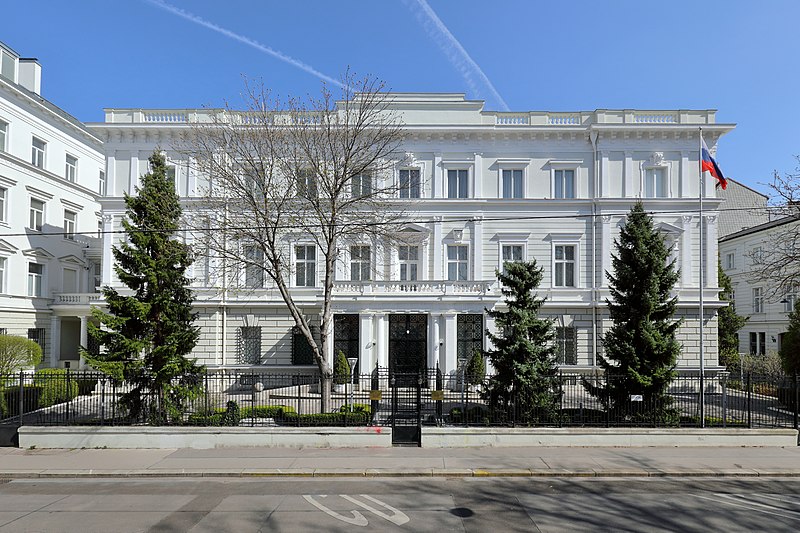 Following the attack on Austria’s embassy in Kyiv, Russia is toughening its tone. / Picture: © Wikimedia Commons / C.Stadler/Bwag / CC BY-SA 4.0 (https://creativecommons.org/licenses/by-sa/4.0)
At approximately 4:30 p.m. local time on Thursday, a Russian projectile struck directly in front of the Austrian diplomatic mission in the center of Kyiv. According to an account given by Deputy Head of Mission Daniel Röthlin to the Austrian broadcaster ORF (on the "Ö1-Morgenjournal" program) and reported by KOSMO, staff members immediately sought shelter following the loud explosion. Fortunately, no one was injured; according to Beate Meinl-Reisinger (NEOS), the presence of shatter-resistant film already installed on the windows played a key role in preventing a worse outcome. Nevertheless, significant property damage occurred: several windowpanes shattered, a glass door leading to a meeting room was smashed, and three official vehicles were damaged. This marks the second such incident, which also affected other diplomatic missions—including the Dutch embassy.
Strong reactions from Austria’s top leadership
In Vienna, the incident immediately sparked outrage, as reported by Vindobona.org. Federal Chancellor Christian Stocker (ÖVP) stated that he was "shocked" by the attack, emphasizing that diplomatic missions are inviolable and must be protected at all times. In a video message on Friday, Federal President Alexander Van der Bellen also used firm language: "Putin’s regime is deliberately putting the lives of civilians at risk and does not even spare diplomatic facilities."
Beate Meinl-Reisinger described the attack as "unacceptable" and announced additional protective measures for embassy staff on the ground—though there are currently no plans to relocate the mission to western Ukraine (for instance, to Lviv). "Russia continues to escalate this war, striking an increasing number of civilian targets. It is therefore all the more important to maintain pressure—using all available diplomatic means as well as sanctions," the minister emphasized. As a direct diplomatic consequence, she summoned the Russian ambassador to Austria, Andrei Grosov, to the Foreign Ministry at Minoritenplatz on Friday, November 20.
Moscow turns the tables
Rather than backing down, the Russian side went on the offensive following the summons. In comments made to the Russian state news agency RIA Novosti, as well as in statements issued by the Russian Embassy in Vienna, Grosov dismissed the accusations leveled by the Austrian leadership as "unjustified."
The ambassador claimed that civilian infrastructure "has never been a target for the Russian armed forces," asserting that they strike only military or strategically significant objectives. At the same time, Grosov held Austria itself responsible for any danger faced by its diplomats. He noted that Russia had repeatedly warned foreign nationals and diplomatic missions, advising them to leave Kyiv and refrain from traveling to Ukraine. "Our statements are being pointedly ignored. Full responsibility for any potential negative consequences lies entirely with the Austrian side," the diplomat declared.
Legal context and international reactions
Foreign Minister Meinl-Reisinger firmly rejected this line of reasoning. She emphasized that prior Russian evacuation advisories in no way absolve Moscow of its obligations under international law. Under the Vienna Convention on Diplomatic Relations, embassies are entitled to special protection; attacks that endanger civilian facilities and diplomatic missions are violations of international law, and full responsibility rests solely with the Russian aggressor.
The incident also triggered consequences at the European and international levels. EU High Representative Kaja Kallas announced that the Russian representative in Brussels would likewise be summoned. French Foreign Minister Jean-Noël Barrot described the killing of civilians and the damage to the Austrian and Dutch embassies as "crimes" and requested an emergency meeting of the UN Security Council.