




Record-High Rail Service Offerings and the ÖBB's Dwindling Dominance
While passenger service is setting new records with 138.9 million train-kilometers, ÖBB’s market share in freight service is plummeting. International construction projects are affecting reliability, while other countries are causing delays that spill over into Austria.
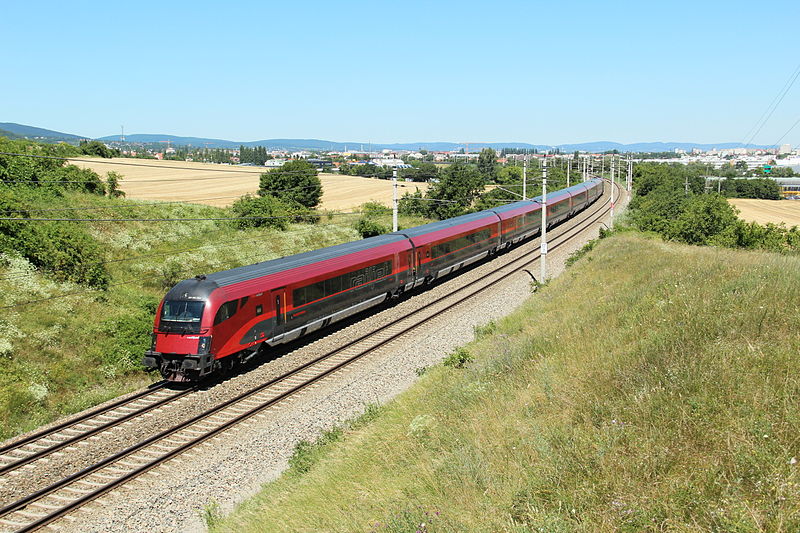 Despite posting a loss, the Austrian Federal Railways (ÖBB) remained the market leader on the domestic rail network with an 84.1 percent share. / Picture: © Wikimedia Commons / NÖLB Mh / CC BY-SA 3.0 (https://creativecommons.org/licenses/by-sa/3.0)
The latest 2025 annual report from the state regulatory authority Schienen-Control paints a fascinating picture of the Austrian rail network, one that is also marked by major challenges. On the one hand, passenger train service is booming like never before. On the other hand, pressure is mounting in freight transport, and the historically dominant ÖBB Group is rapidly losing market share to private competitors.
Record Service Despite Minimal Decline in Passenger Numbers
With a record performance of 138.9 million passenger-train-kilometers, an unprecedented level of service was achieved in 2025. Nevertheless, the absolute number of passengers declined minimally by 0.3% compared to the previous year, to 347.5 million. The main cause of this is considered to be the two-month total closure of the heavily used Vienna S-Bahn main line during the summer.
Long-distance rail service remained unaffected by this trend and recorded a solid 1 percent increase in passenger numbers. As a result, the total number of passenger-kilometers traveled climbed by 0.7% to a new record high of 15.1 billion. A major milestone and growth driver for the network was the full opening of the Koralm line between Graz and Klagenfurt in December 2025, which expanded the domestic network by 17 kilometers to a total of 5,638 kilometers.
Private Railways Gain Ground
The dominance of the national railways is visibly crumbling. Although ÖBB remains the undisputed market leader in passenger transport with a market share of 84.1%, private competitors (such as WESTbahn) were able to increase their share of passengers carried to 15.9%.
This shift is even more pronounced in the freight segment. The market share of the ÖBB subsidiary Rail Cargo Austria fell to just 52% in terms of net ton-kilometers in 2025 (and dropped to as low as 36.5% in the block train segment, where competitors already control 63.5%). On the main transit routes—the Brenner and the Western Axis—alternative providers already dominate the market, each with a market share of over 60%. “Competition on the railways is working, but it urgently needs free capacity and better predictability,” says Maria-Theresia Röhsler, managing director of Schienen-Control GmbH.
Frustration with Construction Sites and Delays from Abroad
Punctuality remains a major problem. Although the delay rate is moderate by international standards, about half of all delays in Austria are attributable to incidents abroad—particularly to inadequate operational management in Hungary and the Czech Republic.
Extensive construction work on the Deutsche Bahn network, as well as the closure of the Tauern Railway, forced freight rail operators to take extensive detours. While this increased the number of rail kilometers traveled by just under 5% in mathematical terms, it drastically raised transportation costs and intensified the pressure to shift back to road transport. The new EU Capacity Regulation offers hope in this regard, as it is intended to significantly improve cross-border coordination of construction projects.
Nevertheless, Austria’s rail system continues to attract market participants: By the end of 2025, a total of 98 rail companies will be registered (an increase of 11 companies), 74 of which will be authorized to actively operate on the ÖBB network.