




OSCE Ministerial Council in Vienna: Between Principles, Pressure for Reform, and the War in Ukraine
The Organization for Security and Co-operation in Europe (OSCE) has concluded its 32nd Ministerial Council meeting in Vienna. The meeting, attended by over 1,200 participants from member states, partners, international organizations, and civil society, was dominated by Russia's ongoing aggression against Ukraine and the urgent need for internal reforms.
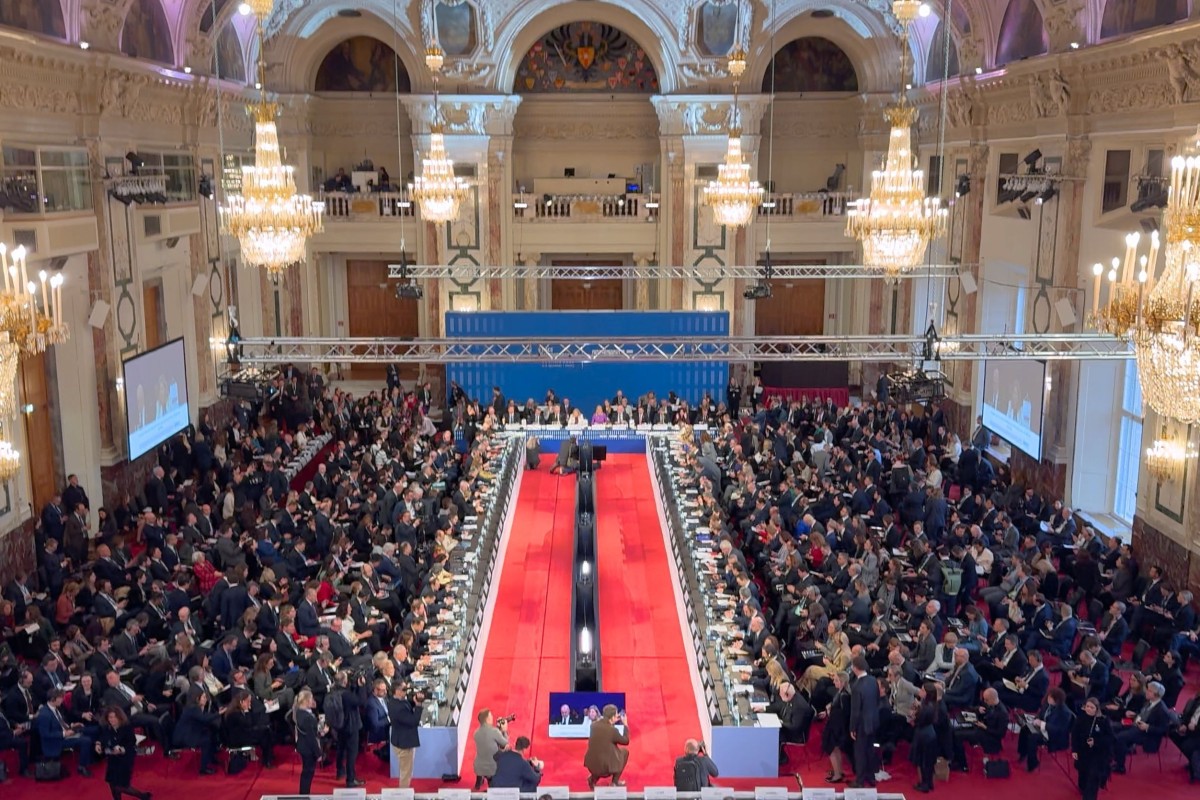 The focus was on reaffirming the founding principles, calling for far-reaching reforms, and wrestling with the role of the OSCE in a divided Europe. / Picture: © OSCE / ID 660945, (CC BY-ND 4.0)
Despite the unprecedented tensions, the Ministerial Council reaffirmed the continued validity of the principles of the Helsinki Final Act (1975). Finnish Foreign Minister and OSCE Chair Elina Valtonen made it clear: “Russia's war of aggression against Ukraine has undermined the core pillars of security throughout the OSCE region and hampered the work of the organisation.” Nevertheless, these principles must continue to form the foundation of European security. The “Helsinki+50” discussions held throughout the year paved the way for ambitious reforms designed to strengthen the organisation. To financially underpin these reforms, the “Helsinki+50 Fund” was established, which has already received pledges of over €17 million from 18 countries. Secretary General Feridun H. Sinirlioğlu emphasised that the OSCE, with its inclusive membership and risk reduction tools, is the only forum that can restore trust in Europe.
Squaring the circle: dialogue amid the blockade
Austrian Foreign Minister Meinl-Reisinger emphasised the OSCE's central importance as “the cornerstone of our European security order.” She underscored the need for dialogue, precisely because the organisation is not a “club of like-minded people.” This value is also appreciated by the designated OSCE Chairperson for 2026, Swiss Federal Councillor Ignazio Cassis, who takes office with the conviction that “when diplomacy seems impossible, it becomes indispensable.” The OSCE's ability to bring all actors in the European security landscape to the table is undisputed. Nevertheless, the organisation has been hit hard by the ongoing budget blockade, as the regular budget has not been adopted since 2021. The ministers and the Secretary General committed to continuing work on a consensus on a unified budget.
The war in Ukraine dominated the debates and highlighted the deep divisions. Ukrainian Foreign Minister Andrii Sybiha thanked the U.S. for its mediation efforts, but warned urgently against a false peace: Ukraine wants “real peace, not appeasement,” he said, calling on the U.S. not to repeat the mistakes of the past, in reference to the 1938 Munich Agreement. Every opportunity will be taken to end the war. Meanwhile, the OSCE is preparing for its role after the end of hostilities; many states believe it will play an important role in monitoring a possible ceasefire and rebuilding Ukraine.
In contrast, Russian Deputy Foreign Minister A.V. Grushko used his speech to launch a sharp attack on the West. He denounced the “total Ukrainization of the agenda” and accused Western states of degrading the OSCE to an “instrument of hybrid warfare and coercion.” Grushko emphasised that the West's aggressiveness had led to the destruction of important arms control agreements and lamented the neglect of Russia's security interests.
U.S. ultimatum: reforms as a condition for further engagement
In addition to the conflicts, the Ministerial Council had to take note of a clear warning from Washington, as reported by TVP. The United States threatened to reconsider its participation and support if the OSCE did not implement “genuine and immediate reforms.” Brendan Hanrahan, Senior Bureau Official at the U.S. State Department, explicitly called for a reduction in the annual budget of at least €15 million by December 2026.
Hanrahan criticised the organisation for deviating from its core task of conflict prevention and for losing itself in “ideological projects.” He called for a return to focusing on core security tasks and demanded that the OSCE avoid dictating national social policy. In addition, as one of three conditions for continuing its involvement, the U.S. must see Russia's direct re-engagement in the dialogue, as conflicts involving Moscow cannot be managed without the participation of this key player. If the organisation continues on its current path, the U.S. will continue to evaluate its participation and support, he warned unequivocally.