




From Wirecard Executive to Russian Power Broker: The Shadowy Networks of Jan Marsalek
He fabricated billions for a German fintech startup, portrayed himself as a flamboyant tech executive, and ultimately made a spectacular escape eastward via the Bad Vöslau airfield: Jan Marsalek. But investigations by media outlets such as "Der Standard", "Der Spiegel", "ZDF", and "The Insider" are gradually revealing the true extent of his double life. The former Wirecard executive not only allegedly committed balance-sheet fraud involving billions, but has also served for years as a key figure and coordinator of Russian intelligence operations across Europe.
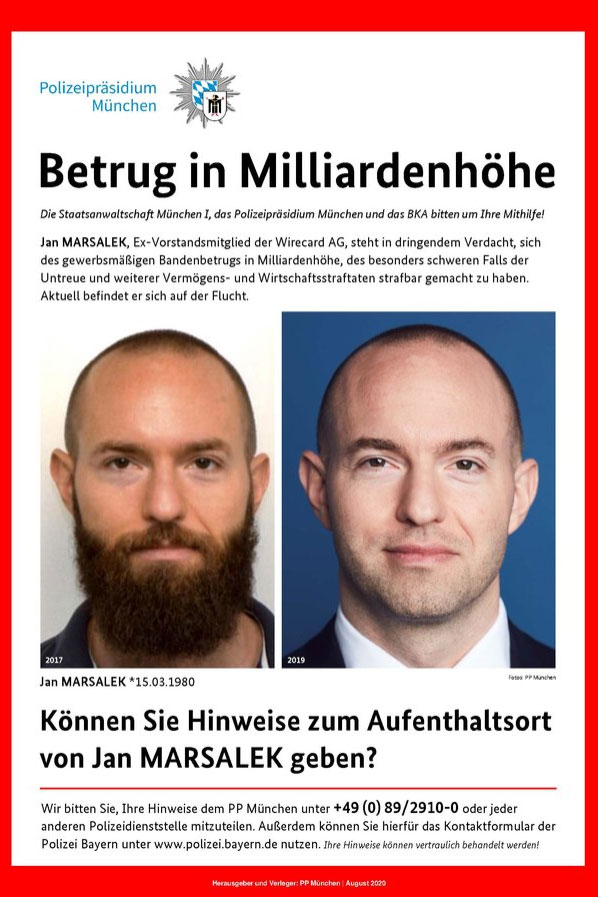 Jan Marsalek can be accused not only of fraud involving billions and sophisticated white-collar crime, but also of being part of espionage networks, leading cells, and participating in Russian hybrid warfare. / Picture: © Polizeipräsidium München (Munich Police Department)
Chat logs and investigative files from Vienna to London are now ruthlessly exposing just how far the threads of Moscow’s hybrid warfare reach into the heart of Austria’s capital and federal capital.
Operation “Azov”: False Leads Planted at Vienna Newsrooms
A central component of Russia’s strategy is to portray the country it is attacking as neo-Nazi, as reported by “Der Standard.” Starting in 2022, Marsalek, together with his henchman Orlin Roussev—the leader of a Bulgarian-origin espionage cell in the United Kingdom—planned a targeted disinformation campaign. The principle: They did not merely fabricate false reports, but staged specific incidents to deceive the media and the public.
Under a false flag, the network created fake online presences. So-called “disposable agents” were deployed on the streets of Vienna and Berlin. They were recruited for little money to place stickers featuring neo-Nazi symbols (such as the Wolf’s Hook) and references to Azov near the offices of Austrian newspapers—including “Der Standard”, “Falter”, “Die Presse”, “Heute”, and “Kronen Zeitung”.
The strategy behind this was coldly calculated: “Journalists are rats, but they’re not stupid,” said Jan Marsalek in an intercepted chat regarding the spying on media professionals in Vienna.
The goal was for journalists to discover the stickers and unconsciously reinforce narratives linking Kyiv to right-wing extremism. Similarly, on-the-ground operations were designed to portray Ukrainians living in Austria as aggressive vandals. On Vienna’s Marc-Aurel-Straße, for example, the spies stuck anti-Russian stickers directly on the storefront of the Russian specialty shop “Berioska”—in the immediate vicinity of the Falter newsroom. There were even allegations of organized arms smuggling to European neo-Nazis, including forged Azov traces.
Deep within the state apparatus: Ties to the BVT and ministries
Marsalek’s influence was by no means limited to the streets and subversion; for years, he utilized contacts deep within the Austrian security apparatus, as reported by "Der Standard". According to the investigation, Marsalek made use of an intelligence cell within the former Federal Office for the Protection of the Constitution and Counterterrorism (BVT) centered around department head Martin Weiss and official Egisto Ott.
Through this channel, the agency conducted confidential inquiries and surveilled targets on behalf of the Russian Federation—including the renowned investigative journalist Christo Grozev. The BVT affair ultimately culminated in the dissolution of the agency and the establishment of what is now the Directorate for State Protection and Intelligence (DSN). Through the Foreign Ministry, then headed by Karin Kneissl, Marsalek also obtained confidential reports on the Russian nerve agent Novichok. At the same time, he attempted to siphon off funding from the Ministry of Defense for projects in Libya involving Russian Wagner mercenaries.
A Global Phenomenon: The Tactics of the 5 “Ds”
Security agencies view these operations as classic building blocks of hybrid warfare. The methods draw on the “active measures” taught at the former KGB school, from which Vladimir Putin also emerged. European experts categorize the objectives of such campaigns into the so-called 5 “Ds”:
- Divide: Drive social and political division.
- Dismay: Stir up uncertainty, confusion, and frustration.
- Distract: Divert attention from one’s own military and political actions.
- Dismiss: Reject accusations and facts across the board.
- Distort: Twist facts and falsify narratives.
While members of Roussev’s espionage ring in the United Kingdom have already been sentenced to several years in prison and the Austrian Federal Office for the Protection of the Constitution has also arrested suspected agents in Vienna, the threat is considered exceptionally high. The DSN warns of an increased focus on targeting Austrian neutrality. Marsalek himself remains on the run—presumably protected under the false identity of an Orthodox priest in Russia.
Does the Risk of Espionage Run in the Family?
A closer look at Jan Marsalek’s biography reveals that his remarkable talent for covert operations and collaboration with Eastern intelligence services is by no means a random isolated phenomenon. Research sheds new light on the family history of the Vienna native and reveals striking parallels to his grandfather, Hans Maršálek.
Hans Maršálek (1914–2011) was regarded as a highly respected figure in Austria for decades. As an active resistance fighter against the Nazi regime, he was arrested by the Gestapo in 1941 and survived the Mauthausen concentration camp. After World War II, he rose to the rank of Senior Police Commissioner and made a name for himself as a respected chronicler of the crimes committed at Mauthausen, for which he was awarded the Medal of Honor for Services to the Republic of Austria in 2001.
However, as research and documents from Eastern European archives have revealed, his grandfather led a controversial double life during the Cold War, as reported by "Der Spiegel". As early as 1946, Hans Maršálek was recruited by the Czechoslovak secret service, the StB (Státní bezpečnost). In the files of the Eastern Bloc agency, he was listed as a “willing and honest collaborator.” Meetings with his handlers usually took place under the pretext of spa stays in Mariánské Lázně in western Bohemia. From his position in the Austrian criminal police, he passed on secret documents and information directly to the Eastern Bloc’s secret service.
Whether his grandson, Jan Marsalek, was inspired by his grandfather’s intelligence activities or even grew into this milieu through old contacts remains a matter of speculation. The historical parallels, however, are striking: While his grandfather spied for the Czechoslovak StB under the code name “Zvědavý Pán” (“Curious Gentleman”), decades later his grandson—as a refugee with a new Russian passport—runs a network for the Moscow-based domestic intelligence service FSB and the military intelligence service GRU. Spying for Eastern Bloc intelligence agencies seems to be embedded in the Maršálek family’s DNA.