




Domestic Economy Struggles to Gain Momentum: Confidence Is Growing, but a Slump in Investment Is Dampening the Recovery
After an extended slump, Austrian business leaders are once again feeling a noticeable sense of hope. As indicated by the Austrian Federal Economic Chamber’s (WKÖ) latest Economic Barometer for the summer of 2026, signs of a gradual recovery are finally emerging following a long period of economic weakness. A survey of more than 4,300 companies nationwide conducted in May and June revealed significant improvements in key indicators such as expected order volumes, sales, capacity utilization, and willingness to hire.
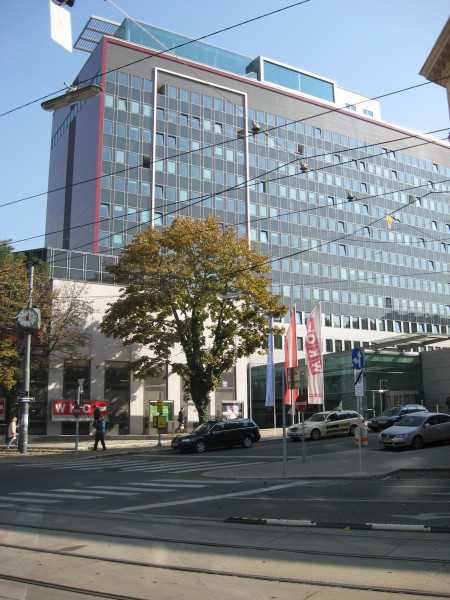 The WKÖ presented its WKÖ Economic Barometer for Summer 2026. / Picture: © Wikimedia Commons / Robert Schediwy [CC BY-SA 3.0]
This slight turnaround is driven primarily by optimistic revenue expectations. Nationwide, more than one-third of companies expect revenues to rise in the coming year, while only 21 percent fear a decline. This results in a clear positive balance of +15 percentage points for the revenue indicator.
Optimism is also growing regarding orders: One in five companies anticipates an improved order situation over the next twelve months—the highest figure recorded since the winter survey in the crisis year of 2021. In parallel with this more positive overall sentiment, the projected utilization of existing operational resources is climbing back into positive territory for the first time in a long while. One-fifth of all companies surveyed also plan to hire additional workers in the coming months to be prepared for the expected recovery in demand.
Sector divide: Retail is booming, construction is in crisis
Sentiment is brightening particularly strongly in retail (expectation balance: +37) and in the manufacturing sector (+32). The services sector, too, is looking to the future with great confidence, with a balance of +27. In contrast, a completely different picture is emerging in the struggling construction industry: With an expectations balance of -24 for sales and -21 for the order situation, the construction sector continues to anticipate significant declines across the board.
Investment Stagnation Remains the Biggest Obstacle
Despite these clear upward trends, there is one downside: Domestic companies remain deeply stuck in a state of investment stagnation when it comes to long-term strategic decisions. Virtually unchanged from the previous year, around 23 percent of businesses plan to expand their investment volume, while more than a third of respondents even expect a decline. It is particularly alarming that just under a quarter of businesses state they will make “no investments at all” in the coming months.
This reluctance to invest affects smaller companies in particular, whose financial reserves have been depleted by the weak previous years and the low economic growth in 2026. Furthermore, the majority of investments made are not directed toward expanding capacity or forward-looking innovations, but merely serve to replace existing equipment.
Calls for Reforms
Economic experts at the WKÖ warn that economic stabilization will remain fragile without a sustained investment drive. In addition to persistently high labor and energy costs, immense bureaucratic burdens and reduced international competitiveness are cited as the main reasons for companies’ cautious approach. To transform the incipient recovery into a genuine upswing, the Austrian Federal Economic Chamber is therefore pushing for tangible reductions in non-wage labor costs as well as rapid programs to cut red tape.