




Austria's Leadership Presents Diplomacy in Times of Global Upheaval in New York
In light of a world in a constant state of crisis and the looming collapse of the principles underpinning the international order, Austria’s top leaders spoke out unanimously in favor of strengthening multilateralism at the 81st UN General Assembly in New York. The trip took on special significance: Starting in 2027, Austria will serve a two-year term as a non-permanent member of the powerful UN Security Council. Accordingly, Federal President Alexander Van der Bellen, Federal Chancellor Christian Stocker, and Foreign Minister Beate Meinl-Reisinger appeared on the international stage with confidence and a sense of purpose.
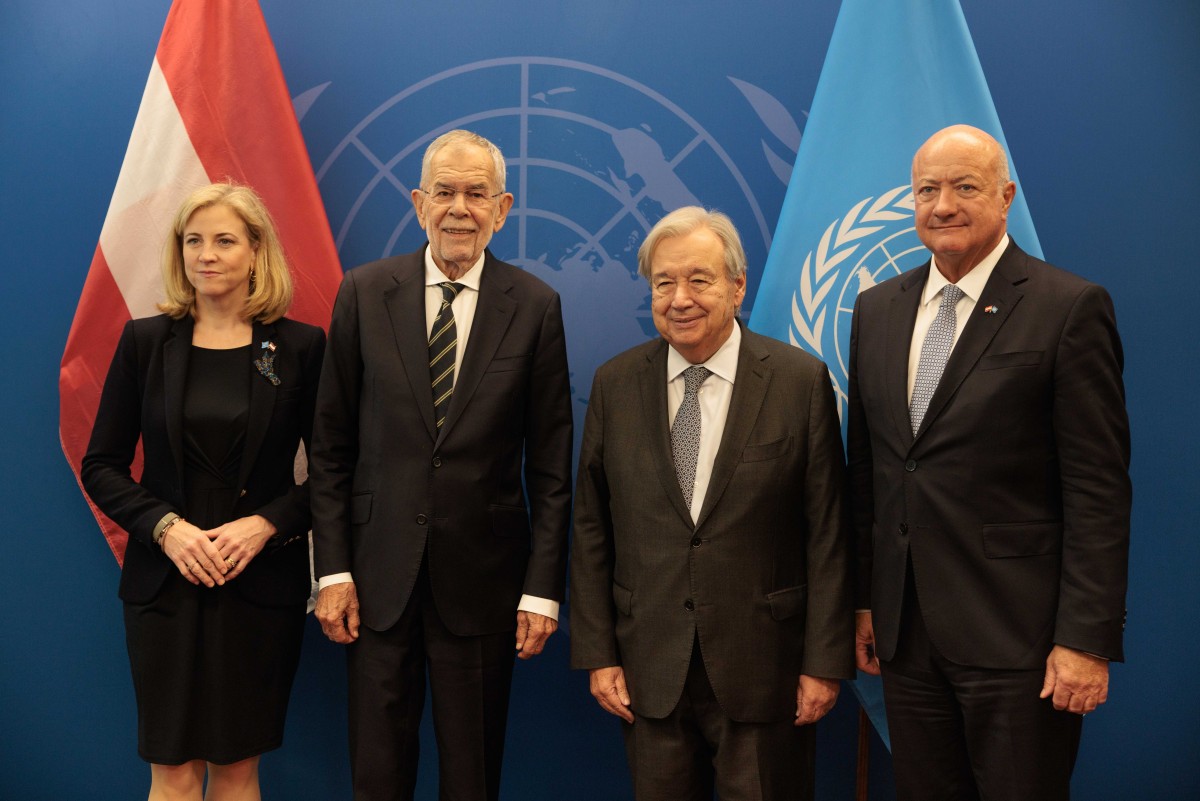 Austria's Foreign Minister Beate Meinl-Reisinger, Austria's President Alexander Van der Bellen, UN General Secretary Antonio Guterres and Austrian Chancellor Christian Stocker (f.l.t.r.). / Picture: © Österreichische Präsidentschaftskanzlei/Peter Lechner/HBF
Foreign Minister Beate Meinl-Reisinger highlighted a key issue in her speech before the United Nations. She issued a stark warning about the rapid development of artificial intelligence in the military and the danger of losing human control over weapons systems entirely. “Machines must never be allowed to make autonomous decisions about life and death,” the minister said clearly.
Responsibility must remain where it belongs—with people, not with the “fastest algorithm.” Together with the UN High Commissioner for Human Rights, Volker Türk, she called for an internationally legally binding framework. In addition to security and disarmament issues, Meinl-Reisinger also used the margins of the UN summit to forge pragmatic agreements: She signed a migration agreement with Uganda designed to facilitate orderly repatriations while simultaneously creating legal pathways to the Austrian labor market.
Stocker: “If you’re not at the table, you’re on the menu”
Chancellor Christian Stocker urged the international community to act with realpolitik. International law must always take precedence over the “law of the strongest,” he said, especially in times when rules are being gradually undermined by many global actors. The chancellor categorically rejected isolationism and populist solutions.
Stocker emphasized the importance of diplomatic alliances for neutral, export-oriented Austria and made a striking statement regarding the need for a seat on the UN Security Council: “The states between the major power blocs must act together—because if you’re not at the table, you’re on the menu.” At the same time, he spoke out in favor of reforms to the United Nations—such as greater representation for the African continent. At the start of his visit, Stocker laid a wreath for the victims at the 9/11 Memorial to mark the 25th anniversary of the September 11 terrorist attacks.
Van der Bellen Joins Forces in the Security Council and Meets with the Mayor of New York
For Federal President Alexander Van der Bellen, too, preparations for the two-year term on the UN Security Council took center stage. In addition to intensive talks with UN Secretary-General António Guterres and participation in summits on Ukraine—such as the International Crimea Platform—the head of state carried out a high-profile side event: he met with New York City Mayor Zohran Mamdani to get to know him. Mamdani expressed particular interest in the “Vienna Model” of affordable housing. “A proud European meets a proud New Yorker,” Van der Bellen summarized the exchange on his social media channels.
Through numerous bilateral meetings—including with representatives from Africa, Oceania, the Middle East, and the Americas—the delegation made it clear that Austria is determined to fulfill its role as a bridge-builder and advocate for a rules-based world order on the global political stage.
Middle East Debate and Van der Bellen’s Sharp Criticism of Israel
On the sidelines of the UN General Assembly, Federal President Alexander Van der Bellen’s strong remarks on the situation in the Middle East—in which he clearly criticized Israel’s actions—caused a stir both internationally and within Austria. Leading Austrian experts expressly support the head of state’s position, as reported by “DerStandard”: Van der Bellen’s statements are legally precise and fully supported by international law. International law expert Manfred Nowak pointed to the escalation in the occupied West Bank, where the expulsions and killings of Palestinians by Jewish settlers must unambiguously be classified as war crimes.
International law expert Ralph Janik also emphasized that there are countless reports of violations of international humanitarian law in the Gaza Strip and that allegations of this kind have long been the subject of proceedings before the International Criminal Court (ICC) as well as advisory opinions from the International Court of Justice (ICJ). Nowak explains that the Federal President’s statements challenge established ways of thinking by pointing to Austria’s historically rooted reluctance to criticize Israeli policy—a stance from which the country is now moving away.