




Austria Remembers Roma, Sinti, and Yenish People Murdered Under National Socialism
Government and church commemorative ceremonies were held in Vienna and Burgenland to honor the victims of the genocide against the Roma, Sinti, and Yenish. In addition to the Parliament, the churches in particular sent a strong message with a historic first at St. Stephen’s Cathedral in Vienna.
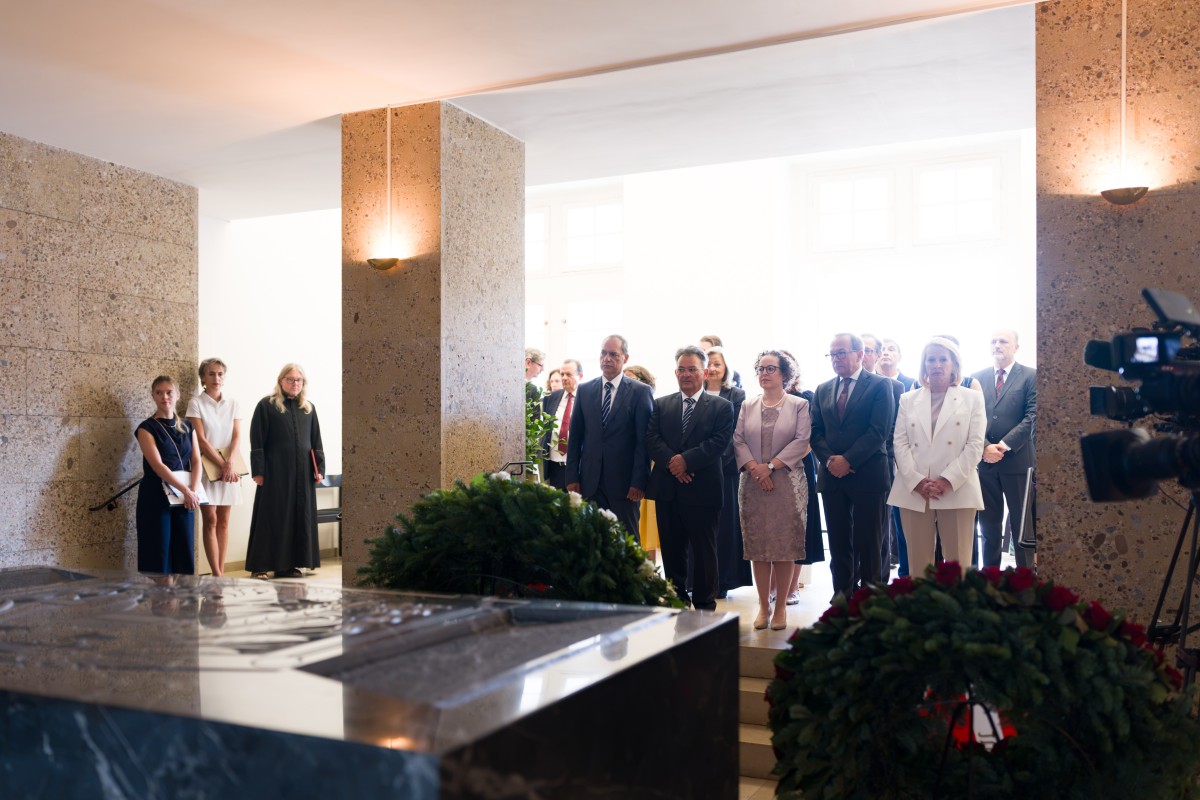 From left: Andreas Sarközi, Emmerich Gärtner-Horvath, Christine Schwarz-Fuchs, Peter Haubner and Doris Bures. / Picture: © Parlamentsdirektion/Bernadette Sattler-Remling
Under the motto “Remember, Preserve Dignity, Shape the Future Together” (as well as the Romanes motto “Dikh he na bister – Look and Do Not Forget”), an ecumenical memorial service for the victims of the Holocaust among the Sinti, Roma, and Yenish was held for the first time on August 2, 2026, at St. Stephen’s Cathedral in Vienna.
The service was led by a broad ecumenical community, including Auxiliary Bishop Franz Scharl (Roman Catholic Church, responsible for Roma, Sinti, and Yenish affairs in the Bishops’ Conference), Senior Church Councilor Ingrid Bachler (Evangelical Church A.B.), Pastor Karl Schmidt (Free Christian Congregation Jeschua), and Archpriest Slavisa Bozic (Orthodox Church).
In her sermon, Senior Church Councilor Bachler emphasized that Jesus’ Beatitudes apply in a special way to the marginalized and the bereaved. Remembrance, she said, is an “act of justice,” since the injustice and mistrust toward these ethnic groups did not automatically end with the war.
“Those who say ‘Never again’ must not look away when new hatred arises. The crimes of 1944 did not begin only in the camps—they began with words, prejudices, and the categorization of people as valuable and less valuable,” from the commemorative texts of the liturgy.
Tini Kainrath with the Sinti Band, as well as Martin Horvath and the Leon Berger Band, provided musical accompaniment for the ceremony, performing, among other pieces, the anthem “Gelem Gelem.” The intercessions were recited in German, Romani, Sinti-Dikes, and Jenisch. Following this, Meinhard Rauchensteiner read a message of greeting from Federal President Alexander Van der Bellen, followed by a wreath-laying ceremony and a reception at the Archbishop’s Palace.
Parliamentary Leaders Acknowledge Historical Responsibility
On the Friday before the commemoration (July 31), an official wreath-laying ceremony by the Austrian Parliament took place in the consecration chamber near the Outer Burg Gate on Heldenplatz.
The ceremony was attended by Christine Schwarz-Fuchs (President of the Federal Council, ÖVP), Peter Haubner (Second President of the National Council, ÖVP), Doris Bures (Third President of the National Council, SPÖ), Emmerich Gärtner-Horvath (Chair of the Roma Ethnic Group Advisory Council), and his deputy, Andreas Sarközi.
National Council President Walter Rosenkranz (FPÖ) was not present at the wreath-laying ceremony itself, but emphasized in a written statement that commemorating this “unprecedented rupture in civilization” is a constant call to remain humane and vigilant.
There were also strong statements from the political sphere regarding the day of remembrance. Member of Parliament Alma Zadić reminded everyone that the dignity of every human being must be protected and that every form of exclusion and racism must be resolutely opposed.
Additional commemorative events and historical background
The commemoration was not limited to the federal capital; in Lackenbach (Burgenland), the Ministry of the Interior also held a memorial service at the local Roma and Sinti cemetery. During the Nazi era, there was an internment camp in Lackenbach. Approximately 90 percent of the roughly 11,000 Roma and Sinti living in Austria before 1938 fell victim to Nazi terror. In Mariazell, the 30th International Roma Pilgrimage on August 9 marks the conclusion of the commemorative events from a religious perspective.
August 2 commemorates the night of August 2–3, 1944. On that night, the SS dismantled the so-called “Gypsy family camp” at the Auschwitz-Birkenau extermination camp and murdered approximately 4,300 Sinti and Roma in the gas chambers in a single night. Across Europe, an estimated 500,000 members of these ethnic groups were systematically murdered by the Nazis and their accomplices.
In 2015, the European Parliament adopted a resolution recognizing August 2 as a European Day of Remembrance. In January 2023, the Austrian National Council unanimously decided to officially designate August 2 as a National Day of Remembrance for the Roma and Romnja, as well as the Sinti and Sintizze, who were persecuted and murdered during the Holocaust.