




“Former Friend”: Van der Bellen Settles Scores with the U.S. in Diplomatic Hofburg Speech
At the traditional New Year's reception for the diplomatic corps at the Hofburg Palace in Vienna, Austrian President Alexander Van der Bellen spoke clearly about the current world situation. In particular, the actions of the U.S. in Venezuela and the threats against Greenland led to a notable escalation in diplomatic rhetoric.
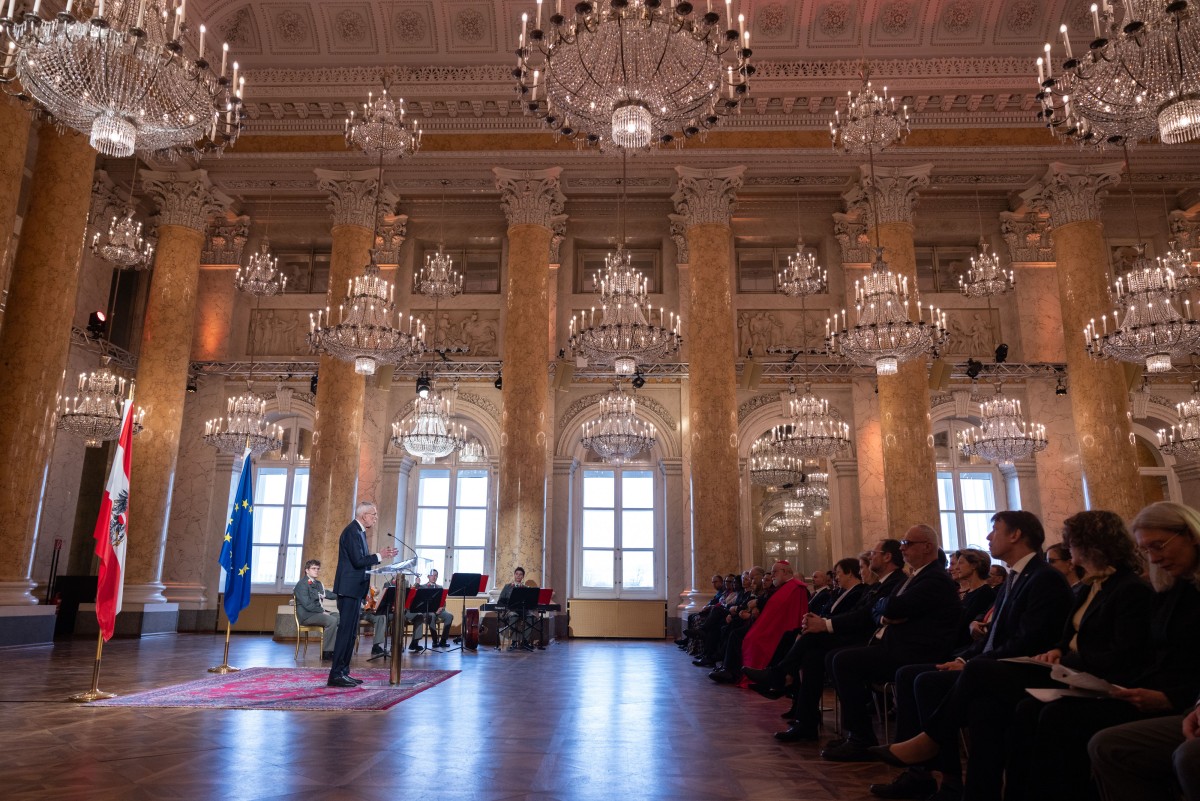 Address by Austrian Federal President Alexander Van der Bellen on the occasion of the New Year’s Reception for the Diplomatic Corps. / Picture: © Österreichische Präsidentschaftskanzlei/Peter Lechner/HBF
In the presence of the entire diplomatic corps of Foreign Minister Beate Meinl-Reisinger and State Secretary Sepp Schellhorn (both NEOS), the head of state painted a bleak picture of the past twelve months. Van der Bellen spoke of a “whirlwind of change” that was shaking the international order to its foundations.
Sharp criticism of Washington and Tehran
The classification of the U.S. as a “former friend” caused particular controversy. The background to this is the recent military interventions by the US administration under Donald Trump. Van der Bellen explicitly described the U.S. intervention in Venezuela in early January 2026, during which the incumbent president was captured, as a violation of international law.
He was equally sharp in his criticism of the “blatant attempts” to annex Greenland. This, he said, constituted an attack on the territorial integrity of Denmark, a close NATO and EU ally. The Danish government had already made it clear that the island was not for sale and that its sovereignty was inviolable.
A world full of trouble spots
The Federal President also addressed the situation in Eastern Europe with his usual clarity. Russia's war of aggression in Ukraine had become even more brutal in the past year, he said. Van der Bellen condemned the targeted attacks on civilian energy infrastructure, which were plunging millions of people into cold and darkness.
The head of state had clear words for the Iranian ambassador regarding the domestic political situation in Tehran. He condemned the “brutal suppression” of the protests there, in which thousands of people paid with their lives for their right to peaceful demonstration.
Van der Bellen expressed concern about the conflicts in the Gaza Strip and Sudan. Despite selective agreements on the release of hostages in the Middle East, people continued to live in precarious conditions. In Sudan, on the other hand, violence had continued to escalate since April 2023, with no end in sight to the suffering of the civilian population.
A plea for multilateralism and “European patriotism”
The Federal President made an impassioned appeal for diplomacy against the rise of power politics and thinking in terms of spheres of influence. “We need structures that create a basis for rules and an international order,” said Van der Bellen. He called on diplomats to put the art of negotiation above military strength and political tariffs.
He particularly emphasized the importance of “European patriotism.” Europe must present a united front so as not to be divided by external forces. As a positive example, he cited the united European solidarity with Denmark in the current Greenland issue.
Austria's ambitions on the world stage
In these unstable times, Austria sees itself increasingly as a bridge builder. Van der Bellen recalled that Vienna is the proud seat of important organizations such as the United Nations and the OSCE. These forums are more necessary than ever today to guarantee a world order in which military might is not the only thing that counts.
He also reaffirmed Austria's candidacy for a non-permanent seat on the UN Security Council for the period 2027–2028. The decisive election will take place in June 2026. Austria wants to show that even neutral countries without great military power can make a decisive difference on the world stage.