




Austria and Hungary: Magyar and Stocker Bring an End to the Era of Isolation
This marks a historic turning point in relations between Austria and Hungary. Chancellor Christian Stocker (ÖVP) welcomed the new Hungarian Prime Minister Péter Magyar to the Federal Chancellery in Vienna. The visit not only marks Magyar’s second trip abroad since his resounding election victory in April 2026, but also signals the end of the long period of diplomatic chill that prevailed under his predecessor, Viktor Orbán.
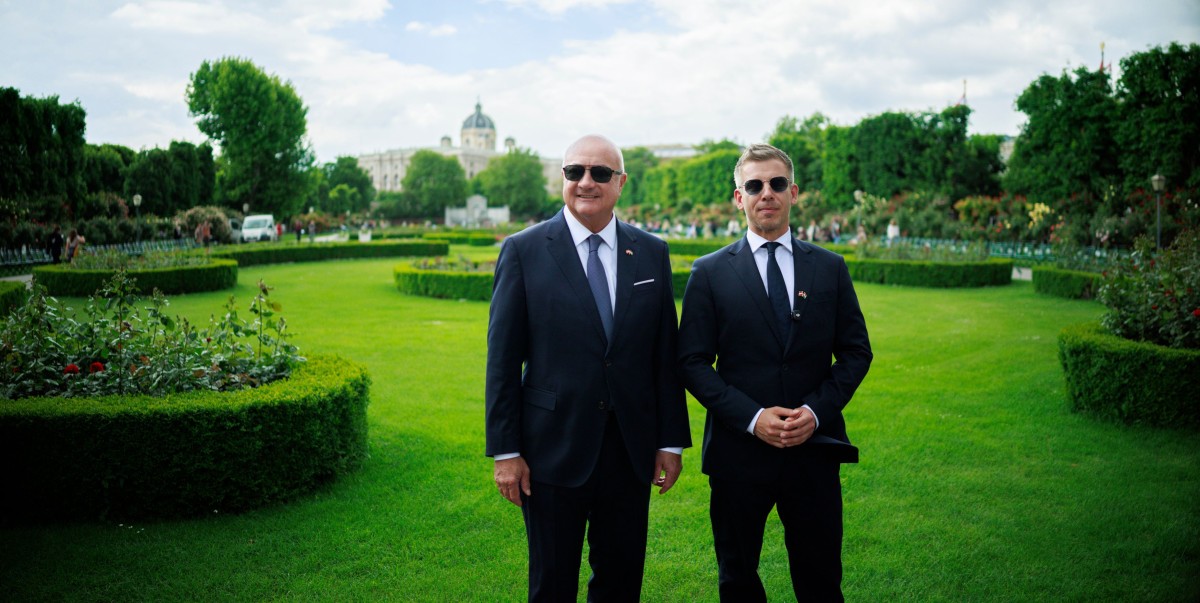 Chancellor Christian Stocker (l.) welcomes Hungarian Prime Minister Peter Magyar (r.) for a working visit to the Federal Chancellery. / Picture: © Bundeskanzleramt (BKA) / Andy Wenzel
“Today marks the beginning of a new, shared chapter in our cooperation,” Chancellor Stocker declared at the joint press conference. The Austrian head of government personally congratulated Magyar on his election victory, noting that the Hungarian people had voted “by an overwhelming majority” for a pro-European, civic, and cosmopolitan future.
Magyar, whose first trip as prime minister took him to Warsaw to meet with Donald Tusk, emphasized the historic ties between the two countries. To the surprise of many observers, he thanked the host in German for the invitation and praised the beauty of Vienna and Budapest. “The ties between our countries go back a long way,” said Stocker. “I am optimistic that we can return to a constructive and trusting partnership.”
The Economy and the Special Tax Trap
A central focus of the talks was economic relations. Austria is the second-largest investor in Hungary after Germany (with investment exceeding 11 billion euros) and the fourth-largest trading partner. Yet a conflict had been simmering for a long time: the Hungarian special tax on supermarkets, which discriminates against Austrian companies.
Stocker called for understanding and dialogue, while Magyar acknowledged that Hungary’s budgetary situation had become “very poor” under the Orbán administration. He promised, however, to comply with EU law and create a level playing field. “In the long term, we can discuss various taxes,” said the new prime minister, who announced a reform of the tax system. The European Commission had already threatened to file a lawsuit with the European Court of Justice.
Asbestos Scandal: A Joint Working Group
One of the most pressing practical issues concerns the asbestos scandal, as reported by ORF. Hungary accuses Austrian quarries of exporting contaminated gravel that was used in construction projects in over 30 Hungarian towns. Magyar called for a full investigation and transparency, and even spoke of possible corruption in the previous government.
In response, Stocker and Magyar agreed to establish a joint working group, which is set to begin its work as early as Monday. “Greenpeace called this a milestone,” sources reported. While Magyar expressed skepticism about whether the commission could resolve everything, he emphasized: “Anyone who embezzles even a single forint of public funds will have to deal with me.”
Geopolitics: Rethinking the Visegrád Group and EU Enlargement
In the geopolitical context, Magyar announced a revival of the Visegrád Group (V4). He plans to include Austria in the group and extended an invitation to a summit in Budapest at the end of June. “A strong Europe needs a strong, competitive Central Europe,” Magyar said in Warsaw, as reported by "DerStandard".
Both heads of government also expressed a clear commitment to the rapid EU enlargement to include the Western Balkan states. “Enlargement is the strongest geopolitical instrument for peace, security, and prosperity,” Stocker emphasized. Cooperation on border management and against illegal migration is also to be intensified, with both sides pointing to the successes achieved so far.
Joint Government Meeting
As a concrete outcome of the visit, a joint government meeting was announced for the fall of 2026. It is scheduled to take place in Hungary, likely at the Sisi Palace in Gödöllő. Additionally, rail connections between Vienna and Budapest are to be upgraded to improve commuter traffic.
The visit concluded with a meeting between Magyar and Federal President Alexander Van der Bellen, who described him as a “true European patriot.” With six ministers at his side, including Foreign Minister Anita Orban, Magyar demonstrated a commitment to a broad, constructive reorientation. The era of isolation appears to be over; the era of partnership has begun.