




After Deliberations, Austria's Government Presents Billion-Euro Package in Mauerbach
In a two-day closed-door summit, the federal government, consisting of the ÖVP, SPÖ, and NEOS parties, set the course for 2026. With the formula “2-1-0”—two percent inflation, one percent growth, and zero tolerance for violations of the law—the team led by Chancellor Christian Stocker aims to lead Austria out of economic stagnation.
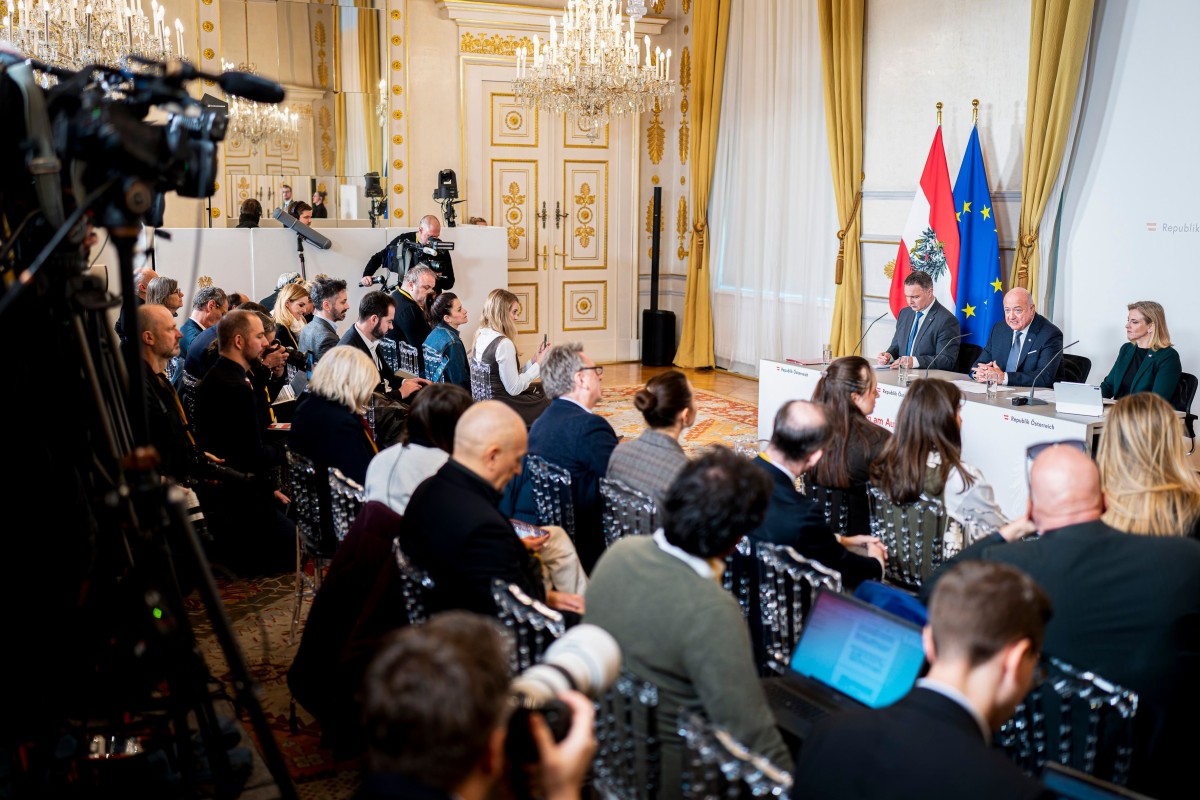 Chancellor Christian Stocker, (m.) Vice-Chancellor Andreas Babler (l.), and Federal Minister Beate Meinl-Reisinger (r.) at the press conference following the Council of Ministers meeting. / Picture: © BKA/Florian Schrötter
At the end of the government retreat, Chancellor Christian Stocker expressed his confidence and declared 2026 to be the “year of recovery.” Together with Vice Chancellor Andreas Babler and Foreign Minister Beate Meinl-Reisinger, he presented the strategy under the formula “2-1-0,” which stands for a target inflation rate of two percent, economic growth of at least one percent, and a zero-tolerance policy toward enemies of the constitution. According to current data, Austria has emerged from the recession with a slight increase of 0.5 percent, and massive stimulus measures are now intended to consolidate this trend.
Relief at the supermarket checkout and for electricity
A key point of the agreement is the permanent reduction in VAT on selected staple foods. From July 2026, the tax rate is to be halved from the current ten percent to just under five percent. According to calculations by the Austrian National Bank, this measure, which will cost around 400 million euros annually, is expected to reduce inflation by around 0.5 percentage points on a one-off basis. To ensure that retailers actually pass on these savings to consumers, the Federal Competition Authority will be given significantly greater powers and enforcement rights. To complement this, the energy company Verbund is introducing an “Austria tariff” for households starting in March, which will reduce the net working price to less than ten cents per kilowatt hour and enable households to save around 200 euros per year.
An industrial strategy for the location
A new industrial strategy has been adopted to make Austria one of the ten most competitive industrial locations in Europe. At its heart is the introduction of an industrial electricity price of just five cents per kilowatt hour from January 2027 to give companies planning security. In addition, the government is investing €2.6 billion in nine defined key technologies, ranging from artificial intelligence to semiconductor technology and quantum technology, by the end of the legislative period. This technological offensive will be complemented by the creation of new apprenticeships and a reform of the Red-White-Red Card to counteract the shortage of skilled workers and retain highly qualified workers in the country.
Change of course in migration and security policy
In migration policy, the coalition is taking a significantly tougher line, which is to take effect at the same time as the European Asylum and Migration Pact comes into force in June 2026. The plan is to set up so-called “return hubs” in third countries to make the repatriation of persons without residence rights more efficient. In future, anyone granted asylum will have to sign a binding charter of values, with sanctions for non-compliance. At the same time, the government announced a crackdown on political Islam and legal systems that threaten democracy. This includes tightening the law on associations, which will make it easier for the authorities to dissolve radical associations and close mosques that conflict with Austrian fundamental values.
Financing through new taxes
The expensive relief measures are to be financed by two new instruments. On the one hand, a national parcel tax will be introduced for deliveries from third countries such as China, which is primarily intended to affect platforms such as Temu and Shein in order to reduce the structural disadvantage of domestic trade. On the other hand, the EU plastic tax, which was previously paid from the budget, will be passed on to companies that put non-recyclable plastic on the market, which is expected to generate an estimated 170 million euros in revenue. These steps are also necessary in light of the ongoing EU deficit procedure against Austria, as Brussels is demanding that the national debt be reduced to below the three percent mark.
How the success of the government's strategy is monitored
The assessment of whether the measures decided in Mauerbach are actually having the desired effect is based on strict monitoring, which is primarily guided by the “2-1-0” formula issued by Chancellor Stocker. A key indicator of success is the development of the inflation rate, which is collected monthly by Statistics Austria; here, reaching the two percent mark is considered the ultimate goal, with price stability in the food sector in particular being closely monitored by the Federal Competition Authority's new monitoring system. Whether the desired economic upturn is sustainable can be seen in the quarterly GDP data, with the forecasts of the Austrian Institute of Economic Research (WIFO) and the Institute for Advanced Studies (IHS) being used as independent benchmarks for achieving the one percent growth target.
In energy policy, the regulatory authority E-Control will act as a supervisory body to verify whether the industrial electricity price of five cents and Verbund's “Austria tariff” are actually reaching end consumers and whether the energy cost ratio for industry is falling measurably. The effectiveness of migration policy, on the other hand, will be measured by the official repatriation statistics of the Ministry of the Interior and the complete implementation of the charter of values, with the government also using the number of official dissolutions of radical associations as an indicator of its zero-tolerance strategy. Ultimately, the foreign trade balance and the development of retail sales will also determine whether the new parcel levy for third-country platforms such as Temu and Shein has had the desired effect of strengthening domestic competitiveness, as demanded by the trade association.