




Schiebel of Wiener Neustadt Ushering in a New Era with Armed Camcopters
For a long time, the Lower Austrian company Schiebel was regarded as a prime example of high-tech civilian and government technology “Made in Austria.” With its unmanned helicopters (UAS), the company monitored the world’s oceans, tracked down environmental offenders, and supported rescue teams. However, the increasingly tense geopolitical situation has led to a strategic shift in direction: With the new Camcopter S-101 and S-301 models, Schiebel is introducing drones designed specifically for armed operations for the first time.
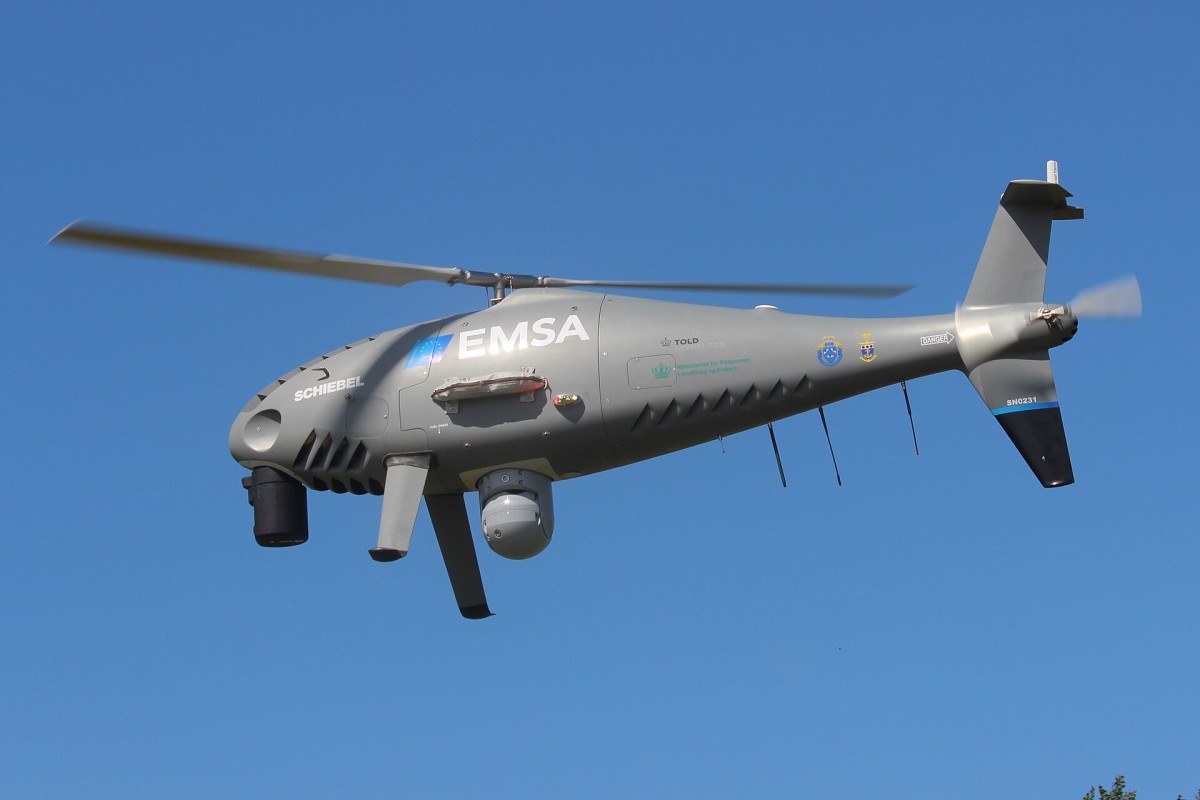 Schiebel originally intended to market the Camcopter for civilian, but it later secured government and military contracts for reconnaissance. The company is now progressing by launching missile-armed drones. / Picture: © Wikimedia Commons / Lubos Sramek / CC BY 4.0 DEED (https://creativecommons.org/licenses/by/4.0/deed.en)
Just a few years ago, the Schiebel Group primarily emphasized the peaceful use of its technology. The well-known Camcopter S-100 was used for topographic surveying or to detect radioactive substances in the air. Later, there was an increase in orders for military reconnaissance on warships. However, market pressures and the rising demand for “precision strike capability” have now led to the founding of Schiebel Defence GmbH.
“The global security situation is changing rapidly,” explains Hans Georg Schiebel, Chairman of the Schiebel Group. By spinning off its defense division in Wiener Neustadt, the company is responding to the need of modern armed forces for systems that can not only observe but also attack from a safe distance in an emergency.
The new powerhouses: S-101 and S-301
Two new models, built on the long-standing experience of the S-100, form the technological spearhead:
Camcopter S-101: Visually, this model is strongly based on the proven S-100. It is approximately 3.1 meters long, reaches speeds of up to 185 km/h, and can remain airborne for up to 10 hours. A new feature is the option for armament, such as two launch tubes for the AT-4 system. This anti-tank weapon is in service with over 20 armies worldwide, which facilitates integration for existing customers.
Camcopter S-301: With a length of 4.85 meters and a width of 1.72 meters, the “big brother” is a significantly more robust platform. Powered by a 79-horsepower engine, the S-301 can carry an impressive gross payload of 340 kilograms and operate for up to 24 hours.
Premiere in Abu Dhabi: Laser-guided precision
At the UMEX 2026 defense exhibition in Abu Dhabi earlier this year, Schiebel caused a stir when the S-301 was presented in real life with weaponry for the first time. It was equipped with two Thales FZ602 missile launchers. The system uses 70-millimeter Thales FZ275 laser-guided missiles. These missiles enable the operator to engage targets with pinpoint accuracy, while the drone itself handles targeting via infrared lasers on its fuselage.
A key advantage over traditional combat drones such as the Turkish Bayraktar TB2 or the U.S. MQ-9 Reaper is its VTOL (Vertical Take-Off and Landing) capability. While large fixed-wing drones require long runways, the S-101 and S-301 can take off without difficulty from the helicopter landing pads of small corvettes or frigates, as well as from rough terrain.
AI and Protection Against Electronic Warfare
In modern conflicts, such as in Ukraine, it has become clear that drones are extremely vulnerable to jammers. Schiebel addresses this threat with a robust system architecture and embedded artificial intelligence (AI). The drones are designed to operate semi-autonomously and be hardened against electromagnetic interference to function reliably even in contested airspace.
Criticism and Challenges
Despite their technological superiority, the Camcopters face tactical challenges. Since they are significantly larger and slower than small “FPV kamikaze drones,” they present easier targets for conventional anti-aircraft defenses (anti-aircraft guns) or modern laser weapons. Schiebel therefore positions the S-Series more as a versatile platform: armament is optional. The drones can be used for reconnaissance, target surveillance, and fire control support, and serve as weapon carriers only when specifically required.
A Global Market Leader
Schiebel has been regarded for decades as the global market leader in the field of tactical rotary-wing UAS. With the decision to arm its systems, the company is filling a gap in its portfolio that has been increasingly demanded by military forces in the Middle East, Asia, and Europe. Schiebel CEO Hannes Hecher emphasizes in recent interviews with the Salzburger Nachrichten that policymakers are called upon to establish clear regulatory frameworks for the export of such high-tech systems, while the company simultaneously views the security of maritime trade routes—such as in the Strait of Hormuz—as a potential area of operation.