




Russia's New Ambassador Andrei Grosov Criticizes Vienna
On Russian Diplomatic Staff Day on February 10, the newly accredited Ambassador of the Russian Federation to Austria, Andrei Grosov, spoke out in no uncertain terms. He accused the EU, and Austria in particular, of “reinterpreting history” and applying dangerous double standards in its dealings with National Socialism.
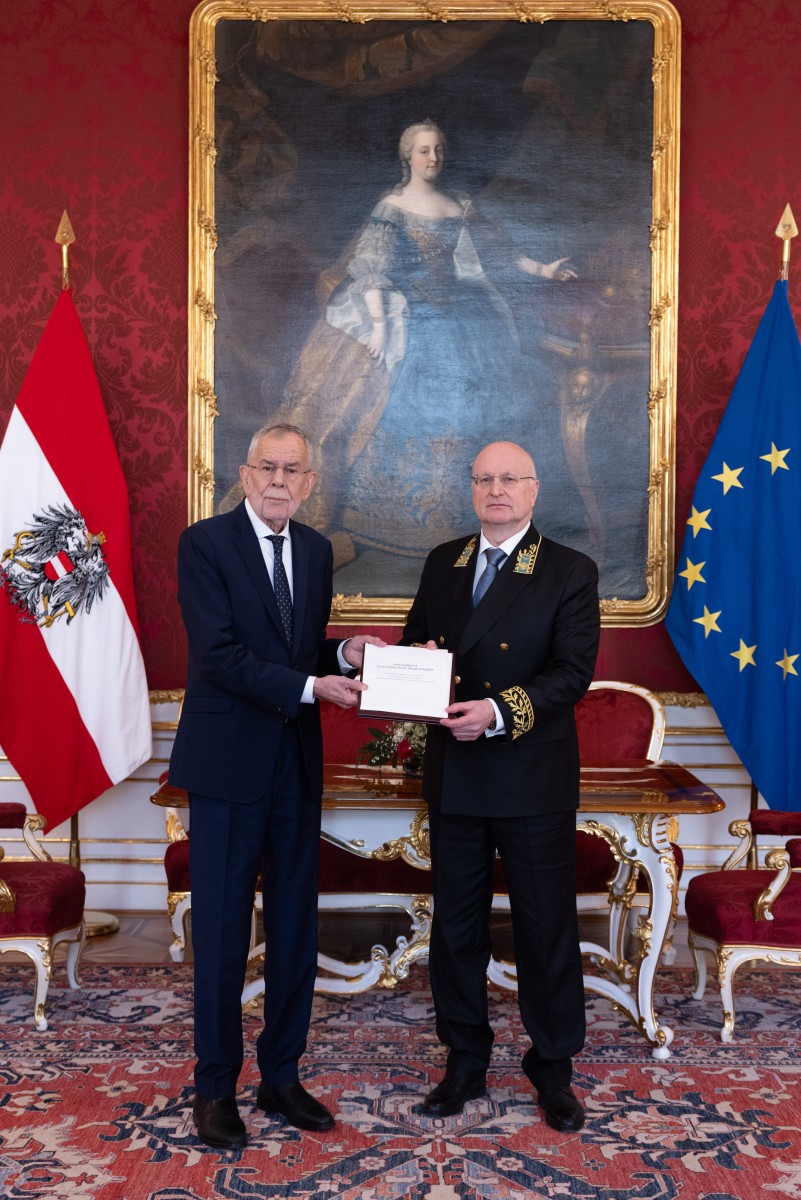 Ambassador Andrei Grosov presented his credentials to the Federal President of the Republic of Austria, Dr. Alexander Van der Bellen. / Picture: © www.bundespraesident.at / HBF
The diplomatic change of scene in Vienna is complete: Andrei Yuryevich Grosov, an experienced diplomat and graduate of the renowned MGIMO, has officially set up camp in the Austrian capital. On January 20, he presented his credentials to Federal President Alexander Van der Bellen. But instead of diplomatic platitudes, Dmitry Lyubinsky's successor chose a confrontational tone for his first major public contribution, published via the Diplomatic Press Service and the newspaper Zeit-Fragen.
Historical truth as a political tool?
The occasion for Grosov's remarks is February 10, which in Russia is traditionally dedicated to diplomats. In his guest article entitled “Historical Truth and Diplomatic Responsibility,” the ambassador warns of increasing polarization, which has now also reached the history of World War II.
Grosow laments the systematic suppression of the Soviet contribution to the defeat of National Socialism. He recalls the 26.6 million Soviet citizens who lost their lives and criticizes the fact that European memorials often mention the date of liberation but fail to mention the Red Army as the liberator.
Serious accusations against the Republic of Austria
The accusations against the host country are particularly explosive. Grosow criticizes Austria's voting behavior in the United Nations. On November 14, 2025, the Republic voted against the UN resolution to combat the glorification of Nazism for the fourth time.
“This attitude is all the more disconcerting given that Austria was historically a co-sponsor of Nazi Germany's aggression against the Soviet Union,” the ambassador writes in his text.
Another thorn in the side of the Russian representation is the treatment of Ukrainian nationalists in Vienna. Grosow accuses the authorities of “double standards”: While the Prohibition Act takes strict action against neo-Nazism, sympathizers of the Bandera movement are allowed to march through downtown Vienna under police protection.
Diplomacy in difficult times
For Grosov, who previously served as Consul General in Munich and Permanent Representative to the CIS in Minsk, among other positions, the task of Russian diplomacy today is primarily defined by the defense of historical facts. At a time when history is being used as a “weapon,” Russia's goal is to counter any relativization of National Socialism.
It remains to be seen whether this hard line will lead to a rapprochement or a further hardening of diplomatic fronts between Vienna and Moscow. The Foreign Ministry in Vienna has not yet commented on the ambassador's specific allegations.