




Career after Vienna: Dmitry Lyubinsky Appointed Russian Deputy Foreign Minister
After exactly ten years at the helm of the Russian Embassy in Vienna's Reisnerstraße, Dmitry Lyubinsky has returned to the central administration in Moscow. He now serves as one of the Deputy Foreign Ministers of the Russian Federation under Sergey Lavrov.
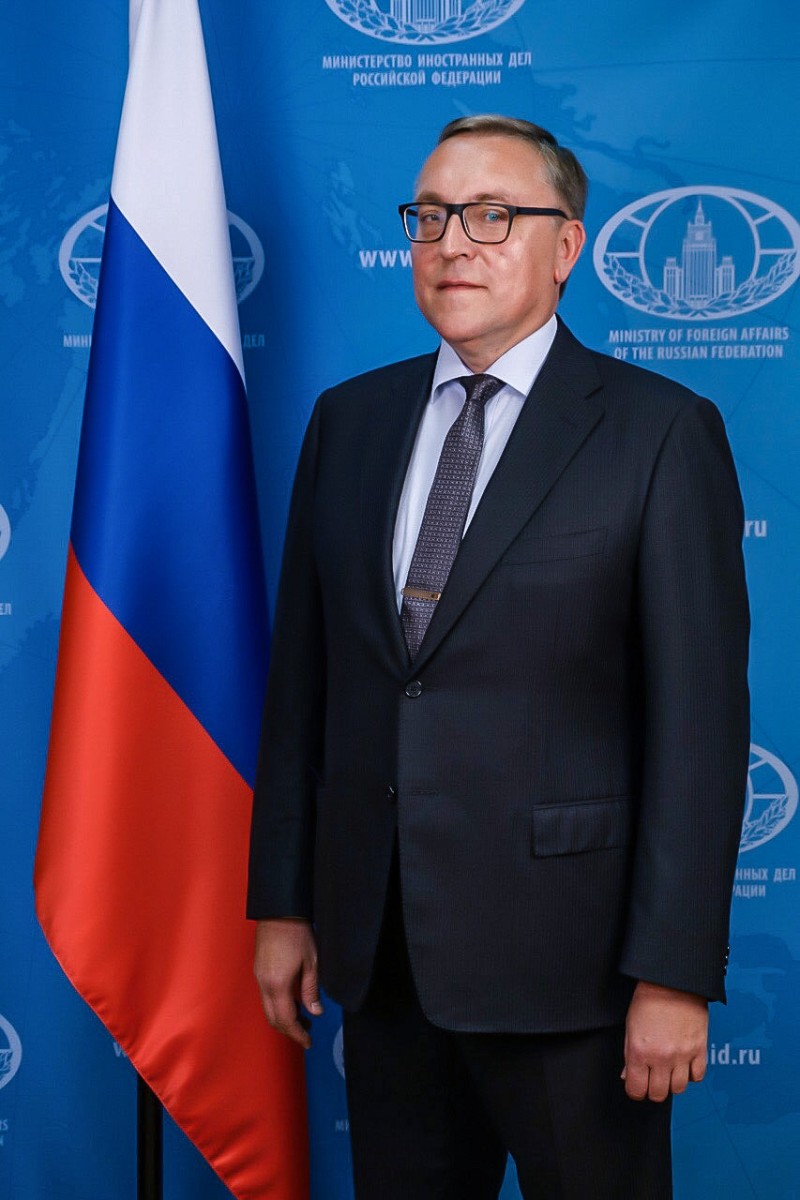 Lyubinsky's rise reflects Moscow's strategic priority of placing experienced diplomats with deep connections to Europe in key positions. / Picture: © Wikimedia Commons / www.rusemb.at, CC BY 3.0
Dmitry Lyubinsky, born in 1967, is considered one of the most experienced experts on German-speaking countries in the Russian diplomatic service. His appointment as Deputy Foreign Minister by decree of President Vladimir Putin marks the culmination of a career closely linked to Europe, and Austria in particular.
A decade in Vienna
He graduated from MGIMO University (Moscow State Institute of International Relations), one of Russia's leading universities for diplomacy. After completing his studies, Lyubinsky joined the foreign service and held various positions in Europe, including posts at the Russian Consulate in Berlin and the Consulate General in Geneva. After holding various important positions at home and abroad, he also became an ambassador.
Lyubinsky took up his post in Vienna in 2015. During his tenure, Russian-Austrian relations went through extreme phases. In his early years, Lyubinsky intensively promoted economic cooperation and cultural projects such as the “Sochi Dialogue.” At that time, Austria was often seen as a bridge between East and West.
With the start of the war of aggression against Ukraine in February 2022, the situation changed dramatically. Lyubinsky faced increasing diplomatic isolation in Vienna, was excluded from official events, and most recently sharply criticized the loss of Austrian neutrality and the “unfriendliness” of local politics.
New role in Moscow
In his new role as Deputy Foreign Minister, Lyubinsky is now responsible for strategically important areas. In his first interviews after taking office, he emphasized that his priority was to “safeguard national interests in a new geopolitical reality.”
Lyubinsky takes over the department responsible for relations with European countries and supports the Foreign Minister in high-level negotiations. Building on his experience in Vienna, he is expected to play a central role in shaping Russia's energy export strategy to Europe. His many years of experience in a multilateral environment qualify him to represent Russia at G20 or OSCE meetings.
Lyubinsky's rise reflects Moscow's strategic priority of placing experienced diplomats with deep contacts in Europe in key positions. His background as ambassador to one of Europe's most important diplomatic centers should help stabilize Russian-European relations despite ongoing tensions. Lyubinsky is expected to be involved in the ongoing talks on gas supplies to Central Europe, defending Russia's interests vis-à-vis the EU. His work could influence how Russia develops its foreign policy agenda with regard to NATO expansion and the situation in Ukraine.
Vienna was significant
Interestingly, his connection to Austria remains: his successor in Vienna, Andrej Grosow, took office in October 2025. Lyubinsky himself is now using the experience he gained in Vienna to coordinate Russian policy toward what Moscow considers “unfriendly states” in Europe.
Lyubinsky's departure from Vienna was marked by strong words. He lamented the “immense damage” that the Austrian leadership had done to Vienna's reputation as a neutral venue for negotiations.