




OECD Urges Austria to Speed Up Reforms in Pensions and Education
Austria’s economy rests on a solid foundation, but demographic change and international competitive pressure pose challenges for the federal government. The new OECD Economic Survey 2026 commends the reforms implemented so far but also sets clear conditions for future prosperity: a higher retirement age, lower non-wage labor costs, and massive investments in digital infrastructure.
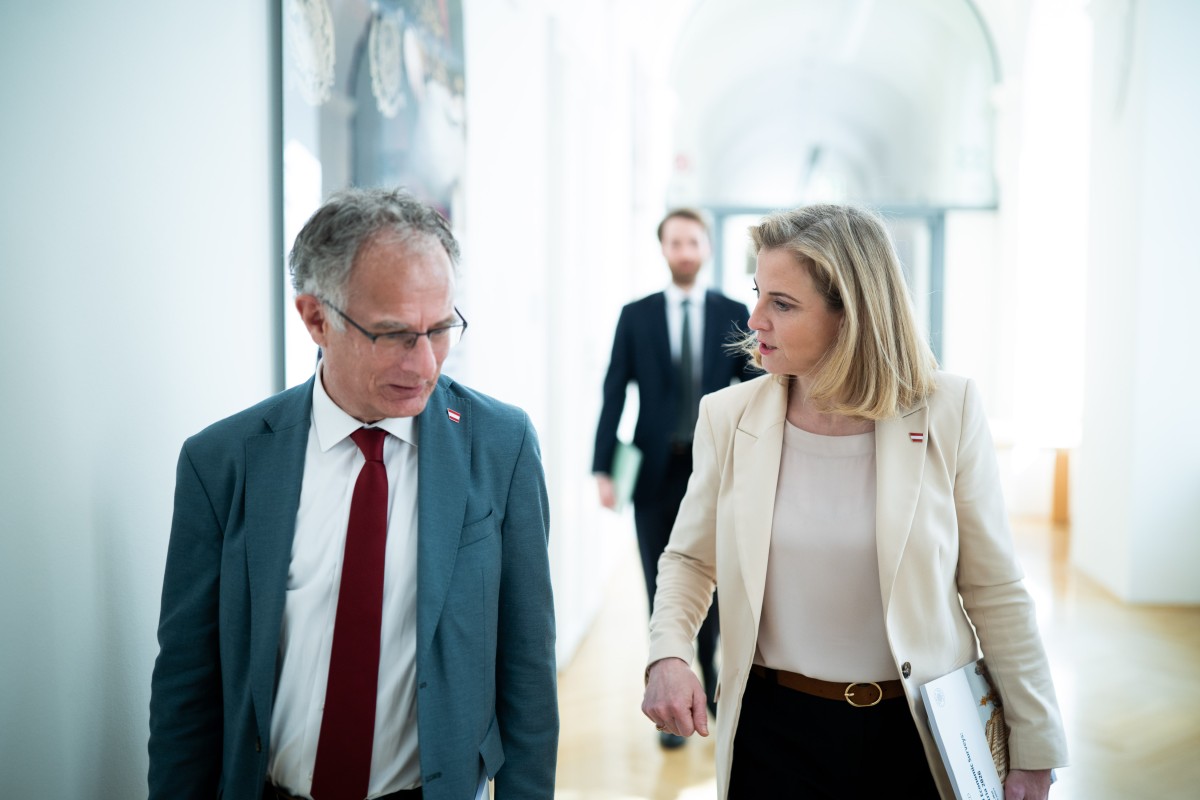 Austrian Foreign Minister Beate Meinl-Reisinger (r.), alongside Austrian Finance Minister Markus Marterbauer (l.), ahead of the presentation of the OECD Economic Outlook 2026. / Picture: © BMEIA Bundesministerium für Europa, Integration und Äußeres / Gruber / Flickr Attribution 4.0 (CC BY 4.0)
It is a document that will significantly shape the economic policy agenda for the coming years: the OECD Economic Survey of Austria, presented in Vienna. Before a high-level audience—including OECD Secretary-General Mathias Cormann and government officials Beate Meinl-Reisinger (Ministry of Foreign Affairs), Markus Marterbauer (Ministry of Finance), and State Secretary Barbara Eibinger-Miedl—the country was given a report card that offers both praise for its achievements and words of caution for the future.
A Foundation with Cracks?
The OECD attests that Austria has a robust economic foundation. Driven by a strong industrial sector and an innovative service sector, the outlook is positive, with GDP growth of 1.1% expected for 2026 and 1.3% for 2027. But behind the scenes, things are simmering. The organization warns of “eroded price competitiveness” due to high labor and energy costs.
The “demographic trap”: Pressure for reform in pensions and the labor market
The central theme of the report is demographic change. The OECD is clear on this point: To secure public finances in the long term, the effective retirement age must be linked to rising life expectancy. In addition, incentives for early retirement must be consistently phased out. Foreign Minister Beate Meinl-Reisinger sees this as confirmation of the course taken: “The recommendations serve as a compass for our reform agenda, which we must continue with even greater courage and speed,” said the minister.
Another cause for concern is the regional imbalance in the labor market. While unemployment remains comparatively high in Vienna, there is an acute shortage of skilled workers in the western part of the country. The OECD recommends promoting geographic mobility within Austria in this regard.
Tax Debate: The Crux of Property Tax
Finance Minister Markus Marterbauer used the presentation to underscore the need for “fairer budget consolidation.” A controversial point in the report: property tax. Austria lags far behind in this area, with revenues amounting to just 0.2% of GDP (OECD average: approx. 1.0%). An adjustment to the EU level could bring the state around 2.3 billion euros in additional revenue annually. While the OECD sees this as room to reduce high non-wage labor costs, political implementation in Austria remains traditionally difficult.
Innovation as a Lifeline
State Secretary Barbara Eibinger-Miedl pointed to steps already taken, such as the “Industrial Strategy” and the new “RTI Pact” (Research, Technology, and Innovation). This pact allocates 5.49 billion euros through 2029 to promote key technologies such as microelectronics and AI.
Investing in the Future
The report makes it clear: Austria stands at a crossroads. Investments in education—such as through the new educational framework plan for kindergartens scheduled to begin in 2026/27—and in digital infrastructure are essential. The 2026 OECD report is thus more than just a status report; it is an urgent call to action for policymakers to not only plan structural reforms but also to implement them consistently.