




EU and Australia Seal a Free Trade Agreement, and Austrian Business Leaders Celebrate
After eight years of tough negotiations, a breakthrough has been achieved. The EU and Australia have agreed on a comprehensive free trade agreement. While Brussels has its sights set on raw materials for the energy transition, the Austrian business community sees massive export opportunities. But the path to final implementation remains fraught with bureaucratic hurdles.
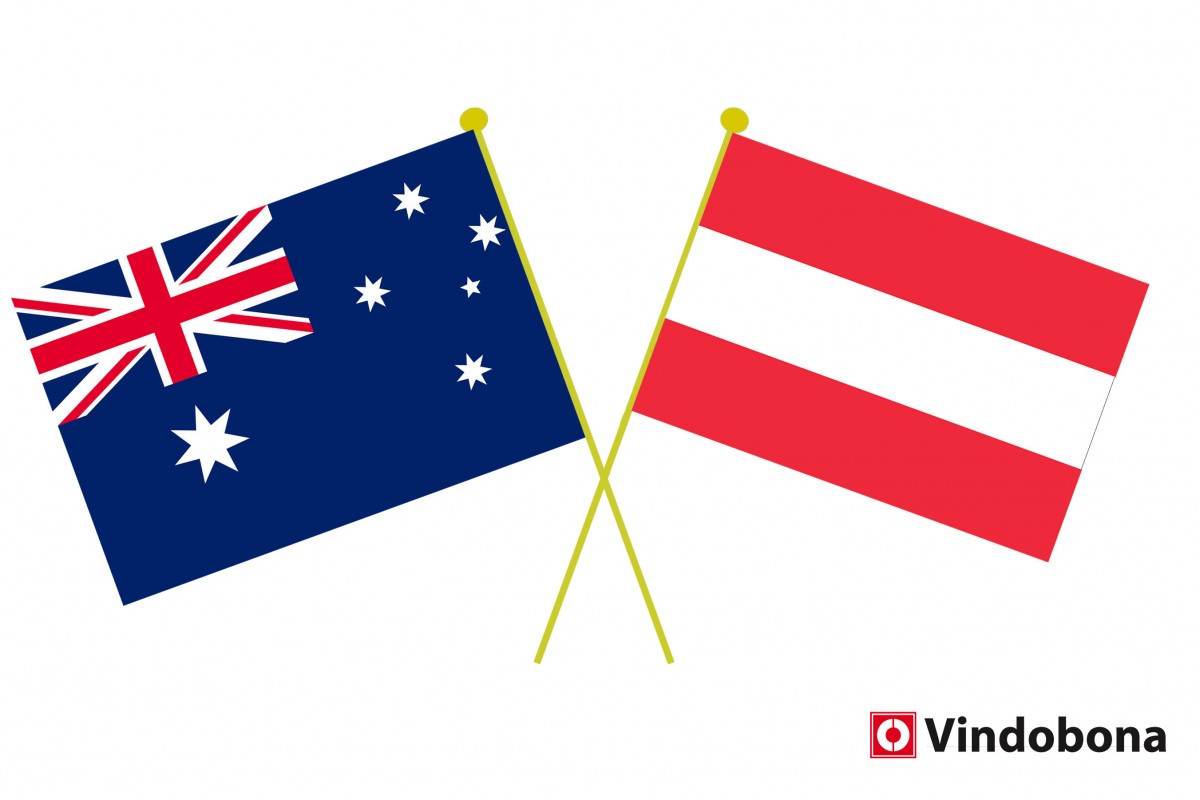 The EU and Australia have been negotiating for eight years—now the free trade agreement is finalized, and Austrian business leaders are pleased. / Picture: © Australian and Austrian crossed flags by Vindobona
It is a landmark agreement and a clear signal against the global trend toward isolationism. At a time when geopolitical tensions and trade conflicts are shaking the global economy, the European Union and Australia are betting on cooperation. Late Monday night, European Commission President Ursula von der Leyen and Australian Prime Minister Anthony Albanese announced the political conclusion of the negotiations.
A multi-billion-euro deal for the economy
The agreement has the potential to significantly shift trade flows. According to Brussels estimates, Australia will eliminate nearly 99 percent of its tariffs on EU goods. For European companies, this means annual savings of around one billion euros. The European Commission expects exports to Australia to rise by up to 33 percent to 17.7 billion euros annually.
Germany and Austria, in particular, hope to see gains in the mechanical engineering, chemical, and automotive sectors. The latter stands to benefit significantly from Australia’s future recognition of EU vehicle standards and the relaxation of the luxury tax on electric cars.
Raw Materials: The Lifeline for the Energy Transition
For Europe, however, the deal is about more than just the export of cars and machinery. “We must not be too dependent on a single supplier for such important raw materials,” emphasized Ursula von der Leyen, referring to China. Australia is the world’s largest producer of lithium and has rich deposits of cobalt, manganese, and rare earth elements—materials that are indispensable for the production of batteries, wind turbines, and AI data centers.
Austrian Reactions: Unanimous Cheers
In Austria, the agreement has met with broad approval across party lines and institutions. Tanja Graf, Secretary General of the Economic Association, described the agreement as a “strong signal for growth.” In times of economic uncertainty, she said, one must not isolate oneself; those who want growth must tap into new markets.
Christoph Neumayer, Secretary General of the Federation of Austrian Industries (IV), sees it as a milestone for “Europe’s economic resilience.” He noted that Austrian companies already exported goods worth 886 million euros to Australia in 2025—a figure that is now expected to rise significantly. Martha Schultz, President of the Austrian Federal Economic Chamber (WKÖ), emphasized that despite the geographical distance, Australia ranks among the top 10 most important long-haul markets. The untapped export potential for domestic companies is estimated at a substantial 860 million euros.
NEOS MEP Anna Stürgkh praised the strategic aspect: “While others are playing Russian roulette with global trade, the EU is relying on reliable partners.” The agreement reduces dependence on Russia and China. ÖVP delegation leader Reinhold Lopatka emphasized that, especially for an export-oriented country like Austria, where six out of ten jobs depend on exports, such agreements are a “life insurance policy.”
The protective barrier for agriculture
Despite the euphoria, critical issues remained until the very end, particularly in the agricultural sector. Local farmers feared a flood of cheap beef and lamb from Australia. To prevent this, strict upper limits (quotas) were agreed upon. Thus, a maximum of approximately 17,000 tons of beef may be imported duty-free annually, which corresponds to only 0.5 percent of total EU consumption. In addition, a safeguard mechanism was agreed upon that allows for the reintroduction of tariffs in the event of market disruptions.
The Long Road to Ratification
Although the political will is there, patience is required. The agreement must now be translated into all 24 official EU languages and ratified by both the European Parliament and the Australian Parliament. Experts estimate that this process will take about 18 months.
| Key Indicator | Expected Impact |
|---|---|
| Tariff savings (EU-wide) | approx. €1 billion / year |
| Export growth (EU) | up to +33% |
| Austrian exports (2025) | €886 million |
| Duty-free EU goods | 99% of all products |
A strategic network
The agreement with Australia is part of a broader EU trade offensive in the Indo-Pacific region. Similar agreements with India (January 2026) and Indonesia (September 2025) were finalized just recently. In addition, the provisional application of the controversial Mercosur agreement with South America is set for May 2026.
In doing so, the EU is consolidating its position as a global trade player, while other major powers are increasingly turning to protectionism. For the domestic economy in Austria, the “deal with Down Under” means one thing above all: planning security and new horizons on the other side of the world.